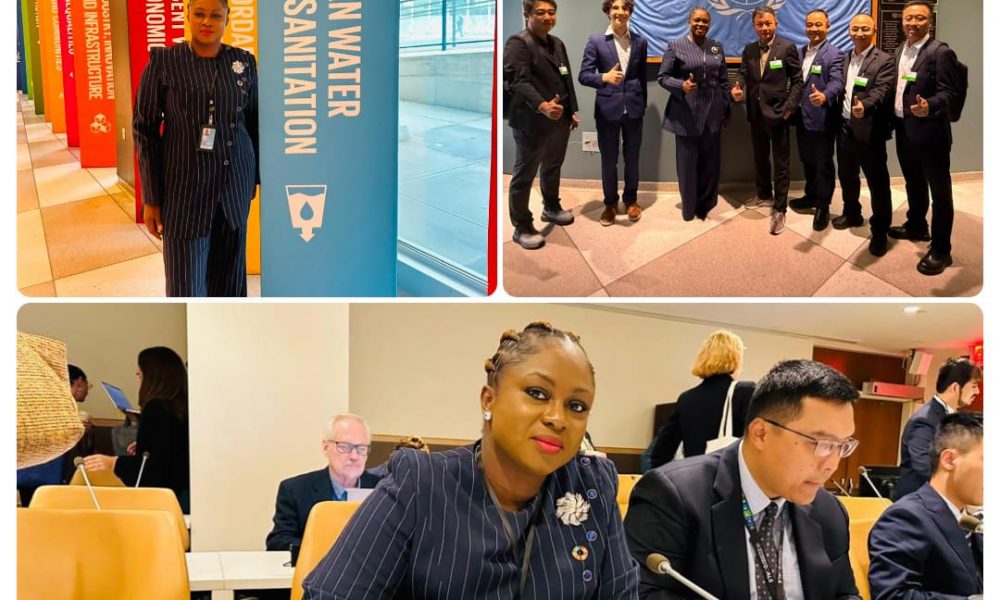
Day 1 of the High-Level Political Forum (HLPF) is done, and it was intense. From the high-level panel sessions and country statements to the special events and report launches, the pace was relentless. One thing is clear: the world cares. The conversations are happening. The commitments are being made. But implementation remains our greatest challenge, especially when it comes to connecting global commitments with realities at the grassroots.
Water took centre stage at the HLPF day 1 in New York this week. But if you listen carefully to the numbers behind the speeches, you hear something more troubling: water is central to our development narratives, yet still marginal in our financing and implementation choices. For a climate-justice and sustainability community that has long argued that injustice is encoded in budgets and institutions, HLPF’s day-one review of SDG 6 was a stark confirmation.
Progress we can’t ignore, and can’t rest on
Inside the ECOSOC chamber, the Secretary-General’s report on the Sustainable Development Goals painted a complex picture: meaningful gains alongside deep, persistent gaps. Since 2015, hundreds of millions of people have escaped extreme poverty, gained access to improved sanitation, and benefited from expanded social protection. Disaster-related deaths have declined sharply, electricity access has reached the vast majority of the world’s population, and roughly one-third of that electricity now comes from renewable sources.
Water and sanitation tell a similar story. Global water-use efficiency has improved significantly in recent years, showing that countries are learning to do more with less. Monitoring has strengthened: far more countries now report water quality data than a decade ago, and the SDG system draws on billions of data points. These are not abstract achievements, they are children living longer, communities healthier, and households spending less time and money on basic survival.
You May Like: Why Primate Ayodele’s Prophecies On Anambra Governorship Election Stand Out
Yet the report was equally clear that we are off-track. Many SDG targets have regressed below their 2015 baselines, and nearly half are progressing too slowly to meet the ambitions of the 2030 Agenda. Extreme poverty and food insecurity remain widespread, maternal mortality still exceeds global targets, and millions of children continue to suffer from stunting. For the climate-justice community, these are not just indicators; they are symptoms of a global development model that changes too slowly to match the pace of overlapping crises.
As we cite figures, data, and statistics, we must keep asking: who is being counted? Are grassroots communities truly represented in the evidence that shapes these discussions? Because if the people closest to the challenges are still invisible in our data, our claims of progress will always be partial.
Water as connector, and mirror of injustice
Throughout the day, water was framed not as a technical issue, but as a connector: binding together food security, energy systems, ecosystems, public health, human dignity, climate resilience, and economic stability. UN-wide strategies on water and sanitation urge governments and institutions to stop treating water as an isolated sector and instead embed it across policies, institutions, and investments. In climate-justice terms, SDG 6 is less a single goal than a stress test of whether we are serious about justice in the transition.
Consider the regional perspective shared on the Arab region. Over 90 per cent of the population there lives in water-scarce countries, with water stress rising and two-thirds of freshwater resources crossing international borders. Water scarcity is therefore inseparable from geopolitics, displacement, and livelihood insecurity. The call for stronger policy networks, legal frameworks, and digital knowledge platforms for transboundary cooperation was, at heart, a call to transform shared waters from potential flashpoints into platforms for solidarity.
From a climate-justice lens, this is crucial. Communities least responsible for historical emissions are often those living with the most acute water stress. When we speak about “loss and damage” or “just transition,” water access, quality, and governance must be part of that conversation. If they are not, justice becomes a slogan rather than a practice.
The real bottleneck: speed, consistency, and money
The most striking interventions of the day did not focus on new solutions. They focused on why known solutions are still not reaching the people who need them. One panelist made the point bluntly: our challenge is not a lack of ideas, but the speed and consistency of implementation. To achieve universal access to safely managed drinking water by 2030, the world would need a dramatic acceleration; for safely managed sanitation, an even greater leap.
Behind this implementation gap lies a simple, uncomfortable reality: underinvestment. In many countries, governments allocate only a tiny fraction of their national budgets to the water sector, covering everything from drinking water and sanitation to irrigation, flood management, drought resilience, and water resources management. By any measure, that is a shockingly low share for a sector that underpins health, livelihoods, and climate resilience.
The financing landscape is equally skewed. Public sources carry almost the entire burden of water sector financing, while private investment remains extremely limited. Even within public funding, only a small share comes through official development assistance and multilateral development banks. If we take seriously the claim that water sits at the centre of the development agenda, these numbers expose a quiet hypocrisy: political declarations place water at the centre of speeches, but budgets still relegate it to the margins.
For SDG implementers, this misalignment is painfully familiar. Projects are often designed with ambitious targets but implemented in environments where domestic operations and maintenance budgets are chronically underfunded, utilities struggle with weak governance, and enabling conditions for investment are missing. Climate-finance practitioners see the same pattern when water-related resilience projects compete for scarce resources while large-scale, carbon-intensive investments continue to attract capital.
From rhetoric to “Triple I”: Innovative, Integrated, Investable
One of the most useful frameworks introduced during the special event on SDG 6 was the “Triple I” approach: Innovative, Integrated, and Investable solutions. Innovation here is not just about technology; it includes data systems, new financing models, and digital tools that broaden access and accountability. Integration means deliberately connecting water governance to energy systems, food systems, and climate strategies, rather than treating each as a silo. Investability, perhaps the most challenging dimension, requires designing water projects so they can attract both public and private finance without compromising equity or affordability.
For the broader climate-justice and sustainability community, this framework has clear implications. We should be asking of any proposed water initiative:
– Is it genuinely innovative in ways that expand inclusion, rather than deepen existing inequalities?
– Does it explicitly integrate climate, food, energy, and social protection dimensions?
– Is it designed to be investable in a way that safeguards low-income and marginalized communities?
These questions are not technical details; they are justice tests.
Putting people back at the centre