BEN AHANONU
The Supreme Court of Nigeria’s recent dismissal of the lawsuit seeking to remove the Arabic inscription from the Nigerian Army’s logo has brought a protracted legal battle to a definitive close. In a judgment delivered in Abuja, the apex court ruled on a strict technicality: locus standi.
It asserted that a single plaintiff lacks the legal standing to represent the entire Nigerian population on a matter of this nature without explicit authorisation. By striking out the suit on procedural grounds, the court successfully avoided the core cultural, linguistic, and constitutional questions at play. While this decision legally seals the fate of the emblem, leaving the inscription unchanged, it simultaneously highlights an unresolved contradiction in the visual identity of the nation’s primary defence force.
A military emblem is not merely an aesthetic choice; it is a profound declaration of national identity, sovereignty, and shared heritage. When citizens look at the symbol of the forces protecting them, they should see a reflection of their collective history and values. The retention of the Arabic script on the Nigerian Army logo challenges this ideal. A critical analysis of this symbol against the backdrop of Nigeria’s geopolitical reality, colonial history, and contemporary demographics reveals a stark disconnect between the state’s official imagery and the lived reality of its people.
At the very heart of the critique against the emblem is a fundamental geopolitical reality: Nigeria is not an Arabic nation. The country is situated entirely within West African geography and is defined by a distinct sub-Saharan, multi-ethnic composition. Unlike nations in North Africa or the Middle East, Nigeria’s sovereign identity and international alignment are completely detached from the Arab world. To feature Arabic script prominently on the primary symbol of national defence creates a confusing, inaccurate narrative about the country’s geopolitical alignment. For a secular, constitutional republic with deep regional roots in West Africa, prioritising a foreign script over indigenous symbols or the official state language remains a glaring anomaly.
Furthermore, this linguistic choice lacks a historical or administrative foundation in terms of modern Nigerian statehood. Nigeria was never colonised by Arabs. The historical trajectory that shaped the modern Nigerian state was defined by British colonial rule, which established English as the lingua franca and the primary tool for law, military command, and official governance. Long before British intervention, the region consisted of diverse autonomous kingdoms, empires, and societies—such as the Oyo Empire, the Benin Kingdom, and various delta and plateau communities—each with its own distinct oral traditions, languages, and indigenous writing systems like Nsibidi. While Arabic script found a place in the northern caliphate for religious and trade communication, it was never the unifying political or administrative language of the amalgamated territories that formed Nigeria in 1914. Imprinting Arabic on the military logo bypasses this rich, multi-layered indigenous history and the actual administrative reality of the state, elevating a foreign script that has no structural tether to the birth of the unified Nigerian nation.
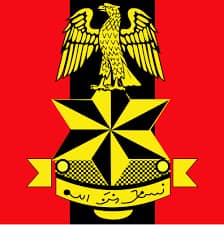
Perhaps the most compelling and practical argument against the continued use of the inscription is its complete lack of utility to the general population. The overwhelming majority of Nigerians do not speak, read, write, or understand the Arabic language. For the millions of citizens across the southern, eastern, western, and middle-belt regions—and indeed many in the north who speak indigenous languages rather than Arabic—the script is entirely illegible. A national military emblem is meant to inspire collective pride, patriotism, and a shared sense of security. It is meant to communicate directly with the population. When the motto of the national army—the very institution tasked with defending every single citizen regardless of tribe or tongue—is written in a script that cannot be deciphered by the vast majority of its populace, the symbol ceases to communicate. Instead of serving as a unifying national anchor, it remains an alien script to the people it is sworn to protect, creating an unnecessary barrier between the armed forces and the public.
Defenders of the inscription often point to historical tradition, noting that the script represents the Hausa language written in Ajami (Arabic script), which was used in early military regiments during the colonial era to command troops who were familiar with it. While this historical context explains its origin, it fails to justify its permanence in a rapidly evolving, modern democratic state. A nation’s symbols should adapt to reflect its contemporary identity and the principles of inclusivity. Relying on an archaic, colonial-era administrative shortcut does not align with the needs of a modern, multi-ethnic federation that seeks to build a neutral, secular, and universally accessible national identity.
By choosing to dismiss the lawsuit on the technicality of legal standing rather than addressing the substantive arguments, the Supreme Court opted for judicial restraint. While this may be a valid legal maneuver to prevent a flood of individual public-interest litigations, it leaves a significant cultural grievance unaddressed. The court’s decision ensures that the Nigerian Army emblem remains unchanged for now, but it does not erase the underlying tension. True national unity is built on symbols that include rather than exclude, and that reflect the actual history, geography, and language of the people. As Nigeria continues to navigate its complex identity, the presence of a foreign script on its national defence logo will remain a poignant symbol of a state imagery disconnected from its citizens.
Prince Ben AHANONU,
SPOKESPERSON,
ALAIGBO POLITICAL WATCHDOG.