Yiaga raised concerns about the reliability of the commission’s electronic results upload process, including cases where the Bimodal Voter Accreditation System (BVAS) failed to scan and upload result sheets despite repeated attempts by presiding officers
Yiaga Africa has identified technical failures, delayed commencement, low voter participation, and discrepancies in polling-unit configuration in the Independent National Electoral Commission’s (INEC) nationwide mock accreditation and results upload exercise.
The election observer organisation also raised concerns over the reliability of the commission’s electronic results upload process, including cases where the Bimodal Voter Accreditation System (BVAS) failed to scan and upload result sheets despite repeated attempts by presiding officers.
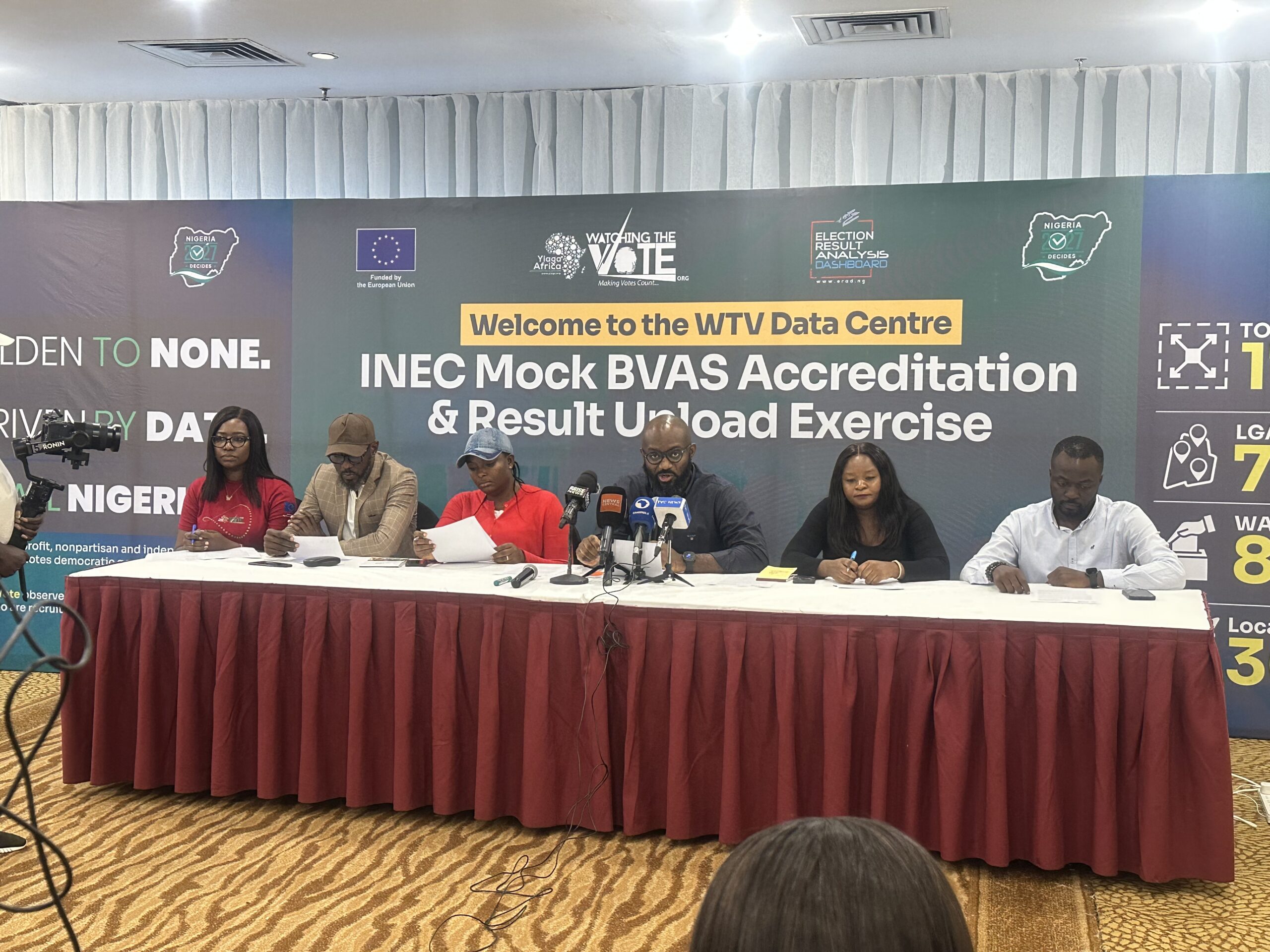
Yiaga Africa Executive Director Samson Itodo disclosed the findings on Saturday during the organisation’s post-exercise briefing on its independent observation of the mock election.
Mr Itodo said although BVAS functioned optimally in most of the polling units observed, the exercise exposed operational, technological and procedural weaknesses that require attention before the 2027 general election.
“Overall, Yiaga Africa’s preliminary findings indicate that the BVAS functioned optimally in observed polling units. However, the exercise revealed important operational, technological, and procedural issues that require attention,” he said.
Yiaga Africa deployed its Process and Results Verification for Transparency (PRVT) methodology to observe 300 sampled polling units across the country, while its Election Results Analysis Dashboard (ERAD 2.0) monitored and analysed the upload of results to INEC’s Election Results Viewing Portal (IReV).
Mr Itodo said the assessment focused on four areas: efficiency, functionality, integrity, and accessibility.
According to the organisation, delayed deployment of INEC officials affected the commencement of the exercise in several locations.
Mr Itodo said only 36 per cent of the polling units Yiaga Africa observed had started by 9:30 a.m., rising to 64 per cent by 10:00 a.m., despite the scheduled start time of 8:30 a.m.
He said some officials arrived several hours after the exercise was expected to begin.
“In polling unit 006, Fadan Karshi in Sanga Local Government Area, INEC officials arrived at 1:40 p.m.,” he said.
He also cited Wanikade Playground in Cross River State, where INEC officials had not yet arrived by 1:30 p.m.
The organisation further attributed the low voter participation recorded in several locations partly to inadequate public sensitisation and declining public trust in the electoral process.
Mr Itodo recalled that Yiaga Africa had, on 19 November, urged INEC to publish the operational framework and list of designated polling units early enough to enable citizens to participate.
Although the commission eventually published the list, he said it did so 48 hours after the organisation issued its statement, leaving limited time for public mobilisation.
“This limited mobilisation period may have adversely affected public participation and also diminished the capacity of this mock exercise to simulate actual election conditions,” he said.
On the performance of the accreditation technology, Yiaga Africa reported that BVAS processed voters within one to two minutes in 68 per cent of the polling units observed.
In another 27 per cent, the average processing time was between three and five minutes, while four per cent recorded processing times of between six and 10 minutes.
However, the organisation documented cases of BVAS malfunctioning in some locations, disrupting the accreditation process.
Mr Itodo cited Gumbe Wajake in Wana Local Government Area and a location in Sokoto State, where the malfunction reportedly disrupted proceedings for about one hour.
He also referenced an incident in Niger State involving a polling unit with 512 registered voters, where the malfunction affected the process.
He said the incidents highlighted the need for INEC to strengthen technical support and provide contingency arrangements to address device failures during elections.
“These incidents reinforce the need for INEC to ensure effective real-time technical support and troubleshooting, and also contingency arrangements for the BVAS devices,” he said.
The organisation also raised concerns over discrepancies in the configuration of polling units and registration areas on INEC’s electronic results platform.
According to Mr Itodo, the mock exercise was designed to cover 8,838 registration areas, with two polling units selected in each.
However, an analysis of IReV’s backend configuration showed that the platform was configured for 8,791 registration areas, leaving a shortfall of 47.
He said the discrepancy needed investigation and correction before the 2027 general election.
Yiaga Africa also questioned the selection of polling units with relatively small numbers of registered voters and historically low turnout.
Mr Itodo said the selection limited the exercise’s capacity to test how the technology would perform under heavy voter traffic, particularly with INEC’s planned deployment of 57,000 newly procured BVAS machines.
He recommended that future mock exercises should include a broader mix of polling units, especially those in densely populated areas and locations with historically high voter turnout.