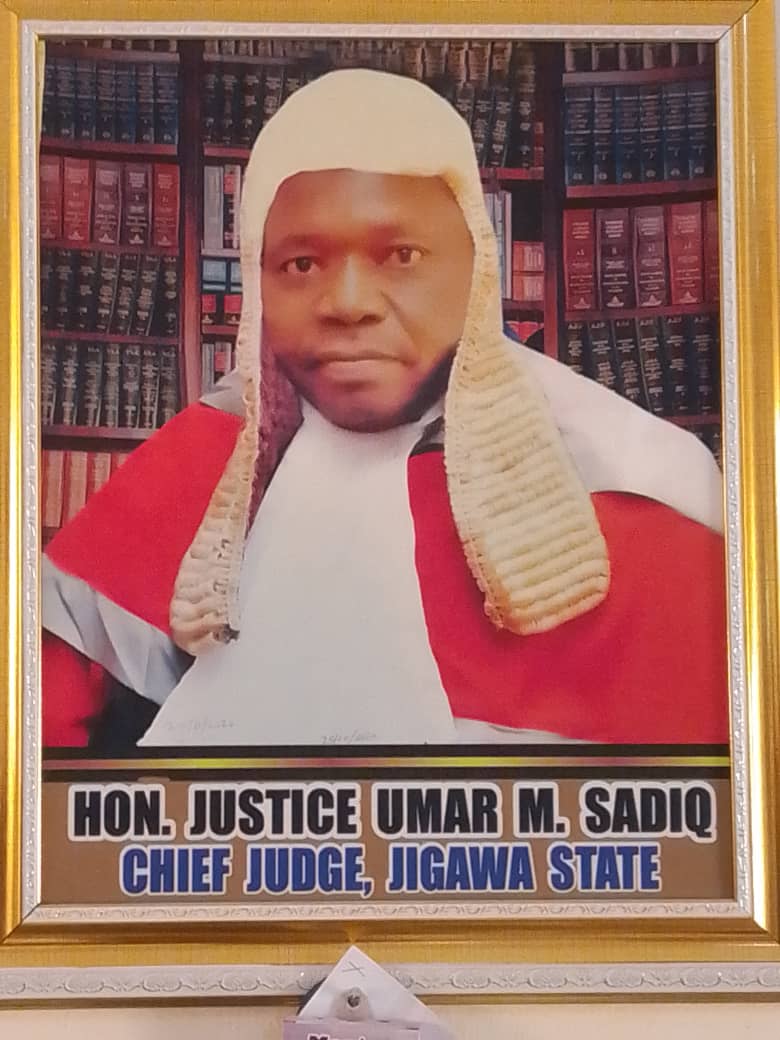
The Chief Judge of Jigawa State, Justice Umar M. Sadiq, has warned judicial officers against allowing artificial intelligence (AI) to take over their constitutional responsibilities, despite its growing usefulness in the administration of justice. Sadiq gave the warning during a one-day training on artificial intelligence and a live demonstration of……
The Chief Judge of Jigawa State, Justice Umar M. Sadiq, has warned judicial officers against allowing artificial intelligence (AI) to take over their constitutional responsibilities, despite its growing usefulness in the administration of justice.
Sadiq gave the warning during a one-day training on artificial intelligence and a live demonstration of a virtual judge, organised by an AI expert firm, LawGPT, for judges of the Jigawa State High Court and Kadis of the State Shari’a Court of Appeal.
The Jigawa State Judiciary disclosed this in a press statement by its Director of Information and Protocol Matters, Abbas Rufa’i Wangara, on Monday, November 23.
According to the statement, the Chief Judge described the acquisition of knowledge about AI as part of efforts to strengthen the capacity of judicial officers to apply emerging technology in the administration of justice.
READ ALSO: EFCC Arraigns Two Over Alleged $6.52m Forgery In Lagos
It stated that Sadiq “stressed the importance of AI in the legal profession, noting that it will assist particularly in legal research, case management, analysis of legal materials, preparation of legal drafts, judgements and rulings, as well as the general administration of courts.”
However, while commending the initiative, the Chief Judge urged the judges and Kadis “not to surrender their constitutional responsibilities to a machine.”
The statement added that he drew their attention to the risks associated with artificial intelligence, including “inaccurate legal authorities, breaches of confidentiality, fabricated judicial precedents, and the possible compromise of sensitive judicial information.”
Earlier, the facilitator, Ibrahim Sule, explained that the training was designed to reduce the time judicial officers spend on research, cross-referencing and clerical drafting.
The statement quoted Sule as saying that the objective of AI in the judiciary was to “liberate up to 70% of research, cross-referencing and clerical drafting time.”
He explained that this would return valuable hours to judges for hearing cases, evaluating evidence and preparing reasoned judgments.
In her vote of thanks, the Chief Registrar of the Jigawa State High Court, Aisha Ahmed Babura, appreciated the organisers for updating the knowledge of judges and Kadis on technological developments.
The statement said Babura commended the initiative for contributing to “the advancement of technology towards the smooth running of their public service in the administration of justice.”