Troops Destroy Hideouts Months After 46 Abductees Endured 56 Days in Captivity
By Onibiyo Segun
(OYO State, Nigeria) – Months after 46 pupils and teachers were abducted in Oriire and held for 56 days, Nigerian Army troops have destroyed suspected criminal hideouts and recovered weapons inside Old Oyo National Park.
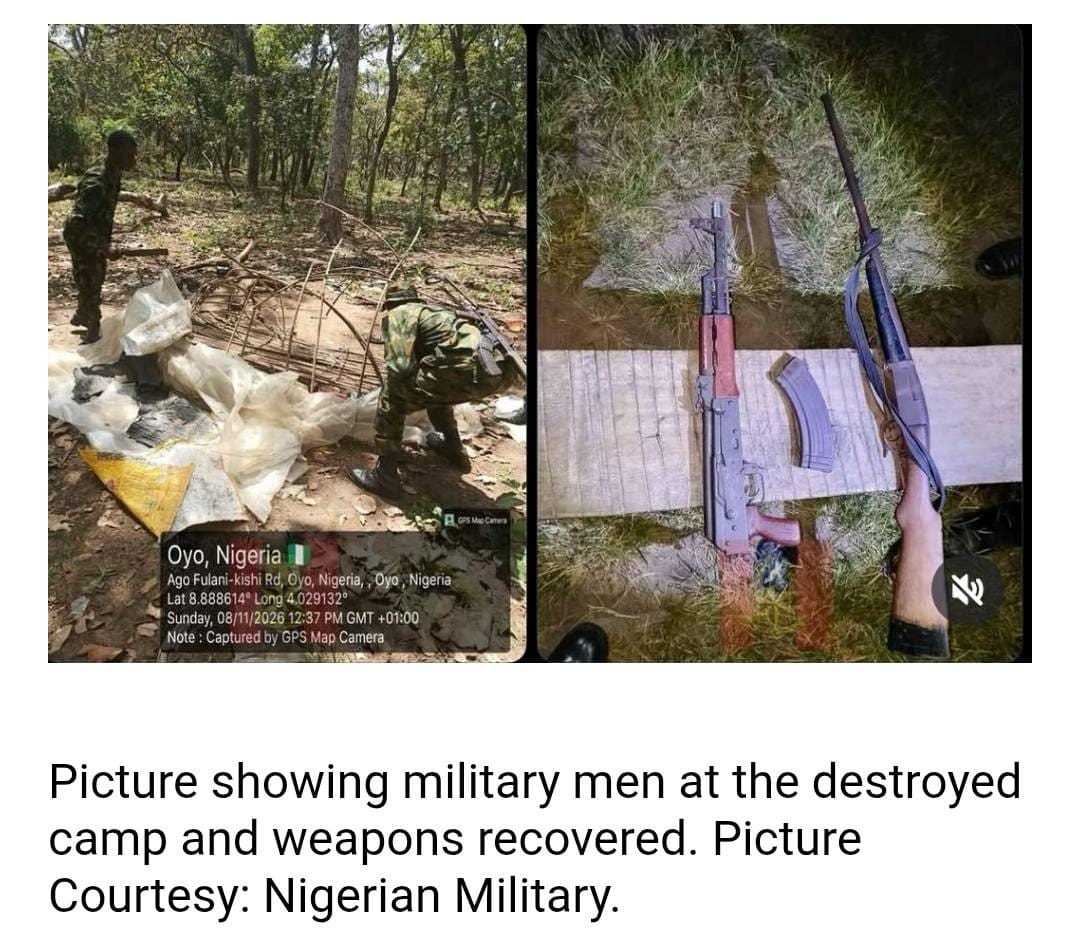
Between November 7 and 8, troops of the Nigerian Army’s Second Division, supported by hybrid forces, conducted an operation inside the park. The Army said troops recovered an AK-47 rifle, a locally made pipe gun and an empty magazine, discovered the body of a suspect from an earlier engagement and destroyed temporary shelters, Premium Times reported.
The Army did not identify the deceased, disclose the precise encounter location or establish a connection between the suspects and the May abduction. Disruption of the wider kidnapping network remains unconfirmed.
Clearing Hideouts Is Not Holding Ground, Analysts Say
Analysts interviewed by TruthNigeria said destroying hideouts is only the first stage.
“Blocking positions are effective only when troops hold them long enough, receive supplies and rotations, and coordinate with other security agencies,” Major General Chukwuma Okeke (rtd.) told TruthNigeria.
He proposed a joint Oyo-Kwara command involving all security agencies supported by permanent forward operating bases.
“Tracing ransom payments, arresting collaborators and prosecuting those who assist armed groups are essential because criminal organisations can rebuild when their support systems remain intact,” Major Fajola Ojomo (rtd.) told TruthNigeria.
A 56-Day Ordeal Still Demands Answers
TruthNigeria’s May 15, 2026, report said gunmen abducted 39 pupils and seven teachers from three schools in Oriire County, Oyo State. The 46 victims spent 56 days in captivity. Forty-four survivors were released on July 10, while two teachers, Michael Oyedokun and Adesiyan Adegboye, died.
Families still need answers about where victims were held, who guarded them and how their captors obtained food, water and supplies. The Army has not said the shelters destroyed in November were detention sites or held the Oriire victims.
TruthNigeria has also separately reported alleged long-running hostage detention in Katsina and a forest detention camp in Rijana, Kaduna State, where abducted Christians were reportedly held. These separate cases have no established link to Old Oyo but underline the need to investigate how captives are moved, held and supplied in remote locations.
A Vast Park, A Difficult Security Task
Old Oyo National Park covers approximately 2,512 square kilometres and is surrounded by 11 local government areas; 10 in Oyo State and one in Kwara. Its size and cross-state location complicate surveillance and patrols, giving criminal groups opportunities to exploit distance and coordination gaps.
Military Presence Extends Beyond Oyo
In January 2026, troops also conducted forest operations in Kwara State aimed at dismantling armed groups’ camps and logistics bases and intercepting fleeing gunmen.
The Kwara State Government said the campaign involved fighting patrols, destroyed camps and logistics bases, and blocking positions to intercept fleeing armed men. The Army also reported that collaborators in nearby communities provided information about troop movements, allowing armed groups to withdraw before troops arrived. These positions do not establish that every Oyo-Kwara route is sealed.
On October 8, 2026, Voice of Nigeria (VON) reported that Major General Auwalu Mahmuda, General Officer Commanding the Nigerian Army’s Second Division, announced that the Army had taken over the entire park as a military training site, on the directive of Chief of Army Staff Lieutenant General Waidi Shuaibu. He said the move was intended to deny criminals a hideout, not necessarily to establish permanent troop presence throughout the park.
Oyo Government Promises Support
Deputy Governor Barrister Bayo Lawal pledged state support to prevent armed groups from establishing a sanctuary in the park. Lawal said more than 35 soldiers were at the security base, with reinforcements in Abacha Village. He cited cleared vegetation, urged residents to report suspected collaborators and warned against illegal mining, as reported by Tribune.
Who Protects Communities After The Army?
Defence Minister General Christopher Musa (rtd.) said prolonged deployments could keep soldiers away from their families for up to two years. The government wants stronger police capacity and a gradual return of soldiers to barracks, as reported by Punch newspaper.
“The police cannot simply replace soldiers in high-threat forests and border locations without adequate mobility, firepower, intelligence and rapid reinforcement,” Okeke told TruthNigeria. Any transfer of responsibility, he argued, must depend on demonstrated capability, not a calendar.
The All Progressives Congress’s 2027–2031 manifesto proposes recruiting 28,000 military personnel, 50,000 police officers and 30,150 civil defence personnel. It also proposes four Army divisions in Makurdi, Ilorin, Jalingo and Benin City. These remain policy targets.
But Is Oriire?
The Owoade Judicial Commission of Inquiry, chaired by retired Justice (Professor) Mojeed Owoade, submitted its report after it heard 72 witnesses and recommended better intelligence, inter-agency cooperation and a review of forest-reserve management.
Governor Seyi Makinde while receiving the committee report said the state would examine the recommendations and respond publicly, adding that confidentiality would not be used to avoid accountability.
The test is prosecuting abduction organisers, protecting witnesses and preventing their return. Families need answers; residents need safe schools, farms and roads. That requires regular patrols, local reporting channels and rapid responses when residents raise warnings.
Onibiyo Segun reports on terrorism and conflict for TruthNigeria.