Nowhere else in the country are people as visibly angry, with reports of attacks on the president’s convoy, destruction of his campaign posters and warnings that the country could face serious consequences if their grievances are not addressed, as in the North.
In Nasarawa State, APC supporters are divided into opposing camps, with one faction backing the incumbent governor while another is protesting what it describes as the imposition of governorship candidates on the state.
The division has triggered clashes and violence at party events across the state. The internal crisis is compounded by public discontent over the country’s economic situation, which residents of Nasarawa have also been grappling with.
The growing hostility is also reflected in the destruction of the president’s campaign posters, which are frequently torn down and burnt whenever the opportunity arises.
In Niger State, the APC campaign, in collaboration with the state government, is erecting electric barbed-wire fences to protect Tinubu’s campaign posters from being pulled down and burnt.
The strong anti-Tinubu sentiment is emerging against the backdrop of worsening insecurity, with Niger State accounting for one of the highest numbers of internally displaced persons in the country.
This is in addition to the economic hardship facing residents as more cultivable land is taken over by bandits and kidnappers, who abduct people from their homes, schools and business premises.
In Kogi State, deplorable roads have compounded the security situation, with incessant kidnappings along federal highways. Motorists whose vehicles break down are particularly vulnerable to attacks by kidnappers.
The state is experiencing worsening insecurity, with more than seven local government areas reportedly abandoned by residents. This has further compounded the economic difficulties facing the people.
In Plateau State, killings continue unabated, while residents groan under the weight of rising inflation and a general sense of helplessness over the country’s worsening situation.
The APC campaign has become a target in these states, with sporadic protests against the president increasingly becoming a feature of political activities.
In Sokoto, Kebbi, Bauchi, Katsina, Benue, Adamawa, Zamfara and Kano, among other northern states, the president’s posters have been removed and burnt, while chants of “We don’t want you again” have greeted APC campaigns and town hall meetings.
In Kaduna, as in some other northern states, the government has deployed police officers to guard the president’s billboards against destruction by angry youths.
The hostility has also extended to the Federal Capital Territory, Abuja, where the president was recently pelted with objects and booed during a visit to the Shehu Shagari Mosque to observe Juma’at prayers. His campaign posters have also been destroyed in parts of the capital.
At least two sources within the APC campaign have acknowledged the difficulty of convincing voters across the North to support Tinubu’s re-election bid.
They attribute the challenge to the worsening economic and security situations, as well as what many northerners consider a deliberate attempt to exclude Atiku Abubakar, the presidential candidate of the African Democratic Congress (ADC), from the 2027 election.
According to the sources, sentiment in favour of Atiku is particularly strong across the North, with some supporters threatening that there would be no election if he were excluded from the ballot.
Videos and commentaries circulating on social media have also highlighted the strength of the sentiment.
The sources further disclosed that some political leaders expected to mobilise voters for Tinubu are themselves opposed to his re-election bid. Others are reportedly afraid of facing their constituents, who have accused them of collecting money to deceive them.
However, Tinubu’s supporters have argued that if Atiku is not on the ballot, the votes secured by former President Muhammadu Buhari in previous elections would automatically accrue to the APC candidate.
They contend that northern voters would readily support Tinubu rather than vote for Peter Obi, the presidential candidate of the Nigeria Democratic Congress (NDC), from the South-East.
But voting figures from previous presidential elections raise questions about the assumption that Buhari’s northern support base would automatically transfer its allegiance to Tinubu.
In the last four presidential elections, Buhari’s votes increased significantly, rising from 6.6 million in 2007 to 12.2 million in 2011.
He secured 15.4 million votes in 2015 and 15.2 million in 2019, showing that he garnered more than 12 million votes in three consecutive elections nationwide.
A breakdown of the 2019 presidential election results shows that Buhari, who polled 15,191,847 votes nationally, secured 11,547,809 votes from the 19 northern states, representing approximately 76 per cent of his total votes.
His votes across the 19 northern states were as follows: Adamawa, 378,078; Bauchi, 798,428; Benue, 347,668; Borno, 836,496; Gombe, 402,961; Jigawa, 794,738; Kaduna, 993,445; Kano, 1,464,768; Katsina, 1,232,133; Kebbi, 581,552; Kogi, 285,894; Kwara, 308,984; Nasarawa, 289,903; Niger, 612,371; Plateau, 468,555; Sokoto, 490,333; Taraba, 324,906; Yobe, 497,914; and Zamfara, 438,682.
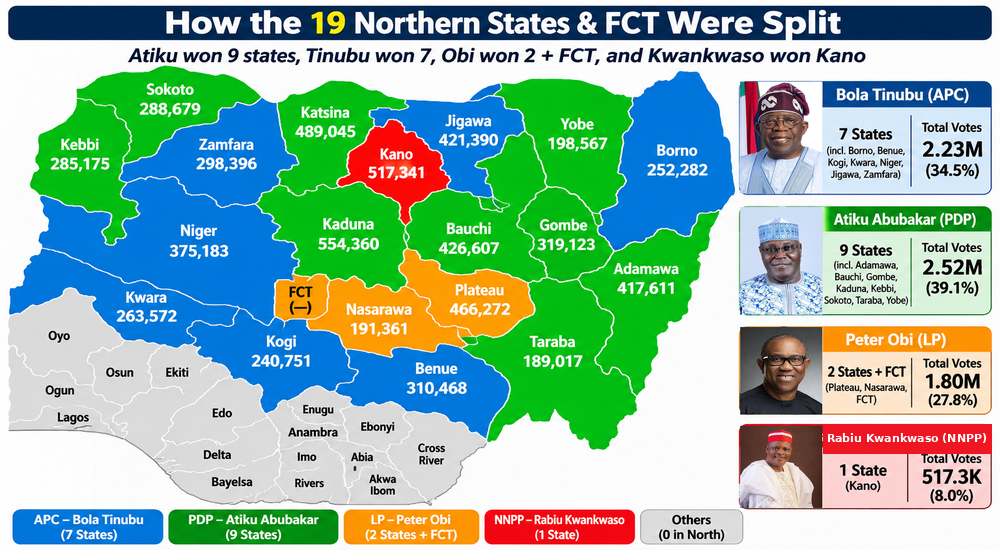
However, the 2023 presidential election results show a different voting pattern, with Tinubu’s performance in the North falling below Buhari’s 2019 figures.
Tinubu, who polled 8,794,726 votes nationally, secured 5,507,784 votes across the 19 northern states, representing 62.63 per cent of his national total.
His votes in the states were: Adamawa, 182,881; Bauchi, 316,694; Benue, 310,468; Borno, 252,282; Gombe, 146,977; Jigawa, 421,390; Kaduna, 399,293; Kano, 517,341; Katsina, 482,283; Kebbi, 248,088; Kogi, 240,751; Kwara, 263,572; Nasarawa, 172,922; Niger, 375,183; Plateau, 307,195; Sokoto, 285,444; Taraba, 135,165; Yobe, 151,459; and Zamfara, 298,396.