By Umar U. Duguri
Former Vice-President Atiku Abubakar on Saturday, 14 November, 2026 took his 2027 presidential campaign to Bauchi State, where he promised to restore petroleum and electricity subsidies, tackle insecurity across the country and revive petroleum exploration in the Kolmani oil field.
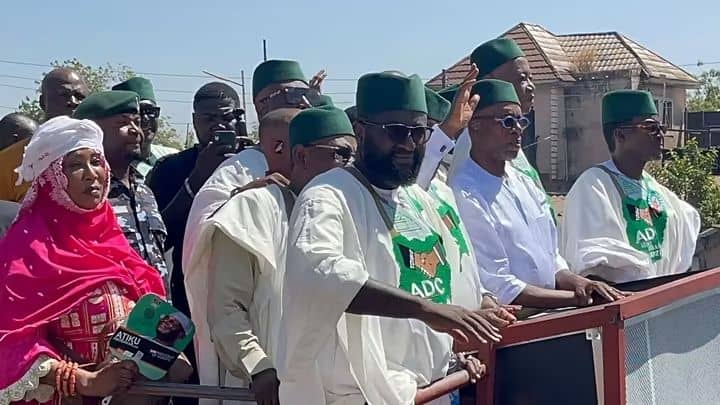
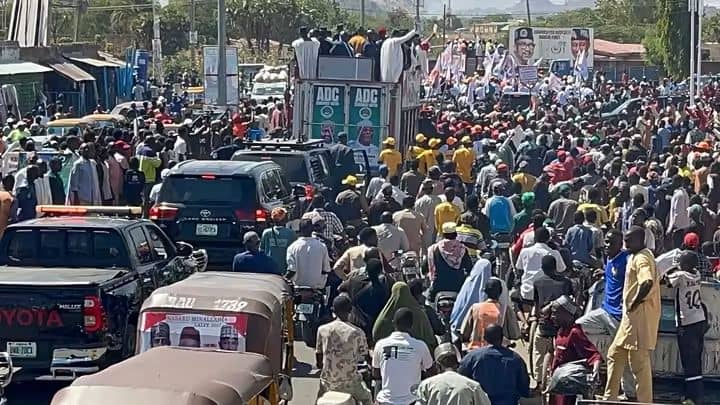
The rally, held at the Sir Abubakar Tafawa Balewa Stadium in Bauchi, attracted prominent political figures, serving and former federal lawmakers, ADC leaders, party supporters and members of opposition movements from across the country.
Among the prominent personalities present were: Senator Dino Melaye, Senator Abdul Ahmed Ningi, Senator Nazi Gamawa, ADC governorship candidate for Bauchi State, Senator Halliru Dauda Jika; former presidential aide Naja’atu Mohammed, Malami and other political stakeholders.
The gathering also featured members of the Tinubu Must Go movement drawn from across the 36 states of the federation, giving the event a broader national opposition dimension beyond the ADC’s traditional party mobilisation.
Atiku, ADC presidential candidate, used the occasion to address some of the country’s most pressing challenges, particularly the rising cost of living, energy affordability, insecurity and the need to accelerate economic development.
Addressing the enthusiastic gathering, the former Vice-President renewed his commitment to reversing the removal of petroleum subsidy and restoring electricity subsidies if elected president in 2027.
“I promise all Nigerians that I will restore the petroleum subsidy. Not only that, I will also restore the subsidy for electricity power. I will restore security in the North-East and the country in general,” Atiku declared.
He further promised to continue petroleum exploration and development activities in the Kolmani oil field, which straddles Bauchi and Gombe states, describing the project as an important opportunity to expand Nigeria’s revenue base and stimulate economic development in the North-East.
His commitments formed the central message of the Bauchi rally, as the ADC seeks to position itself as a credible alternative to the ruling All Progressives Congress (APC) ahead of the 2027 general elections.
The presence of prominent political figures from different parts of Nigeria gave the Bauchi rally significance beyond an ordinary state-level campaign event.
The participation of Senator Dino Melaye, Senator Abdul Ahmed Ningi and Senator Nazi Gamawa, alongside Senator Halliru Dauda Jika and other political stakeholders, demonstrated the ADC’s effort to bring influential political actors together around Atiku’s presidential ambition.
The participation of members of the Tinubu Must Go movement from across the 36 states also reflected the growing efforts by opposition groups to build a wider political platform around dissatisfaction with the current administration.
The development is particularly significant as Nigeria approaches another fiercely contested presidential election.
However, the political significance of such a gathering will ultimately depend on whether the coalition can translate its mobilisation into a coordinated electoral structure, shared policy objectives and sustained grassroots engagement.
Atiku’s commitment to restore petroleum subsidy represents one of the most consequential economic policy positions emerging from his Bauchi campaign.
Since President Bola Ahmed Tinubu announced the removal of petrol subsidy in May 2023, Nigerians have experienced substantial increases in fuel prices, transportation costs, production expenses and the general cost of living.
Although the Federal Government has defended the policy as necessary to reduce fiscal pressure and redirect public resources towards development, its economic consequences have remained a major source of public concern.
Atiku’s proposed restoration of petroleum subsidy is therefore an attempt to offer an alternative economic direction to Nigerians demanding relief from rising living costs.
His additional promise to restore electricity subsidies broadens the proposal to include the financial burden associated with electricity tariffs on households and businesses.
Nevertheless, the ADC will need to explain how the proposed interventions would be financed, how corruption and leakages would be prevented and how the benefits would reach ordinary consumers.
Atiku’s commitment to continue petroleum exploration in Kolmani was another major component of his Bauchi campaign.
The Kolmani oil and gas development has generated considerable expectations in Bauchi and neighbouring Gombe State because of its potential to attract investment, create employment, increase national revenue and stimulate economic activities across the North-East.
For residents of the region, the project represents an opportunity for economic transformation beyond traditional sources of livelihood.
However, the people of Bauchi and Gombe will expect more than campaign assurances. They need clear commitments on project financing, exploration targets, employment opportunities, environmental safeguards and the economic participation of host communities.
The presence of Senator Halliru Dauda Jika, the ADC governorship candidate in Bauchi, also gave the rally important state-level political implications.
Jika’s participation reinforced the party’s determination to link Atiku’s presidential ambition with its own efforts to secure the Bauchi Government House in 2027.
The ADC has been working to strengthen its grassroots structures across the state’s 20 local government areas, while political realignments continue to reshape the contest ahead of the next governorship election.
For Jika, the challenge will be to convert the political momentum generated by the presidential campaign into broad-based electoral support across Bauchi.
Atiku’s Bauchi campaign has placed economic hardship, security, energy affordability and regional development at the centre of the emerging 2027 political debate.
The participation of influential political figures and opposition movement members from across the federation gives the ADC an opportunity to project a broader national coalition.
However, Nigerians will ultimately judge the party by the credibility of its policy proposals, the strength of its leadership and its capacity to translate campaign commitments into measurable improvements.
For Bauchi residents, the expectations are clear: affordable energy, improved security, employment opportunities, infrastructure development and tangible economic benefits from strategic projects such as Kolmani.
Atiku has presented his promises. The ADC must now demonstrate how it intends to deliver them.
As the 2027 election approaches, the defining question for Nigerians will not simply be who promises change, but who can present a credible, workable and accountable pathway to achieving it.
The post Atiku Takes Presidential Campaign to Bauchi, Vows to Return Fuel, Electricity Subsidies; Tackle Insecurity appeared first on The Gazelle News.
