A police investigator has told the Federal Capital Territory High Court in Abuja that former Governor of the Central Bank of Nigeria (CBN), Godwin Emefiele, allegedly replaced the naira redesign approved by former President Muhammadu Buhari with a change in the colours of the banknotes without obtaining fresh presidential approval.
The investigator, Commissioner of Police Eloho Okpoziakpo, also testified that investigations revealed no evidence that the CBN Board met and approved the colour changes eventually introduced to the ₦200, ₦500 and ₦1,000 notes.
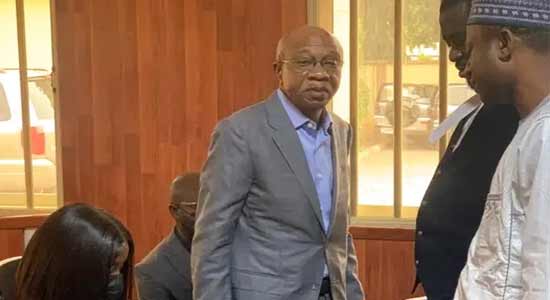
Okpoziakpo, the 11th prosecution witness in Emefiele’s ongoing trial over allegations of unlawful currency redesign and financial misconduct, made the disclosures on Thursday, November 26, 2026, while testifying before Justice Maryann Anenih.
Led in evidence by the Director of Public Prosecutions of the Federation, Rotimi Oyedepo, SAN, the witness explained that Emefiele had initially sought and obtained Buhari’s approval for a redesign of the naira, accompanied by samples showing the proposed changes.
However, according to the investigator, the banknotes eventually produced were substantially different from those presented to the former President.
“But what was eventually done was not a redesign as was approved by the president but a colour swap,” Okpoziakpo told the court.
He explained that the original designs submitted for presidential approval contained proposed changes to the ₦1,000, ₦500 and ₦200 notes, including QR codes, watermarks and different numbering.
The witness maintained that the versions eventually approved for production by Emefiele did not contain the proposed QR codes.
He further told the court that investigators found no evidence that Buhari subsequently approved the changes made to the original designs.
According to him, the investigation also failed to establish that the CBN Board met to authorise the colour swap that was eventually implemented.
Okpoziakpo, who led investigations into allegations against Emefiele following his removal from office in June 2023, explained that the former CBN governor had forwarded Buhari’s original approval to the Managing Director of the Nigerian Security Printing and Minting Plc (NSPM).
The Managing Director, however, raised concerns about implementing the proposed redesign within the available time.
The witness read a letter from the NSPM Managing Director to Emefiele explaining why changes to the colours of the existing notes were considered more practical than implementing extensive alterations to their features.
“It was then agreed that based on the urgency, we should advise the CBN to avoid changes to the banknotes, which require a long period to implement. Instead, work on the colours because of the availability of inks and how far it can be accessed. It will also enable the NSPM to serve the CBN and its nation diligently,” the letter stated.
Okpoziakpo maintained that although the letter explained the practical considerations behind the decision to change the colours, investigators found no evidence that the revised designs received the necessary presidential approval.
The testimony formed part of the prosecution’s case against Emefiele, who is standing trial on four charges filed by the Economic and Financial Crimes Commission (EFCC).
The anti-graft agency accused the former CBN governor of unlawfully redesigning the country’s three highest currency denominations in 2022 and printing banknotes worth ₦684.5 billion at a cost of ₦18.96 billion.
According to the prosecution, the manner in which the redesign was undertaken violated Section 19 of the Central Bank of Nigeria Act, which requires presidential approval based on the recommendation of the CBN Board before changes are made to the currency.
The EFCC maintained that Emefiele failed to comply with the required procedure in carrying out the redesign.
Emefiele has denied the allegations.
Apart from the controversy surrounding the naira redesign, the prosecution also accused the former CBN governor of unlawfully approving the withdrawal of ₦124.8 billion from the Consolidated Revenue Fund (CRF).
The CRF is the Federal Government’s central account into which most government revenues are paid, with withdrawals subject to constitutional and legislative requirements.
The EFCC alleged that the withdrawal was carried out without the necessary appropriation by the National Assembly.
Testifying on the transaction, Okpoziakpo told the court that Emefiele personally approved the debit of ₦124.8 billion from the account.
Reading the approval attributed to the former CBN governor, the witness quoted:
“Please debit the CFR account for N124.8 billion and clear the debit in the account.”
The investigator maintained that the transaction was carried out without the appropriation required for withdrawals from the Consolidated Revenue Fund.
He also disclosed that the Federal Ministry of Finance informed the investigation team in a letter that the debit was made directly by the CBN.
The testimony raised questions about the procedure followed in authorising and processing the transaction, which forms another aspect of the criminal charges against Emefiele.
During cross-examination, Emefiele’s counsel, Olalekan Ojo, questioned the investigator about his qualifications, professional experience and involvement in the investigation.
Responding, Okpoziakpo told the court that he holds a Bachelor of Science degree in Psychology and a Master of Science degree in International Diplomacy.
He also disclosed that he had undergone basic police training and had served in the Nigeria Police Force for 31 years, spending most of his career on investigative assignments.
The witness explained that he was attached to the Police Intelligence Department in Abuja during the period when the naira redesign policy was implemented.
He further disclosed that he participated in taking Emefiele’s statement at the Kuje Custodial Centre alongside Jim Obazee, the special investigator appointed to investigate allegations of misconduct against the former CBN governor.
However, Okpoziakpo clarified that he did not personally interview Emefiele.
He explained that his role in the investigation included examining relevant documents and interviewing the Managing Director of the Nigerian Security Printing and Minting Plc.
During further questioning, defence counsel presented the investigator with an audit report covering the CBN during Emefiele’s tenure.
The witness, however, maintained that the investigation into the ₦124.8 billion transaction was not based on the audit report.
According to him, investigators focused on whether the withdrawal from the Consolidated Revenue Fund complied with the applicable legal requirements.
Thursday’s testimony followed earlier evidence from other prosecution witnesses who had questioned the procedure adopted during the naira redesign and the authorisation of certain financial transactions.
On October 6, 2026, the 10th prosecution witness, Ali Muhammed, told the court that withdrawals from the Consolidated Revenue Fund required approval from the Federal Ministry of Finance and the Office of the Accountant-General of the Federation.
Muhammed also testified that the Ministry of Finance was unaware of the ₦124.8 billion deduction.
Similarly, in November 2024, the fifth prosecution witness, Kingsley Obiorah, a former Deputy Governor of the CBN, testified that the bank’s Board did not recommend the naira redesign to former President Buhari.
Obiorah, who gave evidence virtually, explained that he had served as Emefiele’s Special Adviser on Economic Matters before becoming a Deputy Governor of the apex bank.
According to him, the CBN Board first became aware of the redesign policy in mid-December 2022.
Another prosecution witness, Chinedu Eneaya, testified in October 2025 that Emefiele proceeded with the controversial redesign without first securing the approval of the CBN Board and its Committee of Governors.
Eneaya alleged that the former CBN governor only sought the approval of both bodies after obtaining Buhari’s consent.
He further claimed that Emefiele acknowledged the sequence of events in an extrajudicial statement made during the investigation.
The dispute concerns a policy introduced in late 2022 that required Nigerians to exchange their old ₦200, ₦500 and ₦1,000 notes for redesigned currency.
The implementation of the policy coincided with severe shortages of cash across the country in the months leading up to the 2023 general elections.
Many Nigerians experienced difficulties accessing money from banks and automated teller machines, while businesses and ordinary citizens struggled with the limited availability of the redesigned notes.
The CBN continued implementing the policy despite complaints about the scarcity of the new currency.
The situation prompted some state governors to approach the Supreme Court, challenging the restrictions imposed on the continued use of the old banknotes.
Buhari defended the policy even after the Supreme Court issued an interim order concerning its implementation.
On March 3, 2023, the Supreme Court delivered its final judgment, setting aside the restrictions on the continued use of the old notes and prompting a change in the Federal Government’s position.
The controversy over the policy subsequently became part of the allegations investigated following Emefiele’s removal as CBN Governor in June 2023.
With Okpoziakpo’s evidence, the EFCC has now presented 11 prosecution witnesses in the case.
The prosecution maintains that the currency changes and the disputed withdrawal from the Consolidated Revenue Fund were carried out without the approvals required by law.
Emefiele, however, continues to deny the criminal allegations, which remain subject to determination by the court.
Justice Maryann Anenih adjourned the proceedings until December 2, 2026, for continuation of the case.
The post “Buhari Approved Redesign, Not Colour Swap” — Investigator Tells Court Emefiele Produced Different Naira Notes Without Fresh Presidential Approval appeared first on TheNigeriaLawyer.