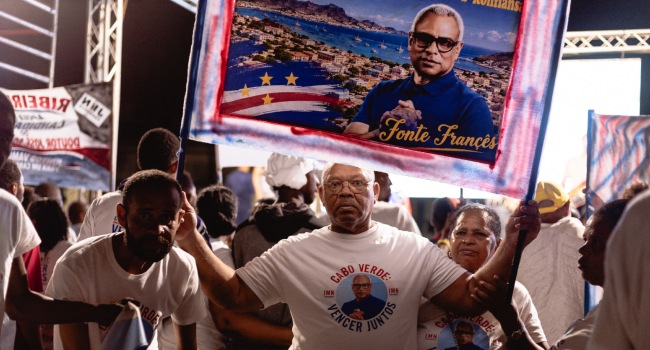
Cabo Verde voted for a new president on Sunday, with incumbent Jose Maria Neves favoured to win a second term as head of state of the West African archipelago renowned for its democratic stability.
He is facing the country’s first woman candidate, Joana Rosa Amado, among other contenders. Voting started at 0900 GMT and ends at 1900 GMT. Provisional results are expected overnight.
“I’ve voted. Now I’m going to mass, and I believe everything will go well — normally and with civic-mindedness,” Adilia Gomes, 55, told AFP after casting her ballot in the capital, Praia.
“Everything went normally despite a few minutes’ delay in the opening of my polling station,” added another voter, Claudino Semedo.
Nearly 420,000 people are eligible to vote. The election is being watched by about 150 observers from the Economic Community of West African States, the African Union and European Union.
Cabo Verde, located in the Atlantic Ocean about 600 kilometres (375 miles) off the coast of Senegal, comprises 10 volcanic islands and is an increasingly popular tourist destination.
It made world headlines this year when its national football team reached the knockout stages in its first World Cup, and when a cruise ship containing people with hantavirus docked off its shores.
Stability, Hospitality
Unlike several of its West African neighbours where presidential elections have been tense in recent years, Cabo Verde is known for its political stability and good governance.
It is considered a model of democracy in Africa, with strong economic growth.

The country is known for its “morabeza” (“hospitality”, in local creole), openness, and carnivals. It also has its own style of music.
According to the Mo Ibrahim Foundation 2026 index on global governance, Cabo Verde ranks third out of 54 countries on the continent.
Politically, it has a semi-presidential system in which the executive is dominated by the prime minister.
The president does not govern but acts more as an arbiter, working to guarantee unity and uphold the constitution.
The head of state appoints the prime minister based on the results of legislative elections and represents the country abroad.
Frontrunners

Among the six candidates in the running on Sunday, two are frontrunners: incumbent Neves, 66, and Amado, 61, a lawyer and former justice minister.
Each is supported by one of the country’s two main parties.
Neves was first elected president in 2021. From 2001 to 2016, he also served as prime minister and the president of the African Party for the Independence of Cabo Verde (PAICV). He has also been a mayor and a lawmaker.
Neves has the support of the PAICV, which won legislative elections in May.
“In these times of international uncertainty, it is essential that Cabo Verde continues to have a patriotic, experienced president capable of inspiring Cabo Verdeans,” he said this week during a rally.
Amado, whose slogan is “Listen to Cabo Verde”, is supported by the main opposition party, the Movement for Democracy (MpD).
“The election of a woman to the presidency would show many young women and young girls that no government job is barred from them,” she told reporters.
Among the other candidates are 45-year-old surgeon Gilson Alves, a hardline figure who is promising to fight corruption, allow gun ownership and reinstate the death penalty.
Challenges

In July, the World Bank classified Cabo Verde as an upper-middle-income country thanks to economic growth in the tourism sector.
However, the country faces many challenges, including persistent social inequality, geographic isolation and a lack of affordable options for travelling between islands.
If elected, the main candidates have promised to implement measures to improve air and sea travel between the islands and also to construct new accommodation for tourists.
Among the population’s major concerns are the increased cost of living, fuel prices, and youth unemployment.
AFP