“Indeed, the Under-17 girls are worthy ambassadors of Nigeria.”
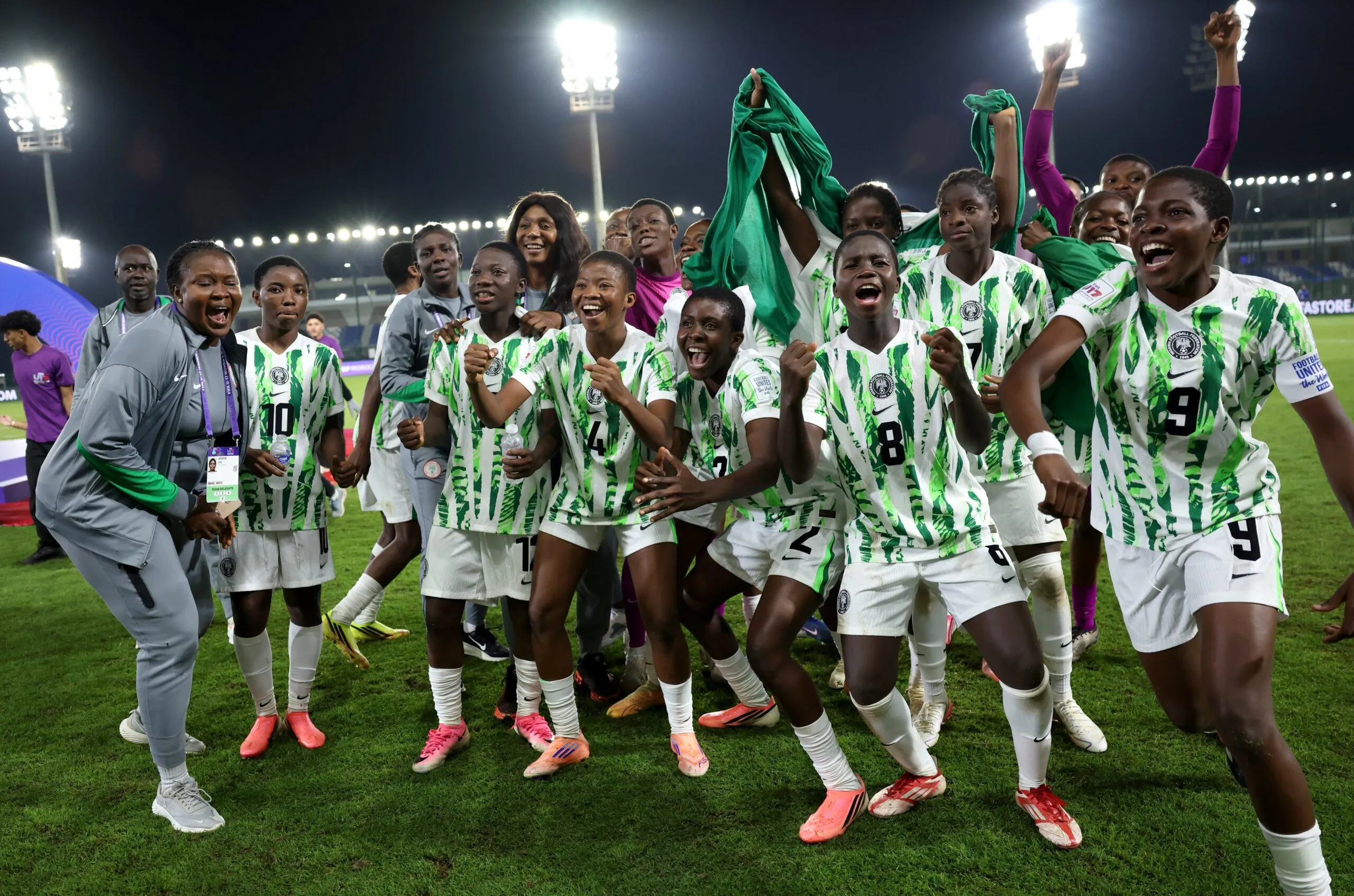
The Flamingos’ shaky start in the just-concluded FIFA Under-17 female competition gave way to determination and resilience, which ended with them being crowned champions of the 2026 edition of the tournament that was held in Rabat, Morocco. In the final played on 7 November, the Flamingos defeated their Japanese counterpart by 2-1. The victory has captured the country’s imagination.
It is the first of such diadem to come the way of an African country since the championship began in 2008. Hence, the players have not only been the toast of all Nigerians, but also the global football fraternity. President of the Confederation of African Football (CAF), Patrice Motsepe, lauded them, saying they have “made Africa and CAF proud,” while inviting the 54-member nations of CAF to support the Flamingos. The President of FIFA, Gianni Infantino, there in Rabat, considered the victory as being “well deserved.”
The result of their first match in Group B was a dampener, with a 2-1 loss to Poland. However, they rallied their wits to beat Puerto Rico 2-0, after which they displaced North Korea 3-1, to top their group. In the round of 16, the Flamingos trounced Mexico 2-1 and sent Venezuela home in the quarter-finals with a 1-0 victory, before triumphing over football powerhouse Brazil by 3-1 in the semi-final.
Japan, the champions in 2014 and finalists in 2010 and 2016, alongside North Korea, which had won the trophy in 2008, 2016, 2024 and 2025, were giants of the competition, and therefore, the favourites to win the trophy. Yet the Flamingos drubbed both on their way to victory.
Other heavyweights of the competition, Spain and France, went home empty-handed. Argentina, Germany, the US, China, Canada, Morocco and Ghana, among other nations, also participated in the competition.
Indeed, the Under-17 girls are worthy ambassadors of Nigeria. In appreciation, the country has showered them, their coach, Akeem Busari, and team officials with unprecedented cash gifts. The windfall began with President Bola Tinubu’s ₦100 million gift to each of the 21 players, when the First Lady, Oluremi Tinubu, hosted them at the State House, Abuja.
Lagos State government donated an additional ₦300 million to the players and officials. Each of them will get ₦10 million each, plus an iPhone. Telecom giant MTN has also gifted them ₦150 million and a free data subscription for one year, just as Kwara State gave them ₦100 million last week. More of these goodies might be underway!
Appropriately, a bond certificate worth ₦100 million was given to each of the girls by the First Lady, instead of cash, as they are still minors. But they will be entitled to a ₦1.1 million monthly accrual from the investment, which would run at a 14 per cent interest rate. This will take care of their education and support their families for the next five years, when they would have been mature enough to have access to the full sum.
This would secure their financial future. MTN too will not pay the ₦5 million gift directly to the lads, but into the bank accounts of their parents, which they would monitor.
But beyond the fanfare of the moment is the bigger picture. How will the victory rub off on female football in Nigeria? A cash haul is not all there is to motivating a national team for more glory. For instance, the $100,000 presidential gift to each of the Super Falcons for their 2025 WAFCON victory did not spur them to qualify for the 2027 FIFA World Cup in Brazil. Also, the consecutive absence of the Super Eagles from the 2022 and 2027 FIFA World Cups adds to this sorry tale of our football.
The “beautiful game,” without a doubt, has become more than a field or pitch drama. Discerning nations now take it as a serious youth development project. This is carried out through huge investments in sports infrastructure, the sponsorship of competitions, training camps, stadium networks, and long-term youth programming.
This, in part, is why great nations in football at different levels, such as Brazil, Argentina, Spain, Germany, France, to name just a few, manage to sustain their trajectories of excellence. Morocco has joined them with its state-of-the-art facilities in football academies, resulting in the steady rise in its game. Obviously, success at the highest level of football is not a fortuitous gambit.
Our policy debit explains why the fortunes of Nigeria’s Eaglets, who were victorious in five FIFA competitions, the last of which was in 2015, did not have any knock-on effect on our football.
With the huge cash reward to the girls, it has become too glaring how sports, especially football, can pull youths and their families out of poverty, all of a sudden. What the country needs is the injection of a missing link in the system – a structure that will give it a cultural imprint or sustainability.
The Minister of Education, Maruf Alausa, has equally noticed the gap in our school system. As a result, he initiated a vocational skills reform that includes sports training in the national school curriculum last month, as part of efforts to create employment pathways for the youths.
The broader initiative targets about 250,000 youths for six months of training at Nigeria Institute of Sports (NIS) centres. The course will expose them to coaching, facility maintenance and so on.
Crucially, school sports must return to serve as breeding grounds for talent, and then catch-them-young programmes, which were aided by secondary school inter-house sports and inter-school competitions. This should be resuscitated. The footballing triumph of Christ the King’s College, Onitsha (CKC), in the 1977 International Schools Sports Federation Championships in Dublin, Ireland, echoes here. The team’s captain, Nnamdi Nwokocha, along with Arthur Egbuna, among others, eventually became a player for Enugu Rangers International and the Super Eagles.
Seeing youth energy and enthusiasm for sports wasted in primary and secondary schools without fields or pitches is unacceptable. It should spark a reset agenda in school administration nationwide.
The rollicking Flamingos and our football authorities should know that the 2027 championship preparation begins now. There can be no better incentive for the girls than providing them with world-class facilities for practice, which would bring out the best in them to defend the trophy, and ultimately pave the way for their long careers in football.