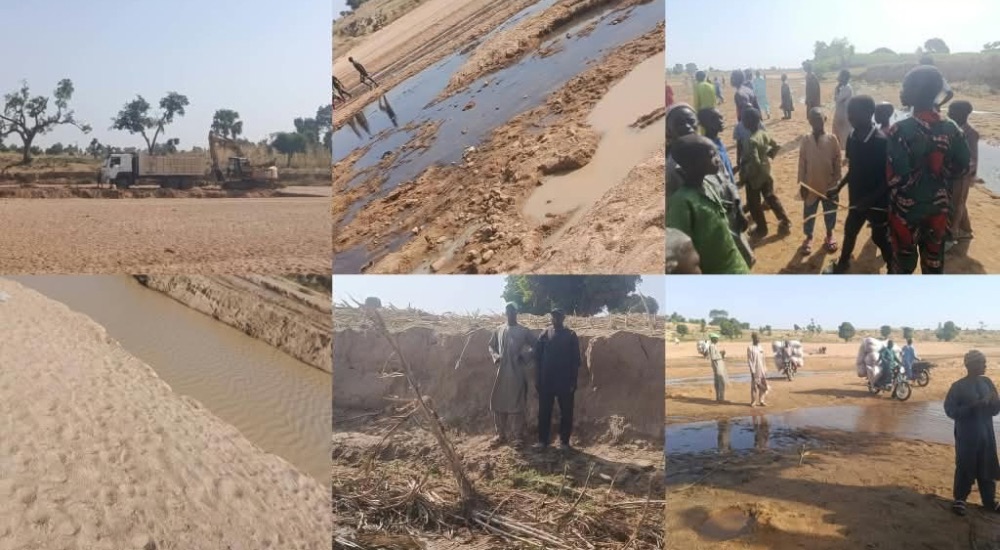
Speaking to THE WHISTLER, residents said the excavation, which they claimed had been ongoing for about three years, had left thousands of people struggling to access drinking water, cultivate crops during the dry season and sustain their livestock.
They lamented that the activities had significantly altered the community’s riverine environment, destroyed hundreds of hectares of farmland and threatened the food security of households that depend largely on farming and animal husbandry.
Speaking on the situation, a resident, Laminu Abdulrasheed, said the community had been plunged into a difficult situation since the excavation activities began.
“Residents are in a big mess due to the excavation. We don’t have water anymore to drink, and we cannot farm any farm produce during the dry season. Our animals can no longer graze or drink water as they used to,” he said.
Abdulrasheed estimated that more than 20,000 people live in the community, noting that the environmental disruption had forced some residents with financial means to relocate to Rogo metropolis.
According to him, poorer households have remained in the village because they cannot afford to move elsewhere despite the worsening living conditions.
“We have over 20,000 people in this community. People who are a bit rich have started relocating to Rogo metropolis. We, the poor ones, don’t have the resources to relocate to another place,” he said.
He explained that the excavation had not only affected access to water but had also destroyed agricultural activities that previously sustained many households.
Abdulrasheed said the community had lost hundreds of hectares of farmland, while mango trees that provided income for residents had been submerged or destroyed by the excavation activities.
He added that the disruption had effectively ended several economic activities, including mango trading, livestock rearing and dry-season farming.
“All our mango trees have submerged due to the excavation activities. Now our mango business is gone. There is no more animal rearing and farming as before,” he lamented.
The situation, according to residents, has also affected household water supply, with several wells in the community reportedly drying up.
Abdulrasheed said residents now trek approximately three kilometres to access drinkable water, turning an essential daily activity into a difficult task for families.
He explained that even water from nearby sources had become increasingly difficult to obtain, forcing households to spend considerable time searching for water for domestic use.
“Even in our neighbourhoods, all their wells have dried up. Getting one bucket of water now is hard from our river. We have to trek about three kilometres to get drinkable water,” he said.
The water shortage has also compounded the difficulties faced by women and other household members responsible for fetching water, cooking and carrying out other domestic activities.
Another resident, Aisha Rabiu, also lamented the impact of the excavation on household activities, saying the situation had made everyday living increasingly difficult for families in the community.
Similarly, farmers Auwal Bashir and Kabiru Sani expressed concerns over the destruction of agricultural land and the difficulties confronting farmers whose livelihoods depend on the riverine environment.
They said the disruption had affected farming activities and raised concerns about the ability of households to sustain themselves through agriculture.
Residents warned that the continued loss of farmland, water sources and livestock-related activities could worsen poverty and food insecurity in the community, particularly among households that have no alternative means of livelihood.
Appeals to authorities yield no response
Abdulrasheed said the community had made several attempts to draw the attention of relevant authorities to the situation but had yet to receive any meaningful intervention.
He listed the district head, the chairman of Rogo Local Government Area, the Department of State Services (DSS) head in the LGA, the emir and the Divisional Police Officer (DPO) among the authorities they had approached.
According to him, residents had written petitions and made complaints to the authorities, appealing for the excavation to be stopped, but the activities had continued.
“We have reported to our district head, DSS head of our LGA, LGA chairman, our emir and DPO. We wrote to all these authorities, but nothing has been done about the sand excavation,” he said.
The residents are now appealing to the Kano State Government to urgently intervene and halt the excavation, which they believe is responsible for the deterioration of their environment and the disappearance of water sources.
They also called for an assessment of the environmental damage and measures to restore the community’s water supply and protect the remaining farmland.
The development has raised concerns about the environmental and livelihood implications of sand excavation in rural communities, particularly where residents depend on natural water bodies for agriculture, livestock production and domestic consumption.
For residents of Karshi, the consequences go beyond the loss of farmland and mango trees. The drying up of wells and the growing distance required to obtain drinking water have placed their daily survival under pressure.