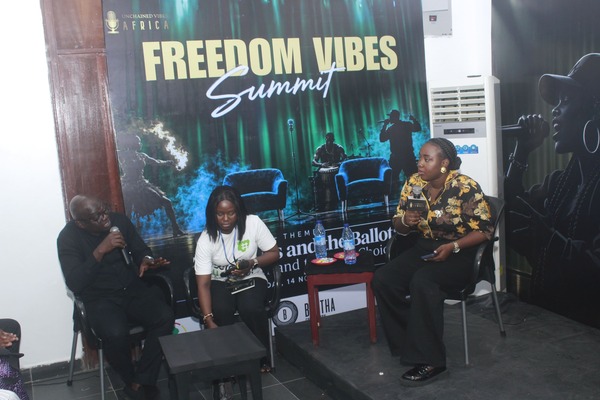
Fact-checkers and other stakeholders have warned that foreign interests, covert funding and digitally manipulated content could influence public opinion ahead of Nigeria’s 2027 general elections, urging citizens and content creators to become more critical of the information they consume and promote.
The warning was raised at the first panel session of the Freedom Vibes Summit and Concert 2026, where Nigeria Editor of Africa Check, David Ajikobi, delivered a keynote address before joining Anna Ajakaiye, founding editor of Facts Matter NG, for a panel discussion on tackling information manipulation and foreign information manipulation and interference (FIMI).
The session examined how political actors and foreign interests could exploit the influence of social media personalities, online publications and content creators to promote narratives that deepen ethnic and religious divisions or shape perceptions of political developments.
Ajikobi argued that the challenge went beyond the circulation of outright falsehoods.
He explained that manipulated information could also be presented through seemingly harmless entertainment, humour and promotional content, making it difficult for audiences to recognise the intentions behind it.
He challenged the assumption that financial inducements automatically determine how people vote, arguing that Nigerians could collect money offered during political campaigns and still make independent electoral choices.
Drawing comparisons with political spending in the United States mid term elections and Nigeria, including the Osun elections, he said voters ultimately needed to be intentional about their choices rather than allow financial incentives to determine their decisions.
However, he questioned the practice of entertainers and other creatives charging substantially more to endorse political candidates, particularly when they genuinely believed in the candidates they were supporting.
Ajikobi argued that an endorsement based on personal conviction could be regarded as a contribution to democracy rather than simply another commercial transaction.
He acknowledged that such expectations could be difficult for ordinary Nigerians facing economic hardship, noting that people struggling to afford basic necessities might find it difficult to reject financial offers.
Proposing ways to address information manipulation, Ajikobi identified digital media literacy, accountability from technology companies and stronger social relationships across ethnic and religious lines as important areas of intervention.
He said many Nigerians were active on social media but lacked the skills to investigate the authenticity of images and other information circulating online.
Using Google Lens as an example, he demonstrated how smartphone users could conduct basic checks on suspicious pictures rather than immediately accepting or sharing them.
He advocated taking media literacy programmes into schools and communities, citing Finland’s introduction of media literacy education for secondary school students as an example of how countries could prepare younger generations to recognise manipulated content.
He also criticised the insufficient scrutiny of technology platforms, particularly as artificial intelligence makes it easier to produce and distribute misleading material.
According to him, organisations including Meta and TikTok must be held more accountable for the content and monetisation systems operating on their platforms, especially where incentives encourage the production of sensational or misleading material.
Ajikobi further urged Nigerians to rebuild relationships across ethnic and religious communities outside social media, arguing that stronger offline connections could help counter narratives designed to turn citizens against one another.
He encouraged participants to pause before sharing information and consider who might benefit from the anger or division a particular message was intended to provoke.
During the panel discussion, Ajakaiye examined how foreign information manipulation could be adapted to local circumstances until audiences no longer recognised the external interests behind particular narratives.
She explained that social media algorithms could reinforce existing perceptions by repeatedly recommending similar content to users, creating an information environment in which people encounter only one side of an issue.
Using online portrayals of Burkina Faso as an example, she described how some content creators had visited the country and produced videos presenting an overwhelmingly positive picture of its development.
However, she noted that such portrayals often focused on the capital while overlooking insecurity and other challenges in different parts of the country.
Her concern was that audiences could mistake these selective presentations for a complete account of events, particularly when they did not seek information from other sources.
Ajakaiye urged Nigerians to be more discerning about the content they consume, explaining that repeated exposure to similar viewpoints could create a distorted understanding of political and social developments.
She also advised content creators to protect their professional integrity by researching assignments before accepting them and ensuring that the messages they promote are factual.
She encouraged greater collaboration between journalists, fact-checkers and entertainment professionals, arguing that such partnerships could help creators reach their audiences with more reliable information.
The panel also examined the kinds of misinformation Nigerians should expect as the 2027 elections approach.
Ajakaiye identified fabricated celebrity endorsements, manipulated photographs suggesting meetings between Nigerian politicians and foreign leaders, false election results and unverified reports of violence or riots as possible forms of electoral disinformation.
She advised citizens not to accept election results circulating on social media unless they had been confirmed by the Independent National Electoral Commission.
Ajikobi, meanwhile, warned that manipulated audio and video recordings could make false claims appear authentic.


