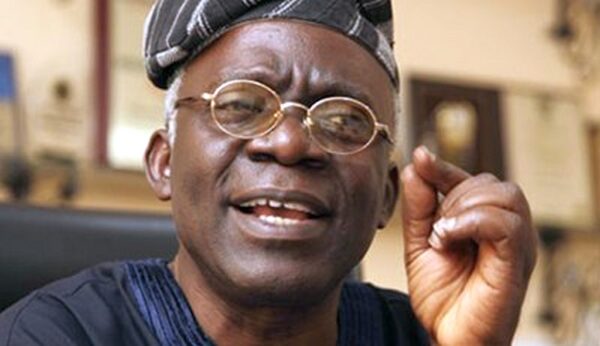
“As the 2027 elections approach, the State must protect lives, enforce electoral laws and punish those who sponsor or perpetrate political violence, irrespective of status or political connections,” Mr Falana said.
Human rights lawyer Femi Falana has urged the federal government to prosecute politicians who sponsor electoral violence, warning that attacks on political opponents and intimidation of voters threaten the credibility of the 2027 general elections.
Mr Falana, a Senior Advocate of Nigeria (SAN), said the government must go beyond arresting suspected political thugs and hold accountable those who recruit, finance and arm them.
He made the call at the sixth Frontier Discourse Annual Public Lecture Series and Awards organised by Pacesetter Frontiers Magazine at Merit House, Maitama, Abuja. The statement was shared with PREMIUM TIMES on Saturday.
In his keynote address, titled “Barrel to Ballot: The Naturalisation of Violence, Nigeria’s Polity and its Democratic Circus,” Mr Falana stated that political violence was rooted in deeper problems of governance, accountability and the failure to protect citizens’ rights.
“As the 2027 elections approach, the State must protect lives, enforce electoral laws and punish those who sponsor or perpetrate political violence, irrespective of status or political connections,” he said.
He accused politicians of recruiting unemployed youths, arming them and supplying them with money and drugs to attack opponents, disrupt political meetings and intimidate voters.
The warning comes amid reports of attacks on political figures and their supporters in different parts of the country.
The African Centre for Security, Governance and Development (CentreSGD) reported 70 physical election-related attacks across 19 states and the Federal Capital Territory between 1 January and 27 October 2026. It said 27 people were killed in 20 of the incidents.
The organisation also cited a Yiaga Africa survey which found that 61 per cent of Nigerians feared violence could prevent them from voting in the 2027 elections.
Mr Falana referred to the 30 October attack on African Action Congress presidential candidate Omoyele Sowore and members of his entourage in Ado-Ekiti, Ekiti State.
The incident generated conflicting accounts. While Mr Sowore described it as an attack by armed men, the Ekiti State Police Command said it was an altercation with another group at a restaurant.
Mr Sowore disputed the police account and questioned the identity of those arrested.
The lawyer also cited the attack on the convoy of Peter Obi, presidential candidate of the Nigerian Democratic Congress, in Calabar, Cross River State.
Police said suspected hoodlums armed with machetes and sticks attacked the convoy around Watt Market Roundabout on 4 November. They later announced the arrest of a 27-year-old suspect, Victor Duke, while investigations continued.
Mr Falana also mentioned attacks on All Progressives Congress leaders in Kebbi, Katsina and Nasarawa states, saying the incidents showed that no political party had a monopoly on political violence.
He noted that political competition should be determined by ideas and persuasion rather than intimidation and the use of force.
He urged the Independent National Electoral Commission (INEC) to establish a dedicated unit to investigate and prosecute electoral offenders.
Mr Falana advised the commission to obtain reports from the police and other security agencies, investigate alleged violations and take offenders to court.
“I am suggesting that INEC should have a prosecution unit with a view to getting reports from the police and other security agencies about electoral offences and then take them to court,” he said.
He also criticised the National Assembly for failing to implement the recommendation for an Electoral Offences Commission, arguing that the absence of an effective prosecution mechanism had allowed politicians involved in electoral violence to escape accountability.
The lawyer raised concerns about what he described as restrictions on opposition parties’ access to campaign platforms. He alleged that some state governments demanded between N150 million and N200 million for political billboards, depending on the office being contested.
He stated that the charges could make it difficult for opposition parties to campaign and give incumbent politicians an unfair advantage.
Mr Falana said the country already had constitutional and electoral provisions prohibiting the use of violence and armed groups for political purposes.
He cited Section 227 of the Nigerian constitution, which prohibits the establishment and maintenance of private political armies and other organisations equipped to use physical force or coercion to pursue political objectives.
He said the prohibition applied regardless of the names given to such groups, including political vanguards, enforcement teams and campaign protection groups.
He also referred to Section 228(a) of the Constitution and Section 78 of the Electoral Act 2026, which provide for sanctions relating to violations of the constitutional prohibition.
Under the Electoral Act, Section 95 requires the police to provide adequate security for political rallies and processions, while Section 96 prohibits the organisation and use of groups for political force or coercion. Section 97 also prohibits threats of force or violence intended to compel support for or opposition to a political party or candidate.
Mr Falana further cited Sections 120, 129, 130 and 132, which address disorderly conduct at political meetings and elections, possession of offensive weapons intended to intimidate voters, and the use of force or threats to interfere with citizens’ right to vote.
He explained that the failure to enforce these provisions, particularly against those who finance and organise political violence, remained a major problem.
“The problem is the gap between the law in the statute book and the law in operation,” he said.