The South African government has summoned Nigeria’s High Commissioner to South Africa, Femi Fani-Kayode, over his allegations that his presentation of letters of credence to President Cyril Ramaphosa was deliberately excluded from a live broadcast and his subsequent comments on social media.
The development marks an escalation of the diplomatic disagreement between the Nigerian envoy and South African authorities, with Pretoria invoking the 1961 Vienna Convention on Diplomatic Relations and insisting that official communication with the host government must be conducted through established diplomatic channels.
The Director-General of South Africa’s Department of International Relations and Cooperation (DIRCO), Zane Dangor, conveyed the government’s position during a meeting with Fani-Kayode following the controversy surrounding the presentation of credentials by the Nigerian diplomat and 14 other foreign envoys on November 13, 2026.
In a statement, DIRCO expressed concern over the developments following the ceremony and Fani-Kayode’s subsequent public comments, while stressing the importance of maintaining cordial relations between Nigeria and South Africa.
“The Director-General reaffirmed the importance of preserving the longstanding and historic bilateral relationship between South Africa and Nigeria, which is founded on mutual respect, friendship and cooperation,” the statement said.
The South African government disclosed that Dangor specifically drew the Nigerian envoy’s attention to Article 41 of the Vienna Convention on Diplomatic Relations, 1961, which addresses the conduct of diplomatic agents in receiving states.
According to DIRCO, the provision requires diplomatic agents to conduct official business with the receiving state through the Ministry of Foreign Affairs.
“Mr Dangor further recalled the provisions of Article 41 of the Vienna Convention on Diplomatic Relations (1961), which require diplomatic agents to conduct official business with the receiving State through the Ministry of Foreign Affairs.
“In this regard, it was emphasised that all official communication should be conducted through established diplomatic channels, including DIRCO,” the South African government stated.
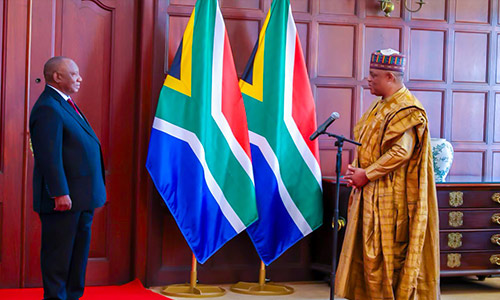
The diplomatic dispute followed the November 13 presentation of letters of credence to President Ramaphosa at the Sefako Makgatho Presidential Guest House in Pretoria.
Fani-Kayode was among 15 foreign diplomats who presented their credentials to the South African President during the ceremony.
However, the Nigerian envoy subsequently alleged that the portion of the Presidency’s livestream featuring his introduction and speech had been deliberately excluded, while the presentations of other diplomats were broadcast.
He claimed that the transmission was interrupted before he delivered his address and resumed only after he had completed his presentation to Ramaphosa.
The High Commissioner maintained that the circumstances surrounding the interruption raised concerns about the treatment of Nigeria’s diplomatic representation during the event.
According to Fani-Kayode, he subsequently brought the matter to the attention of President Ramaphosa, who intervened and directed officials to address the complaint.
However, the South African Presidency disputed aspects of the Nigerian envoy’s account.
President Ramaphosa’s spokesperson, Vincent Magwenya, explained that the President had referred Fani-Kayode to Sophie Mokoena, the acting political and foreign editor of the South African Broadcasting Corporation (SABC), to address his concerns about the broadcast.
Magwenya maintained that Ramaphosa did not interfere with the editorial operations of the broadcaster.
The disagreement subsequently intensified when the Nigerian High Commission rejected Magwenya’s explanation and criticised his handling of the matter.
The mission insisted that President Ramaphosa had intervened following Fani-Kayode’s complaint, maintaining its position despite the Presidency’s contrary explanation.
The public exchanges between the Nigerian diplomatic mission and the South African Presidency widened what initially appeared to be a disagreement over television coverage into a diplomatic controversy.
The SABC also intervened in the dispute, defending its coverage of the credentials ceremony and emphasising its independence as a public service broadcaster.
In a statement issued on Sunday, the broadcaster maintained that its editorial decisions were separate from the livestream arrangements managed by the South African Presidency.
It explained that the ceremony was covered through its SABC News LIVE channel on SABC+ and that footage showing Fani-Kayode’s arrival was aired on its television platform.
The broadcaster also disclosed that footage of the Nigerian envoy interacting with President Ramaphosa had been published on its official social media account.
The SABC expressed regret that Fani-Kayode declined an invitation for an interview following the ceremony.
It nevertheless indicated its willingness to engage with the Nigerian High Commissioner and the Nigerian diplomatic mission over the matter.
However, the broadcaster’s explanation did not directly resolve Fani-Kayode’s complaint concerning the omission of his speech from the South African Presidency’s livestream.
The Presidency subsequently released a recording containing the Nigerian envoy’s address, although the release did not immediately bring the disagreement to an end.
Reports concerning the original transmission indicated that the broadcast appeared to experience a technical problem during the presentation by the French Ambassador, Antoine Michon, who spoke immediately before Fani-Kayode.
The available accounts did not establish that the interruption was deliberate or specifically targeted at the Nigerian envoy.
Despite this uncertainty, the disagreement continued through public statements involving Fani-Kayode, the Nigerian High Commission, the South African Presidency and the SABC.
It was against this background that DIRCO summoned the Nigerian diplomat to communicate Pretoria’s concerns and remind him of the diplomatic procedures governing official engagement with the host government.
By invoking Article 41 of the Vienna Convention, South African authorities emphasised the importance of conducting official diplomatic business through recognised institutional channels rather than public exchanges that could heighten tensions between the two countries.
The development also brought renewed attention to the relationship between Nigeria and South Africa, two of Africa’s major economies with longstanding political, diplomatic and economic ties.
Although the countries have maintained extensive bilateral relations, their relationship has periodically experienced tensions arising from attacks on foreign nationals, immigration-related disputes and concerns over the treatment of Nigerian citizens living in South Africa.
Nigerian authorities and lawmakers have previously expressed concerns about attacks, harassment and other incidents involving Nigerians in the country.
The latest disagreement has therefore raised fresh questions about the management of diplomatic communications between Abuja and Pretoria, particularly where disputes involving representatives of the two governments become matters of public controversy.
However, despite summoning the Nigerian envoy and raising concerns about his public remarks, South Africa maintained that its relationship with Nigeria remained important.
DIRCO reaffirmed Pretoria’s commitment to strengthening the strategic partnership between the two countries and sustaining constructive diplomatic engagement based on mutual respect, cooperation and African solidarity.
The South African government emphasised the need to preserve the longstanding relationship while ensuring that diplomatic interactions complied with established international procedures.
The controversy remains centred on Fani-Kayode’s allegation that his presentation was deliberately omitted from the Presidency’s livestream, the competing explanations provided by South African officials and the subsequent public exchanges that prompted Pretoria’s diplomatic intervention.
While the Nigerian envoy has maintained his position concerning the broadcast, the available accounts have not established that the interruption was intentional.
The post “Follow Diplomatic Channels” — South Africa Summons Fani-Kayode Over Social Media Remarks, Invokes Vienna Convention appeared first on TheNigeriaLawyer.