The Muslim Ummah of South West Nigeria has elected Alhaji Rafiu Adisa Ebiti as its new President, calling the Federal Government to intensify efforts to address the economic challenges confronting millions of Nigerians.
The call for urgent intervention was made by the immediate past President of MUSWEN, Alhaji Rasaki Oladejo, in his opening address at the organisation’s 11th General Assembly held at the University of Ibadan Mosque Hall on Sunday.
Ebiti succeeds Oladejo, whose six-year tenure began in November 2020 and ended on Sunday, 15th November, 2026.
Oladejo acknowledged that Nigeria’s economy had begun to show signs of recovery, attributing the progress to government reforms, including the removal of petroleum subsidies, foreign exchange market adjustments and changes in tax administration.
He said the reforms had improved government revenue, strengthened external reserves and advanced macroeconomic stability, but stressed that their benefits were yet to adequately reflect in the living conditions of ordinary Nigerians.
According to him, the high cost of living, inflation, poverty, unemployment and inadequate infrastructure remain major concerns requiring urgent attention.
Citing World Bank figures, Oladejo said Nigeria’s economy grew by 4.2 per cent in the first half of 2026, compared with 3.9 per cent in the corresponding period of 2025.
He said the growth was encouraging but insisted that economic expansion must translate into improved living conditions for citizens.
While commending the Federal Government’s poverty reduction and primary healthcare initiatives, including reported improvements in pension benefits and the expansion of health insurance coverage to about 60 million people, he called for sustained and expanded interventions.
He urged the government to invest more in roads, railways, housing, education, healthcare and other critical infrastructure to stimulate economic activities, generate employment and improve living standards.
The outgoing MUSWEN president also called on governments at all levels to ensure that the benefits of economic reforms reach ordinary Nigerians, particularly those at the grassroots, through transparent, accountable and compassionate policies.
On the 2027 general elections, Oladejo urged Muslims in the South-West to participate actively in the electoral process and vote for candidates who would demonstrate fear of Allah, integrity, fairness, justice and compassion in leadership.
He described leadership as a sacred trust, warning that the choices Nigerians make at the polls would shape the future of their communities and the country.
Oladejo disclosed that MUSWEN’s endowment fund had grown to over N400 million, expressing the hope that the incoming administration would increase it to N1 billion.
He also recalled the organisation’s donation of N50 million to victims of the 2024 floods in Borno State, describing the gesture as an expression of Islamic compassion beyond geographical and regional boundaries.
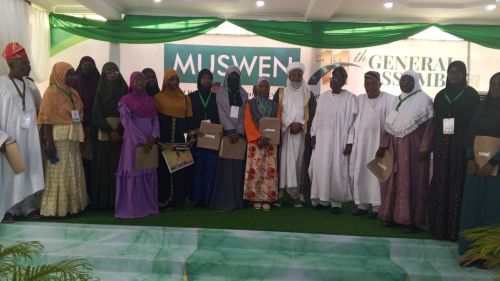
On education, he said MUSWEN had continued to support human capital development through its Sultan Abubakar Female Medical Student Scholarship Scheme, under which 12 female medical students, representing two from each South-West state, received scholarship cheques.
He disclosed that the organisation planned to award 120 bursaries in 2027, with a long-term target of providing 600 annual bursaries.
Oladejo congratulated Ebiti on his recent appointment as Pro-Chancellor and Chairman of the Governing Council of Crescent University, Abeokuta.
He also appreciated journalists, including Alhaji Femi Abbas, Alhaji Nojim Jimoh and Alhaji Mikail Adegoke Mumuni, as well as MUSWEN Executive Secretary, Prof. Wole Abbas, and the organisation’s staff for their support throughout his tenure.
In his remarks, the Chairman of MUSWEN Board of Trustees, Dr Abdul Rauf Wale Babalakin, challenged Muslims to take the lead in the deployment of technology and collaborate with government and security agencies to tackle insecurity.
He emphasised the need for integrity and accountability in resource mobilisation and urged members to renew their commitment to the growth and sustainability of the organisation.
The assembly was held under the theme: “Insecurity in Nigeria: Technology-Driven and Collective Approach for National Development.”
In his acceptance speech, the newly elected President, Ebiti, condemned violence against innocent citizens, stressing that Islam upholds the sanctity of human life and rejects terrorism, kidnapping and murder committed in its name.
He pledged MUSWEN’s support for professional and accountable security agencies, intelligence sharing, early-warning systems and constitutionally grounded decentralised policing as part of efforts to address insecurity.
Ebiti identified institutional sustainability, education, youth and women’s empowerment, Zakat, Waqf and the endowment fund as major priorities of his administration.
Other areas of focus, according to him, include advocacy for religious rights and good governance, security and peace-building, Muslim unity, interfaith harmony and peaceful coexistence.
He promised to strengthen MUSWEN’s institutions through improved administration, transparent financial management, digital infrastructure and measurable performance standards.
The new president also pledged to promote environmental responsibility and equip young people with the skills required to participate effectively in the digital and green economies.
Calling for collective responsibility, Ebiti urged Islamic scholars, professionals, entrepreneurs, women, youths and elders to contribute their knowledge, skills and resources to the development of the Muslim community.
He stressed that MUSWEN would remain strictly non-partisan while engaging constructively with governments on issues bordering on education, employment, security, healthcare, poverty reduction and the protection of citizens’ rights.