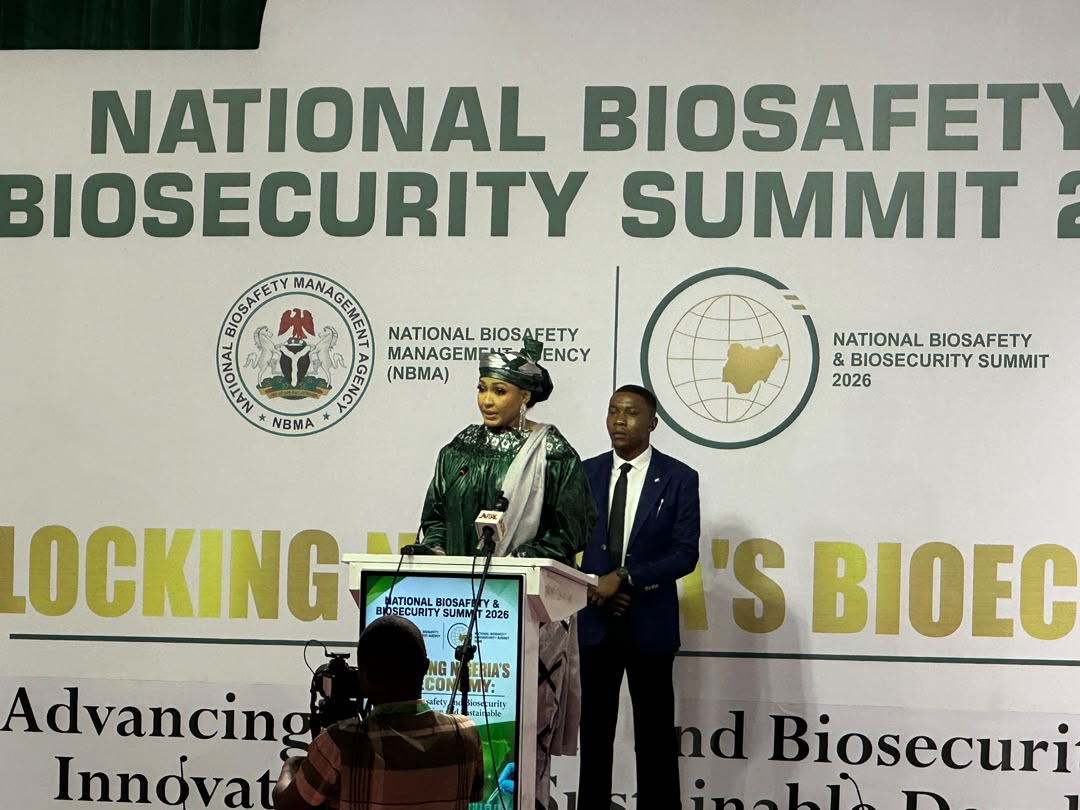
The NBMA says it has established a surveillance team to conduct inspections of supermarkets and retail outlets every two months to ensure that genetically modified products sold in Nigeria have the required regulatory approval
The National Biosafety Management Agency (NBMA) has announced plans to commence bi-monthly surveillance of supermarkets and retail stores across Nigeria to ensure that Genetically Modified Organism (GMO) products offered for sale have the required regulatory approval.
The Director-General of NBMA, Fatima Sulaiman-Zuntu, disclosed this while delivering her remarks at Nigeria’s National Biosafety and Biotechnology Summit in Abuja on Thursday.
In her remarks, she outlined measures the agency is implementing to strengthen the monitoring and regulation of genetically modified products and other biotechnology-related activities in the country.
Mrs Sulaiman-Zuntu said the agency had established a supervision team that would conduct scheduled surveillance visits to supermarkets and retail outlets every two months to identify unauthorised products and ensure compliance with Nigeria’s biosafety regulations.
“To strengthen monitoring within the country, we have also set up a supervision team to conduct scheduled surveillance visits every two months in supermarkets and retail stores. The team checks that GMO products being offered for sale have the appropriate NBMA approval,” she said.
The summit was organised amid lingering concerns over Nigeria’s recent adoption of several genetically modified crops/seeds, in an effort to achieve food security.
The debate over GMO adoption in Nigeria has remained highly polarised. Critics, including environmental activists and public health scientists, have raised concerns about the lack of publicly available, independent, long-term risk assessments and feeding trials for approved GMO products.
Other concerns include inadequate labelling of genetically modified products and the potential for patent restrictions on GM seeds, which could affect farmers’ access to and control over seeds.
Past PREMIUM TIMES coverage/investigations and editorials have questioned the composition of biosafety oversight bodies, short public comment windows, and limited public consultation before approvals.
In her remarks, the NBMA chief explained that the initiative was part of broader efforts to strengthen the agency’s regulatory oversight and ensure that biotechnology products entering the Nigerian market meet established safety requirements.
The NBMA chief executive said the agency was also strengthening border surveillance to prevent the unauthorised entry of regulated products and materials into the country.
According to her, the agency has commenced the process of onboarding onto the National Single Window, a move expected to improve coordination with other government agencies responsible for monitoring the movement of goods across Nigeria’s borders.
She said the platform would improve the agency’s access to information on relevant imports, facilitate the verification of regulatory approvals and help prevent the entry of regulated products without the necessary authorisation.
“This is an important step in strengthening border biosafety and enforcement,” she said.
Mrs Sulaiman-Zuntu also disclosed that the agency had taken enforcement action against the importation of seeds without the required NBMA approval, including their disposal.
She maintained that the agency’s regulatory responsibility was not to obstruct biotechnology innovation or legitimate trade but to ensure that all regulated activities and products complied with the law.
“Our role is not to stand in the way of innovation or legitimate trade. It is to ensure that all regulated activities and products comply with the law and that the safety of Nigerians, our agriculture and our environment is not compromised,” she said.
Beyond market surveillance, the director-general said NBMA was automating and digitalising its regulatory and administrative processes to improve transparency, efficiency and accountability.
She said work on the digital platform was at an advanced stage and would soon become operational. The platform is expected to improve application and permit processing, record management and compliance monitoring.
She also said the agency had completed validation of the National Guidelines on Progeny Lines and Hybrid Seeds derived from Biotechnology-based Hybrid Seed Systems.
According to her, the guidelines would provide regulatory direction as new biotechnology and seed systems emerge.
The agency has equally reviewed and validated the National Guidelines for High Consequence Agents and Toxins as part of efforts to strengthen Nigeria’s biosecurity framework and improve the safe management of biological agents and toxins that could pose serious risks if mishandled or misused.
Mrs Sulaiman-Zuntu further announced the development of NBMA’s first Strategic Roadmap, covering 2026 to 2030, which she said would provide a framework for strengthening the agency’s institutional capacity, regulatory systems and enforcement activities.
She said the agency was also taking steps to ensure the domestication and implementation of Nigeria’s National Biosafety and Biosecurity Policy at state and local government levels.
The initiative, she explained, is intended to extend biosafety and biosecurity implementation beyond the federal level to communities across the country’s 774 local government areas.
Despite the measures, Mrs Sulaiman-Zuntu acknowledged that the agency faced significant challenges, including the need for stronger regulatory presence across the country, improved technical and laboratory capacity, better institutional coordination and more effective monitoring of the country’s sea, air and land borders.
She called for sustained investment in personnel and regulatory infrastructure, stressing that biosafety and biosecurity required coordinated action among government institutions, security agencies, scientists, development partners and the private sector.
“Our response must reflect that reality. No single agency can achieve this alone,” she said.
She urged stakeholders at the gathering to identify regulatory gaps, agree on priorities and make commitments with clear responsibilities and timelines to strengthen Nigeria’s biosafety and biosecurity framework.
The director-general said the agency remained committed to supporting responsible biotechnology innovation while ensuring that public health, agriculture and the environment were protected.