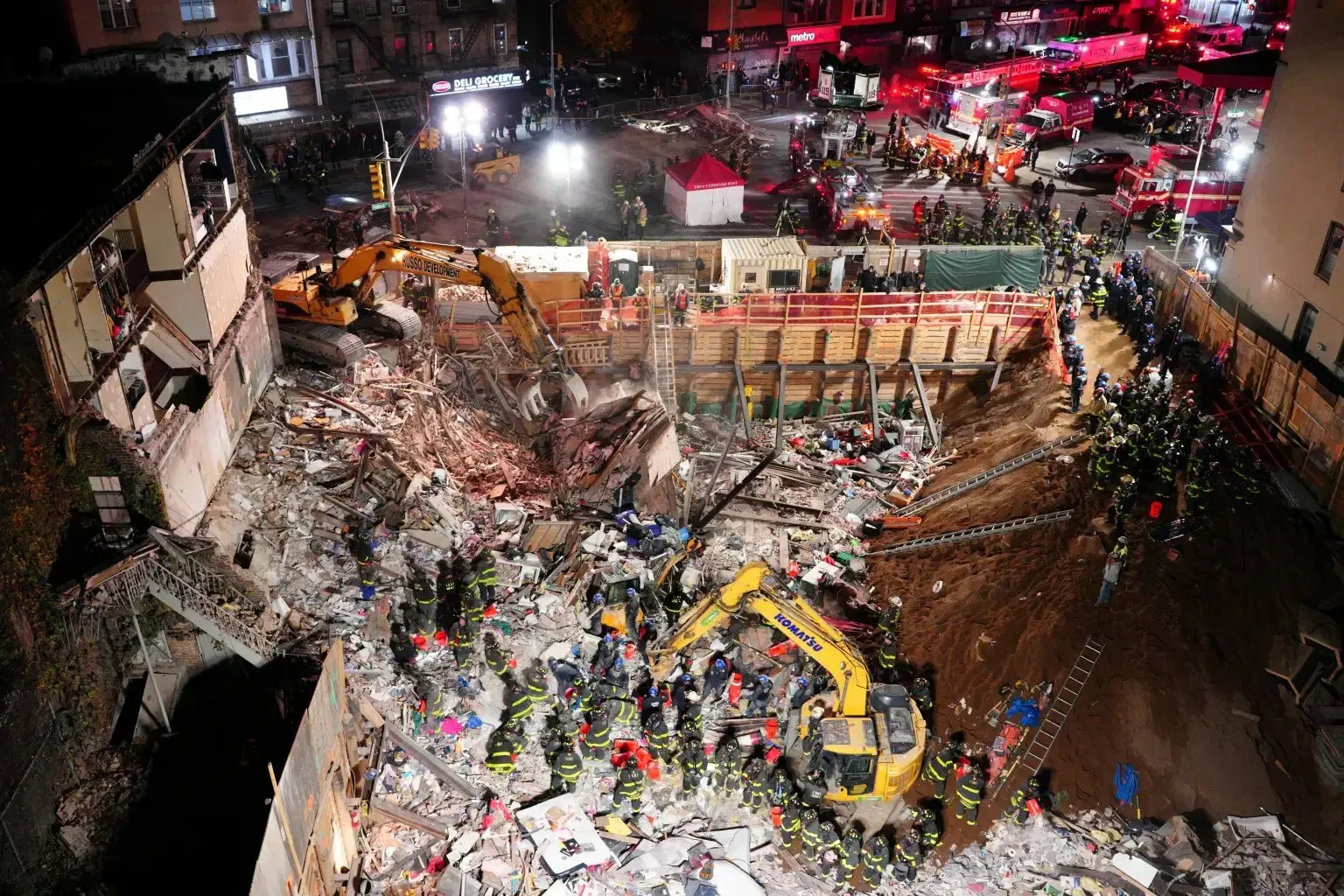
A Nigerian property owner, Olufemi Falade, whose building collapsed onto an adjoining construction site in Brooklyn, New York, killing eight people, reportedly owes more than $450,000 in unpaid taxes, water bills and government fines.
Falade has also reportedly appeared six times on the New York City Public Advocate’s annual “Worst Landlords Watchlist” over allegations of poor property management and failure to maintain his properties.
According to a report by The New York Post, an examination of New York City records showed that most of the outstanding debts were accumulated through a three-storey building at 1321 Flatbush Avenue, which collapsed on Wednesday.
The records indicated that Falade owes approximately $170,000 in fines imposed by the Department of Buildings in 2019 over improperly displayed signs.
He also reportedly owes $114,945 in unpaid water bills and $113,526 in property taxes dating back to 2021.
In addition, a 2010 federal tax lien showed that he owed the Internal Revenue Service (IRS) $49,269 in unpaid personal income taxes, while another $4,316 was reportedly owed in personal income taxes to New York State.
Before the collapse, the building had accumulated 98 outstanding violations with the city’s Department of Housing Preservation and Development, reflecting a long history of reported maintenance and safety concerns.
The violations included a leaking roof, defective doors, bedbug infestations and exposed electrical wiring. Records reportedly showed that complaints about the leaking roof dated back to 1976, with additional violations issued as recently as this year.
Falade acquired the 96-year-old property in 1999 through a company identified as Femi Realty Corp. However, in November 2024, he transferred ownership to another company under his control, Isolag Realty Corp., signing the transfer documents as both the seller and buyer, without any money changing hands.
The report further revealed that Falade was sentenced to 12 days in jail and fined $50,000 for civil contempt in 2006 after failing to address more than 1,800 violations across 12 Brooklyn properties he owned at the time.
Meanwhile, questions have emerged over the excavation work at the adjoining construction site and whether adequate measures were taken to protect neighbouring structures before the building collapsed.
According to the report, the New York City Department of Buildings approved excavation plans in March for a proposed three-storey, 25,000-square-foot mixed-use development at 2625 Bedford Avenue.
However, the approved plans allegedly failed to provide adequate structural reinforcement for the adjoining property that subsequently collapsed.
The circumstances surrounding the collapse, including the adequacy of the excavation plans and the enforcement of existing building safety regulations, have raised concerns about coordination among government agencies responsible for property inspections, construction approvals and safety enforcement.
Real estate attorney Massimo D’Angelo of Blank Rome called for improved coordination among the relevant city agencies to strengthen property safety oversight and enforcement.