CYRIACUS IZUEKWE
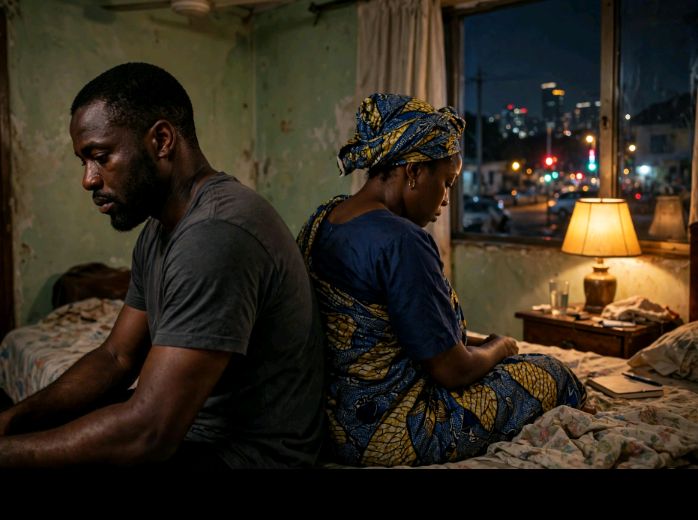
For many married couples in Lagos, the quarrel no longer starts with money or in-laws. It starts in the bedroom.
A husband comes home at 11pm after 4 hours in traffic from Lekki to Ajegunle. A wife has been up since 4:30am, cooked, dropped children in school, worked 9 hours in an office in Ikeja, and still has to wash and clean. When night comes, one wants sex, the other wants sleep. That sleep turns to one week. One week turns to one month. One month turns to three months.
Now, the National Assembly wants to turn that three months into a legal ground for divorce.
The House of Representatives is considering a bill seeking to make the denial of conjugal rights for at least three months an additional ground for divorce in Nigeria.
The bill, sponsored by Hon. Dominic Okafor, representing Aguata Federal Constituency of Anambra State, seeks to amend the Matrimonial Causes Act, 2004. It was read for the first time on Tuesday, November 17, 2026, and is now awaiting second reading where lawmakers will debate it.
Under the proposal, a spouse who has “habitually and constantly denied or deprived” the petitioner of conjugal rights for a period of not less than three months could face divorce proceedings.
The same bill also seeks to recognise threats or infliction of grievous bodily harm, as well as emotional and psychological trauma, as grounds for seeking dissolution of a marriage.
But the bill does not yet specify how courts will prove denial or trauma. It has not become law. It must still be passed by the National Assembly and signed by the President.
Divorce in Nigeria is no longer a whisper. It is now a statistic.
An analysis of Nigeria Divorce Data Estimate for 2026 puts the latest national divorce rate at 3.10 per cent, with year-on-year growth of 11.41 per cent and five-year cumulative growth of 35 per cent.
Urbanised states like Lagos, Kano, Kaduna, and Rivers show higher concentrations. And 62 per cent of divorces are now initiated by wives, compared to 38 per cent by husbands.
Another report is even more alarming. The National Bureau of Statistics (NBS) estimated in its 2025 report that nearly 45% of Nigerian marriages collapse within the first 10 years, with the highest rates recorded in urban centres such as Abuja, Lagos, and Port Harcourt.
Nigeria ranked 11th out of 26 surveyed countries in 2023, with a crude divorce rate of 2.9 per 1,000 people. In 2023 alone, Nigeria recorded a divorce rate of 2.9 per cent, placing the country among the top 26 globally.
Regionally, the South-South zone recorded the highest marital dissolution rate at 7.2%, while the North-West recorded the lowest at 1.3%.
In Lagos alone, lawyers are feeling the heat. One Lagos-based lawyer, Fidelia Ihejirika, told Saturday Sun that her law firm filed 18 divorce petitions between January and July 2026, with infidelity and domestic violence accounting for the majority. In that same firm, infidelity accounted for about 60 per cent of the petitions.
For working-class couples, denial is rarely about wickedness. Most times, na exhaustion.
Research on Nigerian couples found a high level of marital dissatisfaction and instability among working-class couples, linking it to economic hardship and increasing occupational pressures.
In Lagos, the pattern is familiar. A man leaves home by 5am to beat traffic, works 10 hours, does a side hustle to pay school fees, returns home drained. A woman does the same, plus the unpaid second shift at home – cooking, children, extended family.
By night, the body is gone. Sex becomes another task, not pleasure. Marriage experts say when stress dominates the mind, sexual desire rarely survives.
Other working-class triggers include long commuting hours due to traffic, job insecurity and delayed salaries, poor work-life balance, unrealistic targets, multiple jobs, and economic instability.
Phones have also made it worse. Work no longer ends at the office. WhatsApp work groups, emails at night, and online businesses keep couples mentally elsewhere even when they are physically together.
In many homes, denial has also become a weapon. When a husband loses financial power, or when a wife feels cheated, sex becomes a bargaining tool. Experts warn that using sex as a tool for revenge is cancerous to marriage and should be avoided.
A Consultant Obstetrician and Gynaecologist, Dr Eric Okunna, said sex should not be used as a tool for revenge because it could lead to home breakup. He said sex helps create connection and relaxes tensed nerves.
Lawyers say the new bill will open a floodgate if it passes, but they ask: How will a judge prove that denial happened for three months? Will it be by testimony alone? Will it turn private bedroom matters into public court drama?
Pastors and counsellors say the law cannot fix what communication has broken. They argue that couples need rest, counselling, and shared housework, not just divorce papers.
Marriage counsellors interviewed for this feature say the real solution for working-class couples is not to count 90 days. It is to reduce stress: share chores, create phone-free nights, sleep early at least twice a week, and talk about sex without shame.
For now, the bill is still just a bill. But the debate it has started in Lagos homes, churches, mosques, and WhatsApp groups is already real.
Because for many couples, the question is no longer: “Do we still love each other?”
The question is: “When last did we touch each other?”