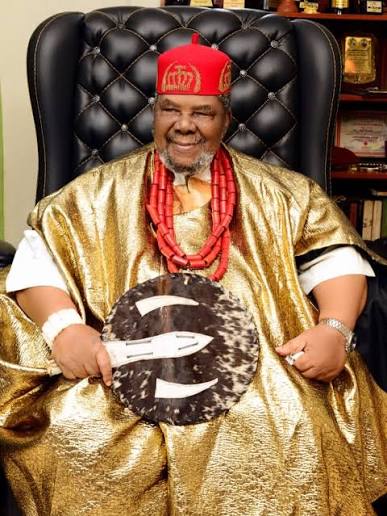
Whether portraying a powerful traditional ruler, a wealthy patriarch, a feared community leader or a father dispensing hard lessons, Edochie possessed a screen presence that few actors could replicate….
Whether portraying a powerful traditional ruler, a wealthy patriarch, a feared community leader or a father dispensing hard lessons, Edochie possessed a screen presence that few actors could replicate.
He was the man whose measured delivery, penetrating gaze, imposing personality and mastery of proverbs made him one of the most recognisable faces in African cinema.
But behind the imposing characters was a broadcaster who found his way into acting, a family man who built a career spanning decades and an actor whose portrayal of one fictional character would eventually define his place in Nigerian entertainment history.
Chief Peter Uwadiegwu Ogugua Edochie, popularly known as Pete Edochie, died in Enugu in the early hours of Wednesday, November 25, 2026, aged 79, following a prolonged battle with prostate cancer.
His death was announced by his son, Leo Pete Edochie, in a statement issued on behalf of the family.
The family described him as a beloved husband, father, brother and kinsman, adding that funeral arrangements would be announced later.
His passing marks the end of an extraordinary chapter in the history of Nollywood and Nigerian television.
From Broadcasting To The Big Screen
Born on March 7, 1947, in Zaria, Kaduna State, Edochie was of Igbo origin and hailed from Nteje in Oyi Local Government Area of Anambra State.
He spent his formative years in northern Nigeria, where he attended St Patrick’s and St James Primary School before proceeding to St John’s College.
His early interest in storytelling and performance would eventually lead him into broadcasting, a profession that laid the foundation for his later success in the entertainment industry.
In 1967, at the age of 20, Edochie joined the Eastern Nigerian Broadcasting Service as a junior programmes assistant. He steadily rose through the ranks, becoming Director of Programmes and subsequently serving as Deputy Managing Director and, on some occasions, Acting Managing Director of the broadcasting organisation.
He also studied journalism and television at the School of Journalism and Television in England, strengthening his understanding of broadcasting and media production.
His years in broadcasting sharpened the deep, authoritative voice and communication skills that would later become defining features of his acting career.
Although he had established himself professionally in broadcasting, the world of entertainment had other plans for him.
The Okonkwo That Nigeria Would Never Forget
Edochie’s defining moment came in 1987 when he played Okonkwo in the Nigerian Television Authority’s television adaptation of Chinua Achebe’s celebrated novel, Things Fall Apart.
The production, based on Achebe’s 1958 literary masterpiece, introduced millions of viewers to his extraordinary acting abilities.
As Okonkwo, a respected warrior and influential figure in the fictional Umuofia community, Edochie delivered a performance that captured the character’s strength, pride, ambition, fear and tragic inability to adapt to a changing society.
He brought to life a man determined to protect his reputation and resist anything he considered a sign of weakness.
His portrayal was so convincing that, for many viewers, it became difficult to separate the actor from the character.
The role also earned him international recognition, with the British Broadcasting Corporation (BBC) reportedly sending a delegation to Nigeria to interview him about his performance.
Decades later, Okonkwo remained the character most closely associated with his name.
It was a remarkable achievement: an actor had taken a literary character and given him such a powerful screen identity that generations of Nigerians would continue to remember both the character and the man who portrayed him.
Building An Enduring Nollywood Legacy
Following the success of Things Fall Apart, Edochie became one of the most sought-after actors in Nigeria.
He featured in numerous Nigerian films, establishing himself as a dependable performer whose presence often gave productions an added sense of authority and credibility.
Among his notable works were Igodo, Billionaire’s Club, The Greatest Harvest, Test Your Heart, Heavy Battle, Mark of the Beast and Lionheart.
In Igodo, he demonstrated his ability to embody the wisdom and authority of an elder entrusted with the welfare of his community.
His appearance in Genevieve Nnaji’s 2018 film Lionheart also introduced his talent to audiences who may have been more familiar with the newer generation of Nigerian filmmakers and actors.
However, reducing his talent to these character types would be an injustice.
He understood the emotional and psychological dimensions of the characters he portrayed, often communicating their fears, disappointments, ambitions and convictions through subtle expressions and carefully measured dialogue.
His deep voice became one of Nollywood’s most recognisable trademarks, while his delivery of Igbo proverbs and traditional expressions helped preserve elements of African oral culture on screen.
He was also among the actors whose careers helped establish Nollywood as a major force in African entertainment.
According to reports, he appeared in more than 200 film productions over the course of his career.
In 2003, he received the national honour of Member of the Order of the Niger (MON) from the administration of former President Olusegun Obasanjo.
He also received recognition from the Africa Movie Academy Awards and Africa Magic for his contribution to African cinema.
Among the honours associated with his career were the Africa Film Academy Lifetime Achievement Award and the Africa Magic Viewers’ Choice Awards Industry Merit Award.
These recognitions reflected his place among the pioneers and most influential figures in Nigerian filmmaking.
Beyond the awards, his greatest achievement was perhaps the respect he commanded across generations of actors, filmmakers and audiences.
He was one of those performers whose appearance in a film immediately communicated that a significant character had entered the story.
https://www.tvcnews.tv/breaking-pete-edochie-dies-at-79-after-battle-with-prostate-cancer/
Family Life and The Edochie Dynasty
His influence on Yul’s acting career was evident, particularly in the younger actor’s early screen appearances, where the resemblance in their commanding delivery and choice of roles was often noted.
The elder Edochie, however, remained an unmistakable personality in his own right, with a career and reputation established long before his son entered the industry.
His family also stood by him during previous false reports of his death.
In February 2026, following another viral death rumour, his son Leo publicly dismissed the reports, describing them as false.
Pete himself had complained that he had been declared dead on social media several times over the years.
In an interview with Vanguard at the time, he said he was alive and would die only when his maker called him home.
Ironically, the actor whose death had repeatedly been falsely announced has now been confirmed dead by his family.
He also became a familiar voice in public conversations about culture, family, morality and the changing values of Nigerian society.
For younger audiences, his appearances in contemporary productions and online comedy skits demonstrated the remarkable staying power of his personality.
Even when he was not playing a king, his screen presence often carried the weight of one.
His influence was also evident in the way subsequent generations of actors approached the portrayal of fathers, elders and traditional rulers.


Few actors succeeded in making their screen personalities so instantly recognisable that a particular voice, facial expression or manner of speaking could identify them even before their names appeared in the credits.
Edochie achieved that distinction.
A Final Curtain On An Extraordinary Career
For those who grew up watching Things Fall Apart, he will forever be Okonkwo: the proud warrior whose tragic struggle against change became one of the most memorable performances in Nigerian television history.
For others, he will be the uncompromising father, the wise elder, the traditional ruler and the man whose words often sounded like proverbs handed down through generations.
His voice may have fallen silent, but the characters he brought to life will continue to speak to audiences.
Pete Edochie leaves behind his wife, children, grandchildren, an extensive body of work and a legacy firmly embedded in the history of Nigerian cinema.
The curtain has fallen on Ebubedike, but his place in Nollywood’s history is assured.
May his soul rest in peace.