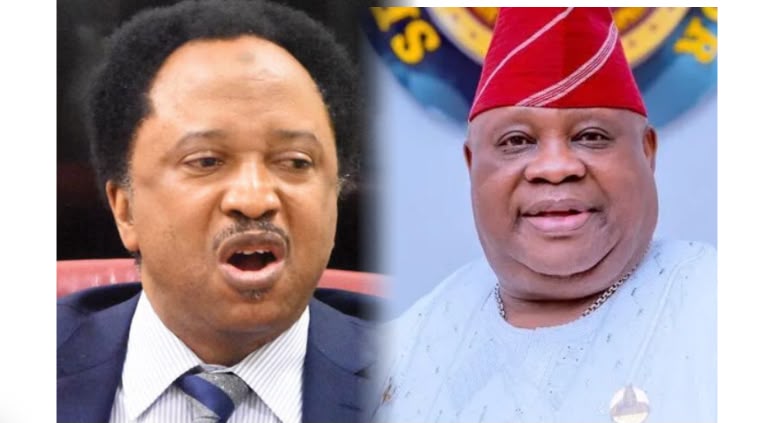
Former Kaduna Central senator Shehu Sani has urged Governor Ademola Adeleke to devote his second term to strengthening public institutions, resolving the local government dispute, improving public services and creating more productive jobs
Former senator Shehu Sani has urged Osun State Governor Ademola Adeleke to use his second term to resolve the state’s prolonged local government crisis, strengthen public institutions and ensure greater transparency in the management of public funds.
Mr Sani said the governor’s renewed mandate should be an opportunity to consolidate achievements, address shortcomings and build institutions capable of functioning beyond his administration.
He made the call in a keynote address titled “Beyond the Ballot Box: Subnational Governance, Institutional Independence and the Future of Democracy in Nigeria”, prepared for Mr Adeleke’s second-term inauguration scheduled for Friday.
According to the former Kaduna Central senator, winning an election is only the beginning of democratic governance. The real test lies in whether public institutions function effectively and improve citizens’ lives.
“Elections determine who occupies public office. Institutions determine how that office is exercised. Governance determines whether the exercise of power improves the lives of citizens,” he said.
Mr Sani argued that democracy should be measured by the quality of public schools, healthcare facilities, roads, security and employment opportunities available to residents, rather than the periodic conduct of elections.
He urged Mr Adeleke to ensure that the state’s democratic process translates into tangible improvements in communities across Osun.
A major part of the address focused on Osun’s prolonged local government dispute, which Mr Sani described as one of the state’s most consequential challenges.
The dispute has involved competing claims over the legitimacy and control of local council administrations, legal battles and uncertainty over council operations and access to statutory funds.
Mr Sani said the crisis had disrupted grassroots administration and affected local government workers. He also noted that confrontations around council secretariats had resulted in violence and loss of life.
He said ordinary residents had borne the consequences of the political and legal disagreements, particularly those who depend on local councils for primary healthcare, sanitation, rural roads and other essential services.
“Whatever the legal and political arguments advanced by the contending parties, the ultimate cost was borne by ordinary residents,” he said.
He urged the governor to prioritise residents’ welfare, respect court decisions and pursue outstanding disputes through lawful channels.
He also called for a transparent framework for managing and publishing local government finances, including monthly disclosures of council allocations, budgets, contracts and expenditure.
Mr Sani recommended regular town hall meetings by council chairpersons and independent audits, with the findings made public.
“Local government autonomy without accountability merely transfers the problem from one level of government to another,” he said.
The former senator also called for greater independence of the legislature, judiciary, civil service, auditor-general and procurement institutions, warning against political interference in their operations.
He said the Osun State House of Assembly must be able to scrutinise government expenditure, examine policies and ask difficult questions without intimidation.
“A confident Governor should welcome a strong legislature because scrutiny improves policy and protects public resources,” he said.
He further urged Mr Adeleke to ensure that recruitment, promotion and deployment in the public service were based on competence, fairness and due process rather than political affiliation.
Mr Sani cautioned the governor against allowing political hostility at the federal level or disagreements with opponents within Osun to define the limits of his administration.
He said the best response to political obstruction was to strengthen institutions, promote transparent administration, engage strategically and demonstrate results.
Assessing the governor’s first term, Mr Sani acknowledged reported interventions in roads, schools, primary healthcare, social welfare and public finance.
He cited figures from the Osun government’s third-anniversary account, which reported that the Imole Free Surgical Scheme reached more than 70,000 people across the state’s nine federal constituencies and that 120 schools were rehabilitated.
The account also reported an increase in internally generated revenue from about ₦27.72 billion in 2023 to ₦54.7 billion in 2024. It further put the state’s domestic debt at ₦83.32 billion in early 2025, down from approximately ₦148.37 billion in December 2022.
However, Mr Sani said the claims should be independently verified, adding that residents deserved transparent data on the administration’s performance.
“The public deserves more than competing claims by government and opposition. The next stage must be characterised by independently verifiable outcomes, transparent data and a willingness to correct shortcomings,” he said.
He urged the governor to establish an independently assessed Osun State Governance and Development Scorecard, to be published annually and made accessible to the public.
The proposed scorecard, he said, should assess road conditions, school learning outcomes, the functionality of health facilities, jobs created, agricultural productivity, access to water, public debt, revenue performance, procurement compliance and local government services.
He recommended that credible professionals, universities, civil society organisations and relevant public institutions participate in the assessment.