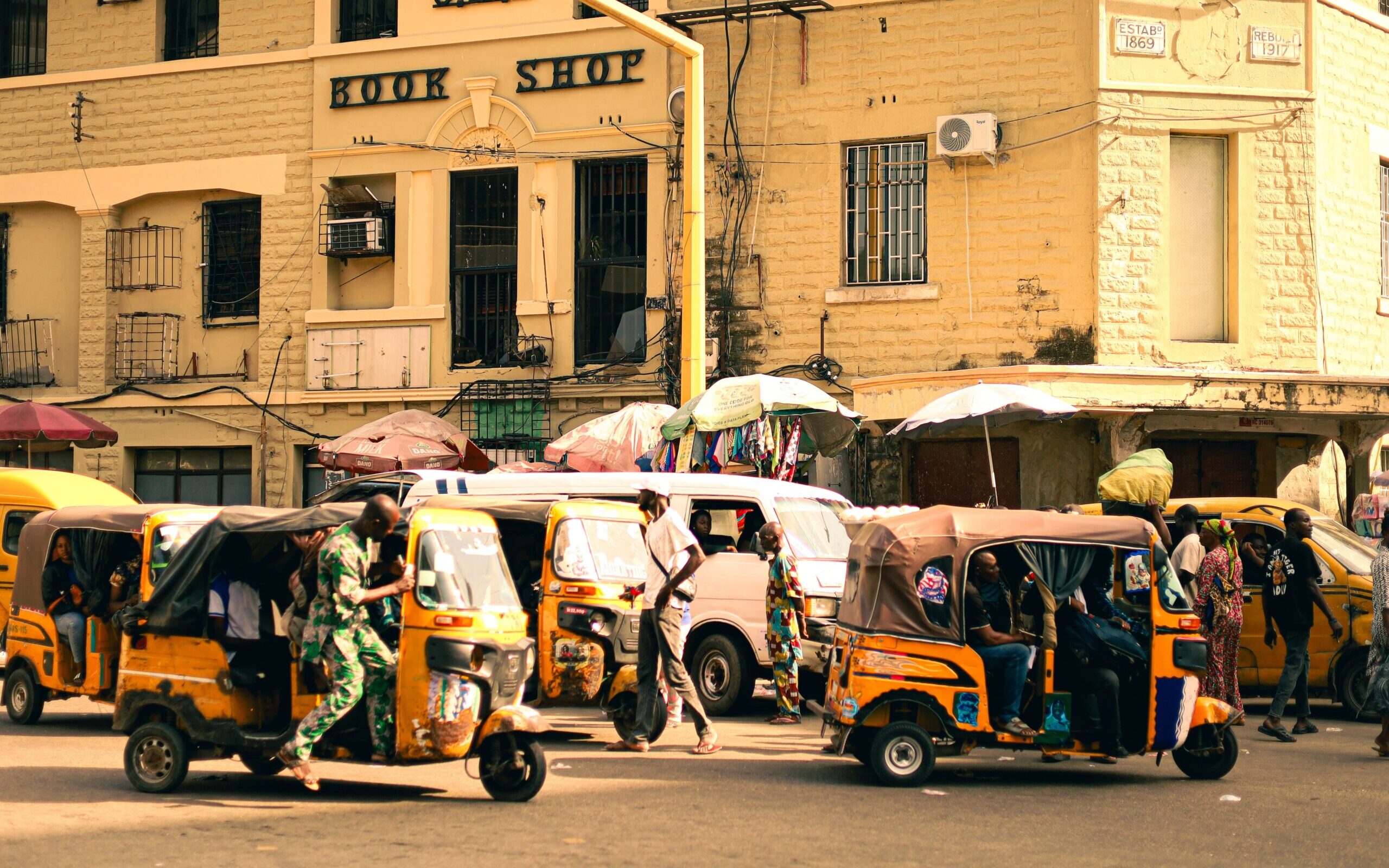
An overwhelming majority of the hundreds of commercial tricycle riders in the Nigerian capital are not licensed.
Efe Solomon had just danced hard at the University of Abuja during a Students’ Union party. He was still in a party mood as he sat on the passenger seat of his classmate’s motorcycle. At 5:00 a.m., they zoomed off towards the school gate. It was a few days before Christmas in 2025, and the road was quiet.
Then there was a loud crash. A commercial tricycle, popularly known as Keke NAPEP, crashed into them. The tricyclist was driving against traffic with no headlights, and it was too late for Mr Solomon and his friend to swerve off the road.
In a split second, Mr Solomon’s celebration turned into trauma. He had suffered a fracture and the flesh above his left kneecap was torn open with a deep, visible cut. Other party-goers who were around the location of the crash rushed him to Allied Specialist Hospital in Gwagwalada.
“When I got to the hospital, I saw blood everywhere,” Efe Fatima, Mr Solomon’s sister, fought back tears as she recalled that morning. Mr Solomon recalled grabbing his sister’s hand saying, “sister, sister, don’t worry, I will not die.”
“At that point, I was confused. I didn’t know what to say. I just started crying,” Ms Fatima said.
The family faced another crisis at the hospital. Ms Fatima said the doctor on duty told her they needed to raise N1.5 million for immediate surgery or Mr Solomon’s leg would be amputated.
“Solomon is a young boy. He is just 18 years old. Imagine an 18-year-old boy with just one leg,” Ms Fatima said, wiping the tears that formed in her eyes.
As the family fought to save Mr Solomon’s leg, claims that keke riders in Nigeria operate without training and a license continue to circulate on X.
On 10 March 2023, an X user, Odu Obodumu, posted on his page (archived here), claiming that commercial tricycle riders in Nigeria operate without a license.
“We haven’t started. The Keke NAPEP riders have no driving licence & nobody cares. They are a menace on the road. They have no idea of traffic rules. What category of licence should they possess? (I) asked a VIO who stopped me one day; he didn’t know. He said they are registered. Is registration licence?” he wrote.
In March 2024, Mr Obodumu made another post (archived here) in response to a user lamenting the reckless driving of keke riders in Abuja. Again, he repeated the claim he made in 2023.
“Keke riders are not licenced,” Mr Obodumu repeated. “What category of licence are the riders? Not A for motorcycles, not for any type of cars, not articulated vehicles. So they ride without a licence.”
Apart from Mr Obodumu, several other social media users have put up different posts questioning whether commercial tricyclists in Nigeria are ever trained or licensed. These claims are archived here, here, here, here, here, and here.
Meanwhile, on paper, Nigeria’s laws say anyone who drives any class of vehicle on public roads must be properly trained and licensed.
For example, Section 23 (1) 9 of the Federal Road Safety Corps (Establishment) Act 2007 states that no one is allowed to drive a vehicle of any class on Nigerian roads without a driver’s license. Subsection 2 outlines that offenders shall pay a fine of N10,000 upon conviction.
Similarly, Regulation 46(5) of the National Road Traffic Regulations (2012) states that “Any unlicensed person or person below 18 years who drives a vehicle or rides a motorcycle on a public road is guilty of an offence and shall on conviction be liable to a fine of N5,000.”
The Federal Road Safety Corps (FRSC) offers different classes of licenses for different categories of road users. Tricycles fall under Class A, just as with motorcycles.
Earlier in 2026, Assistant Corps Marshal (ACM) Olusegun Ogungbemide, then Corps Public Education Officer (CPEO) of the FRSC (now retired), confirmed to DUBAWA that the law does not permit any commercial tricycle to operate on Nigerian roads without a licence.
But to obtain a driver’s licence, Regulations 45(1), 57(1) and 45(3)(a) of the National Road Traffic Regulations (NRTR), 2012, require applicants to be trained in an accredited driving school and tested by the Vehicle Inspection Service (VIS).
Since public claims appear to contradict what the laws and enforcement agencies say, could it be true that the hundreds of tricyclists who transport thousands of commuters across the FCT are neither trained nor licenced by the FRSC?
To verify these claims, DUBAWA visited Kubwa, Gwarinpa, Apo Gudu, and Nyanya in the FCT. Across the four districts, we randomly interviewed 20 riders, all of whom told the same story. None of them had an FRSC driver’s license. Instead, they operated with union identity cards.
When DUBAWA asked if FRSC ever stops him to demand his rider’s license, Aminu Rabiu, a tricylist in Nyanya, simply said, “No o, road safety no dey stop me. No license, ID card only.”
We further asked how they learnt to ride keke. All 20 riders said they learned to drive keke by accompanying their elder brothers and friends for a few hours, then started carrying passengers to finish their training.
“I finish for school, I no get work wey I go do. So my brother call me say if I no do anything for my place, make I kon do this work make I manage my life before I see government work. One day he carry me enter inside road, he teach me about driving,” said Musa Bello, a tricyclist in Kubwa.
Muhammed Bello, another rider in Apo Gudu, said, “I get one brother that time when I come Abuja. He say come drive the keke, so na him teach me.”
Since none of them had been to a driving school, DUBAWA decided to test their knowledge. We printed ten basic road traffic signs on paper and asked riders to identify them. These included the stop, traffic lights, speed bump warning, no overtaking, speed limit, no parking, no turn left, no turn right, cross road ahead and slippery road signs.
Of the 20 riders, no one could identify the speed limit and slippery road signs. Only two correctly interpreted the three traffic-light colours. Five of the 20 correctly identified the speed bump signs, but 16 did not know what the “No Overtaking” sign meant. Overall, 90 per cent of the riders could not identify more than two of the ten basic road signs DUBAWA showed them.
When asked why, the riders told DUBAWA they did not know the signs because nobody had taught them.
“And all of these things are one of the challenges we riders are having because many of us did not go to driving school to know all of these signs. Train (us) so we will be able to know these signs. That’s why accidents are on the high side,” Samuel Onyewuchi, a tricyclist in Nyanya, complained.
But the problem is not just with the riders. Despite regulations requiring formal training, we did not find any FRSC-accredited driving school in Abuja offering structured training for commercial tricycle operators.
