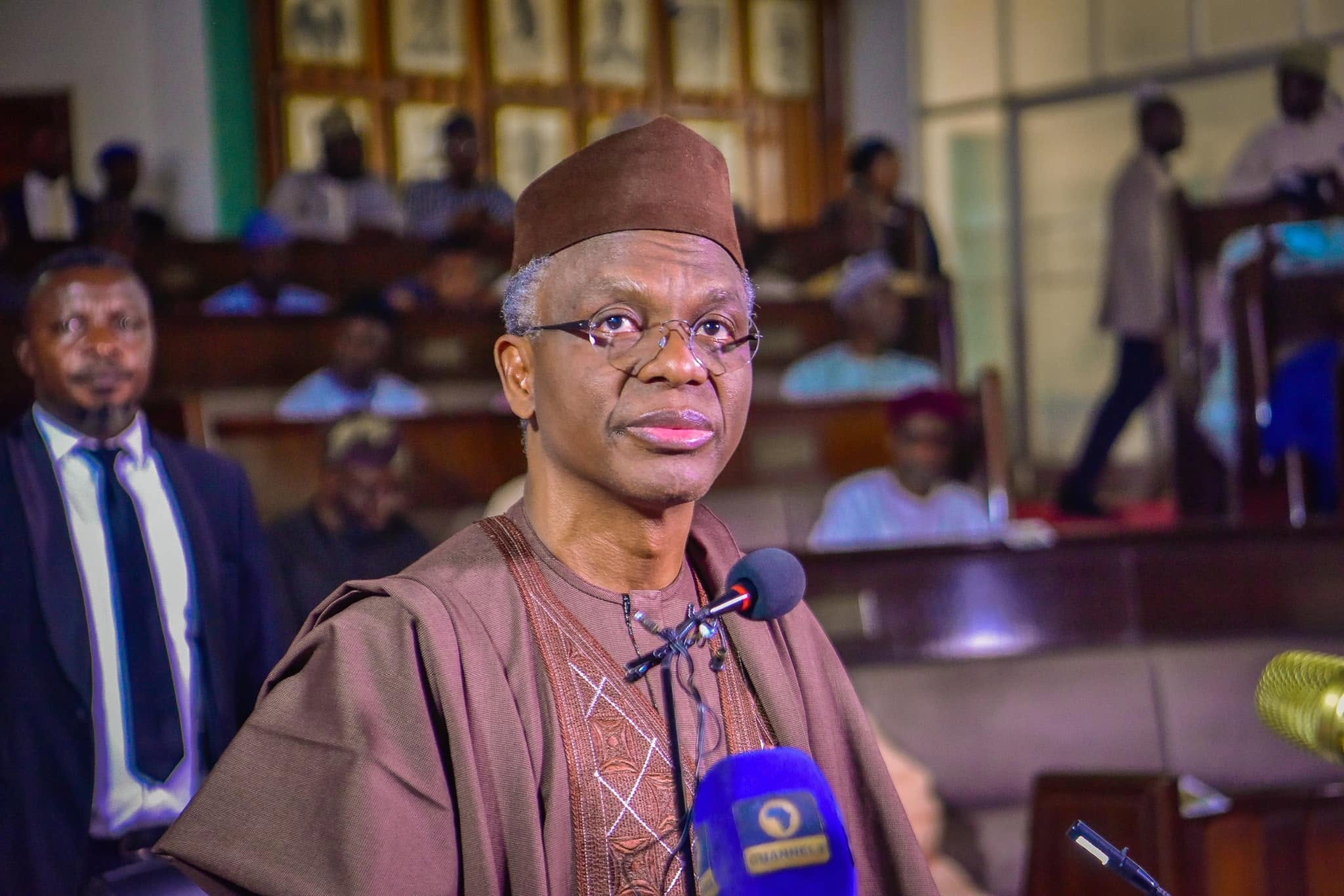
Mr El-Rufai testified in his own defence in the phone-tapping trial on Wednesday.
Former Kaduna State Governor Nasir El-Rufai on Wednesday denied intercepting National Security Adviser (NSA) Nuhu Ribadu’s telephone conversations or asking anyone to do so.
Testifying in his ongoing phone-tapping case at the Federal High Court, Abuja, before Judge Joyce Abdulmalik, Mr El-Rufai told the court that he had never owned equipment used to intercept telephone calls and had no technical knowledge of how to do so.
Led in evidence by his lawyer, Paul Erokoro, a Senior Advocate of Nigeria (SAN), the former governor also denied having access to the NSA’s communication networks or devices.
He maintained that his comments during an interview on Arise Television in February were political rhetoric and not an admission that he had intercepted Mr Ribadu’s telephone.
“I used ‘we’ to refer to opposition politicians. When I said ‘tapped’, it was an embellishment intended to make the government feel the pain we are feeling.
“It was rhetorical and exaggerated. My objective was to engage in political retort and linguistic flourish,” he told the court.
The case followed an interview Mr El-Rufai granted Arise Television’s Prime Time programme on 13 February, a day after security operatives attempted to arrest him at the Nnamdi Azikiwe International Airport, Abuja, on his return from Cairo, Egypt. Although the operatives seized his passport, they did not arrest him.
During the interview, Mr El-Rufai accused Mr Ribadu of ordering the attempted arrest. He said he knew about the directive because he and an unnamed person had listened to a telephone conversation in which the NSA instructed security operatives to arrest him.
When Arise News anchor Charles Aniagolu asked how he obtained the information, Mr El-Rufai replied, “He made the call because we listened to their calls.” He also acknowledged that intercepting telephone conversations without authorisation was illegal.
Following the interview, the SSS filed three charges against Mr El-Rufai, which were later amended and expanded to five counts.
The charges accused him of unlawfully intercepting Mr Ribadu’s telephone communications, including accessing classified information without authorisation.
He pleaded not guilty to all five counts, and the prosecution presented two witnesses.
One of the witnesses was lawyer and public commentator Deji Adeyanju, who said he was at Arise Television during the interview with Mr El-Rufai.
Mr Adeyanju confirmed that the recording played in court reflected what he witnessed, but acknowledged during cross-examination that Mr El-Rufai did not expressly say he had personally tapped the NSA’s telephone. He maintained that he heard the former governor say, “We listened to their calls.”
The prosecution closed its case in June, but instead of entering his defence, El-Rufai filed a no-case submission, arguing that the evidence presented was insufficient to require him to enter a defence.
On 26 October, Judge Abdulmalik dismissed the application after holding that the SSS had presented sufficient evidence.
She consequently ordered him to enter his defence, which began on Wednesday.
Testifying as the first defence witness in the case, Mr El-Rufai told the court that he lived in Maitama, Abuja, but had spent the past few months in the custody of the Independent Corrupt Practices and Other Related Offences Commission (ICPC).
Reacting to his statement during the interview that “we listen to their calls,” Mr El-Rufai explained that he spoke on behalf of opposition politicians and did not claim that he personally intercepted Mr Ribadu’s telephone.
He added that he knew the government regularly intercepted telephone conversations, so his comments were meant to “alert Nigerians on the government’s interception of conversations involving opposition politicians and former leaders” without court authorisation.
The former governor said his intention was to make the Tinubu administration “uncomfortable” through his criticism of its policies.
His lawyer, Mr Erokoro, also reminded him of his reference during the interview to information from a mutual friend. Mr El-Rufai said the friend had told him that he overheard the NSA ask security operatives to ensure his arrest.
He added that he regularly received such information from people within the government.
To clarify his earlier comments, the court played the interview again at the request of Mr Erokoro.
In the recording, El-Rufai was heard saying, “The government made the call that I should be in custody; someone tapped it and told me because the government thinks that they are the only ones that intercept phone calls.”
After the court played the recording, he maintained that he “did not tap” and that he “did not ask someone (to do so).”
“A mutual friend did and informed me,” he said.
He also explained that, after the interview, the same person had asked him why he used the word “tapped.”
When his lawyer asked him to identify the person, Mr El-Rufai said he could not disclose his source.
“I will not jeopardise my source in this kind of political environment, because his life will be on the line because this government can do anything,” he said.