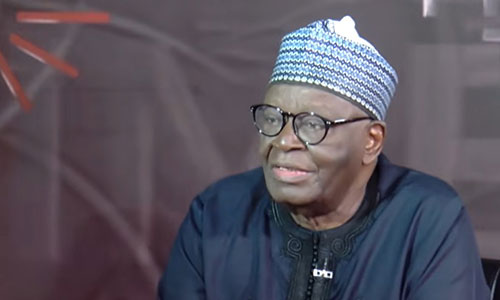
The Minister of Aviation and Aerospace Development, Festus Keyamo, SAN, is facing renewed scrutiny over his previous defence of a death warning to ballot-box snatchers after accusing the Nigeria Democratic Congress (NDC) of using the controversial “rig and die” slogan to encourage electoral manipulation ahead of the 2027 general elections.
Keyamo’s criticism has brought back comments he made during a Channels Television interview on February 19, 2019, when he defended former President Muhammadu Buhari’s warning that those who attempted to snatch ballot boxes during elections could lose their lives.
The renewed debate comes amid deadly attacks on opposition campaign activities, including the November 23 attack on the campaign team of former Deputy Senate President Ovie Omo-Agege in Delta State.
In a post on his X account on Thursday, November 26, Keyamo accused the NDC of using the slogan as a cover to mobilise its supporters to rig elections rather than merely prevent electoral malpractice.
The minister dismissed an explanation offered by the NDC presidential candidate, Peter Obi, who had maintained that the slogan was intended to discourage rigging and not to threaten people participating in legitimate political campaigns.
“There is no need for Peter Obi to clarify the ‘rig and die’ slogan and do damage control. We know what it means. The slogan is nothing but a subterfuge for them to mobilise themselves and rig the elections massively as they did in a part of the country in 2023 but still failed,” Keyamo said.
He questioned whether a political party could legitimately take responsibility for enforcing electoral laws while also participating in an election.
“If a party in a contest with other parties is sufficiently armed to play the role of law-enforcement agents, what stops that same party from rigging the elections itself? Are they saints?” he asked.
The minister argued that allowing political parties to assume enforcement responsibilities would undermine the neutrality expected in electoral contests.
“You cannot be a participant in a contest, yet you want to act as the umpire under the guise that you don’t trust the umpire! That is creating a graver absurdity than the one you’re trying to solve!” he stated.
Keyamo also rejected suggestions that the opposition was being unfairly targeted in the controversy.
“This is a classic case of the villain playing the victim,” he said.
However, the minister’s position has revived questions about remarks he made while serving as a spokesperson for Buhari’s presidential campaign ahead of the 2019 general elections.
During a televised discussion involving former Senator Dino Melaye on February 19, 2019, Keyamo defended Buhari’s directive to security agencies concerning ballot-box snatchers.
At the time, Buhari had warned that those who attempted to disrupt elections by snatching ballot boxes risked paying for their actions with their lives.
Keyamo argued that the President’s statement was legally justified and should not be withdrawn.
He maintained that individuals who violently disrupted elections could face serious criminal consequences, including prosecution for offences carrying the death penalty.
In the interview, Keyamo stated:
“Whoever wants to snatch ballot boxes, be prepared to pay for it with your life.”
He went further to argue that an offender could face fatal consequences during a violent confrontation with security personnel or face prosecution for serious criminal offences.
“If you are shot dead, that is what they call justification and excuse,” he said.
“And if you are charged to court, you will also die. Any way you do, whether you die on the spot, or you are charged to court under robbery or treason, you will still die. Either way you will die.
“Don’t snatch ballot boxes if you don’t want to die.”
Those remarks were made in February 2019, not during the 2023 elections.
The resurfacing of the interview has prompted criticism from some Nigerians who question why Keyamo previously defended such a strong warning against electoral offenders but now condemns similar language being used by opposition politicians.
One social media user, identified on X as DonAza, challenged the minister following his earlier demand that promoters of the slogan withdraw it.
The commentator questioned the connection between the slogan and the deaths recorded during the attack on Omo-Agege’s campaign team, noting that the incident occurred outside an election.
The X user also recalled Keyamo’s support for Buhari’s 2019 warning and questioned why the minister was placing emphasis on the slogan rather than the killings.
The criticism reflects the disagreement over whether the controversy should focus primarily on the language used by opposition politicians or the attacks being reported against their supporters.
Keyamo, however, has drawn a distinction between his 2019 position and the present slogan. He maintains that his earlier comments concerned the powers of authorised security agencies to respond to violent electoral offences, whereas the current slogan could encourage political supporters to take the law into their own hands.
The controversy intensified following the November 23 attack on Omo-Agege’s campaign team at Uduere in Ughelli North Local Government Area of Delta State.
Omo-Agege, the NDC candidate for Delta Central Senatorial District, escaped the attack unharmed.
His media adviser, Sunny Areh, reported that four persons were killed and four others critically injured, although other reports placed the death toll at six.
The attack came weeks after Omo-Agege used the expression during a campaign event in Uvwie, Delta State, in October.
“Anybody who rigs the election on that day, we will kill him!” Omo-Agege had declared.
He added: “It is rig and die.”
Following the attack, Keyamo condemned the killings and urged those promoting the slogan to publicly withdraw it and apologise for increasing political tension.
“It is wrong to tell your supporters to kill other citizens under whatever guise. It smacks of desperation,” he said.
The minister also called for the perpetrators of the violence to be identified and prosecuted.
Obi and his running mate, Rabiu Musa Kwankwaso, subsequently visited the families of those killed in the attack.
Speaking during an interview with Channels Television, Obi defended the intended meaning of the controversial slogan, arguing that it was directed against electoral manipulation rather than legitimate political activity.
“They said we said ‘rig and die.’ We didn’t say ‘campaign and die,’” Obi said.
He explained that the message was intended to discourage electoral fraud and encourage the conduct of free and fair elections.
The NDC presidential candidate also defended the Kwankwasiyya movement’s practice of carrying sticks to political gatherings, maintaining that he had not witnessed the objects being used to harm anyone.
Keyamo rejected Obi’s clarification, insisting that opposition supporters could not simultaneously participate in an election and assume the responsibility of enforcing electoral laws.
The exchange has left two competing arguments at the centre of the controversy.
While Keyamo maintains that electoral offences must be handled by authorised law enforcement agencies rather than political supporters, critics have questioned the consistency of his position in light of his 2019 defence of Buhari’s warning.
The distinction remains important: Keyamo’s earlier remarks concerned what he argued security agencies could lawfully do, while Omo-Agege’s statement expressly referred to killing persons accused of rigging elections.
Nevertheless, the comparison has continued to generate questions about the use of threatening language by political figures and the responsibility of those in government to discourage electoral violence.
The dispute has also drawn attention to the security of political candidates and their supporters, particularly following the deaths recorded during the attack in Delta State.
The NDC has alleged repeated attacks on its campaign activities in different parts of the country, while Keyamo has condemned the killings and called for action against those responsible.
As preparations for the 2027 general elections continue, the disagreement underscores concerns about both the protection of citizens exercising their political rights and the danger of language that could be interpreted as encouraging violence.
For those questioning Keyamo’s present position, his televised defence of Buhari’s warning in 2019 remains central to the debate.
For the minister, the issue is whether political supporters can be permitted to enforce electoral rules themselves.
The post “You Once Said Ballot Snatchers Would Die” — Keyamo Faces Questions Over 2019 Remarks As He Condemns NDC’s ‘Rig And Die’ Slogan appeared first on TheNigeriaLawyer.