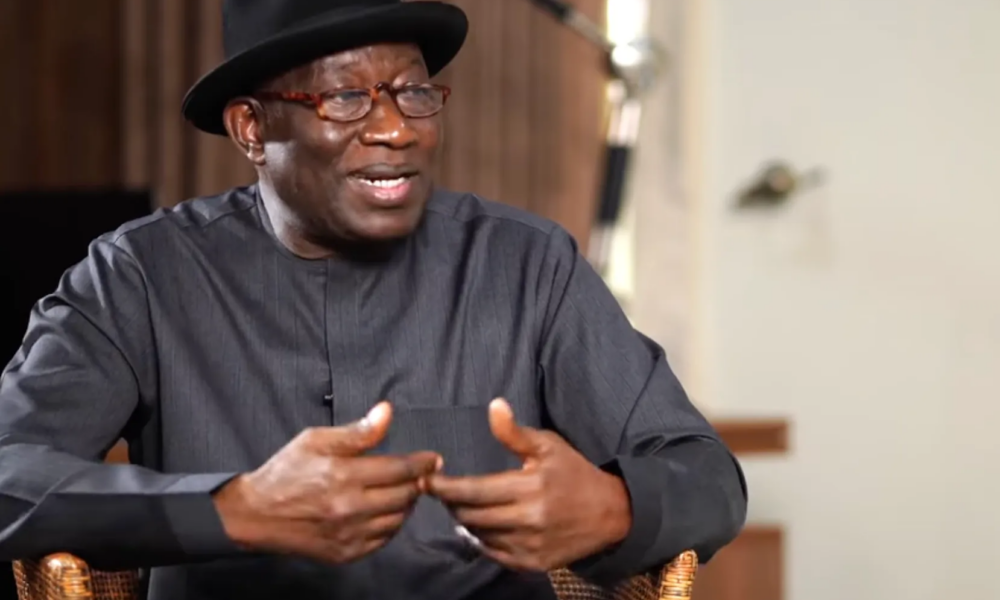
Former President Goodluck Jonathan has responded to recent criticism by former Vice President Atiku Abubakar, admitting that he made mistakes while in office but insisting he acted in the best interest of Nigeria.
Mr Atiku, a presidential hopeful on the platform of the African Democratic Congress, ADC, had described Jonathan as inexperienced, arguing that his tenure was marked by notable missteps.
“I know Goodluck Jonathan very well. He is a decent young man, but also inexperienced, and I believe that contributed to his inability to manage the affairs of the country, particularly when he was faced with challenges,” Atiku said during an interview on Arise TV.
But speaking on Monday at the 2025 Association of Retired Career Ambassadors of Nigeria awards ceremony in Abuja, Mr Jonathan dismissed the claim that his age affected his performance, noting that leadership inevitably comes with errors.
“So not too long ago, a very senior politician said, ‘Jonathan was too young and probably that’s why he made mistakes.’
“If I made mistakes, yes. Nobody who becomes a governor or a president will say you did not make mistakes. All human beings make mistakes,” he said.
Mr Jonathan noted that he assumed office in 2010 at the age of 53 and left in 2015 at 58, questioning the suggestion that he was too young to govern.
“Must it have been 100 years before I ran the affairs of the state?” he asked.
Despite acknowledging shortcomings, the former president maintained that his administration recorded significant achievements, particularly in diplomacy. He cited Nigeria’s successful bids for non-permanent seats on the United Nations Security Council as evidence of strategic leadership.
“If I were so naive, I don’t think I would have been able to navigate that process,” he added.
Mr Jonathan also used the platform to highlight broader regional concerns, warning that political instability continues to undermine economic growth across West Africa.
He stressed that without stable governance systems, meaningful development in the sub-region would remain difficult, urging leaders under the Economic Community of West African States, ECOWAS, to strengthen collaboration.
“We cannot progress economically if we are very unstable politically,” he said, adding that regional bodies must sometimes intervene in member states to uphold democratic standards, even as issues of sovereignty arise.
The former president further called on Nigerian diplomats to properly document foreign policy experiences for the benefit of future leaders.
Paying tribute to the founders of ECOWAS, including former Head of State Yakubu Gowon, Mr Jonathan described the bloc’s establishment in 1975 as a bold step towards regional integration.
Mr Gowon, who was honoured at the event, recalled that the formation of ECOWAS stemmed from post-civil war diplomatic engagements aimed at fostering unity and cooperation across West Africa.