Iran-US Islamabad talks: Regional officials say the United States and Iran have signalled they will attend a second round of peace negotiations in Pakistan — even as both governments trade sharp public warnings and a two-week ceasefire teeters on the edge of expiry. US President Donald Trump told CNBC that he doesn’t want to extend the ceasefire, signalling pressure on ongoing negotiations.
Trump also said “we don’t have that much time,” adding that the United States was negotiating from a position of strength and would “end up with a great deal.”
While Trump’s flip-flops continue, Pakistan-led mediators have received confirmation that the two top negotiators, US Vice President JD Vance and Iran’s parliament speaker Mohammad Bagher Qalibaf, will arrive in Islamabad early Wednesday, officials told The Associated Press.
Neither Washington nor Tehran has publicly confirmed the timing. Iranian state television has denied that any official is already in Pakistan’s capital. The ceasefire, which halted one of the most destructive military confrontations in the Middle East in decades, expires Wednesday.
What is happening?
The second round of US-Iran talks in Islamabad was thrown into serious doubt after Iran’s chief negotiator set stark conditions for participation. Parliament speaker Mohammed Bagher Qalibaf posted on X early Tuesday: “We do not accept negotiations under the shadow of threats,” adding that the Islamic Republic had been preparing “to reveal new cards on the battlefield.”
Trump responded with mixed signals. He said he still expected to dispatch his negotiating team, led by Vice President Vance, to Islamabad, but also declared he was “highly unlikely” to renew the ceasefire before it expires on Wednesday, and that he was in no rush to end the conflict.
Iranian state television, long controlled by hard-liners within the country’s theocracy, amplified the impasse with an on-screen alert stating that “no delegation from Iran has visited Islamabad … so far.” The alert, analysts say, reflected the internal debate ongoing within Iran’s leadership as it weighs its response to a weekend US naval seizure of an Iranian container ship.
Story continues below this ad
Four triggers behind Iran’s refusal
- US Naval blockade of the Strait of Hormuz: Iran’s Foreign Ministry spokesperson Esmaeil Baghaei accused Washington of having “violated the ceasefire from the beginning of its implementation.” The specific grievance: the US naval blockade of the Strait of Hormuz, imposed on April 13, just two days after the first round of Islamabad talks concluded, which Tehran says breaches both the truce and international law. Iranian state media outlet IRNA went further, dismissing US talk of fresh negotiations as “a media game” and declaring that “no clear prospect for productive negotiations is foreseen” under current conditions, reported Al Jazeera.
- Seizure of an Iranian cargo ship: The most immediate flashpoint was the US Navy’s boarding and seizure of an Iranian-flagged cargo vessel that American officials said had attempted to evade the naval blockade near the Strait of Hormuz. Tehran’s joint military command described the action as an act of piracy and vowed to respond, throwing the fragile ceasefire into direct question. The development sent oil prices climbing sharply, with Brent crude opening at $95 a barrel, up from the $91–$92 range that had prevailed through most of the ceasefire period.
- Iran’s unmet demands from round one: Under its multi-point negotiation plan, Tehran had entered the first round with a specific set of conditions for any permanent agreement: an end to Israeli attacks against Hezbollah, the release of $6 billion in frozen assets, guarantees around its nuclear programme, and the right to levy charges on ships transiting the Strait of Hormuz. None of these conditions was addressed or agreed to after Round 1, reported NPR.
- Unbridgeable nuclear red lines: Iran’s state-affiliated Tasnim news agency blamed US demands for blocking “a common framework and agreement,” with a correspondent reporting from Islamabad that talks had failed “due to what is described as US overreach and ambitions”, reported CNN.
A US official told TIME that Iran refused to accept several Trump administration red lines, including a complete end to uranium enrichment, the dismantling of all major enrichment facilities, and the physical removal of Iran’s stockpile of highly enriched uranium from the country.
Markets remain on edge
Financial markets have experienced sharp swings since the war began, driven by uncertainty over its duration. On Monday, the S&P 500 slipped 0.2% from its all-time high, the Dow industrials edged less than 0.1% lower, and the Nasdaq composite fell 0.3%. Brent crude remains above $95 a barrel. Analysts warn that a prolonged disruption to oil and gas flows through the Strait of Hormuz could trigger a severe inflationary wave across the global economy.
Russia’s Transport Ministry also announced Tuesday that civil aviation authority Rosaviatsia had lifted its recommendation for Russian airlines to suspend ticket sales for flights to and from the United Arab Emirates, and that restrictions on flights via Iranian airspace had also been lifted. (RIA Novosti)
Security build-up in Islamabad
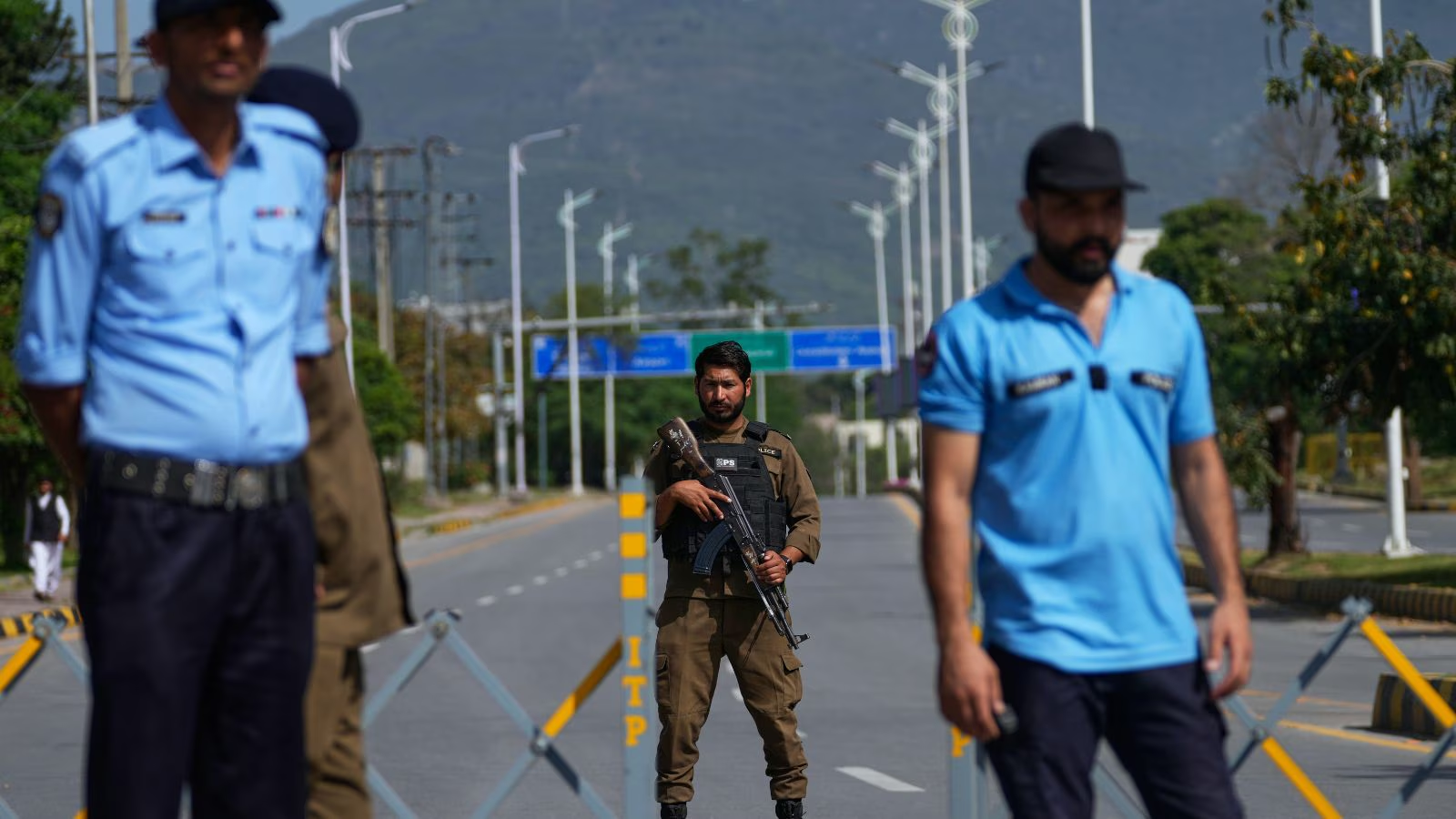
Thousands of security personnel have been deployed across Pakistan’s capital, with increased patrols along routes to the airport, as both delegations are expected to arrive. Officials and witnesses said the security arrangements appear significantly stricter than those in place during the first round of talks, held on April 11 and 12.
Story continues below this ad
Syed Mohammad Ali, an Islamabad-based security analyst, told The Associated Press, “The arrangements this time are markedly different from those during the first round. Pakistan appears to be preparing for the possibility of visits by top US and Iranian leaders if the talks advance to a stage where an agreement could be signed.”
Pakistan’s Foreign Minister Ishaq Dar also spoke by phone Tuesday with Egyptian counterpart Badr Abdelatty, with both sides emphasising the importance of dialogue and agreeing to remain in close contact, Pakistan’s Foreign Ministry said.
What experts are saying
Vali Nasr of Johns Hopkins University told NPR that there is “deep distrust in what the US is playing at, given President Trump’s record in the negotiations with Iran.” He said Iran’s leadership is “deeply suspicious about whether the president is preparing for war while he wants to go to Islamabad.”
Seyed Mojtaba Jalalzadeh, an international relations analyst based in Tehran, framed the contradictions as a deliberate strategy when speaking to Al Jazeera, “This gap reflects a dual-track negotiation strategy. At the public level, Iran maintains a hardline position to preserve domestic legitimacy and increase its leverage; at the nonpublic level, by dispatching a team to Islamabad, it signals that it has not abandoned diplomacy but is instead testing its conditions.”
Story continues below this ad
Fahd Humayun of Tufts University urged caution against reading Iran’s public posture as a definitive final position, telling Al Jazeera, “When warring parties come to the table to negotiate, they come with the understanding that there is occasionally a gap between public posturing and private positions. My sense is that they will pick up from where they left off, rather than getting too caught up in the rhetoric that has emerged since.”
Sina Toossi of the Center for International Policy struck a cautiously balanced note in comments to TIME, acknowledging that both sides retained incentives to continue talking, “The costs of renewed war are high for both”, while warning that “political dynamics in Washington and Tehran, and the tendency toward maximalist positioning, could easily pull things back toward confrontation”.
What happens next
The next 24 hours are crucial as Vice President JD Vance and Iran’s parliamentary speaker Mohammad Bagher Ghalibaf are expected in Islamabad before the ceasefire deadline. According to Al Jazeera, four outcomes are possible. Talks could yield a temporary deal, with mediators pushing for a “memorandum of understanding”. “Success would not be a final deal. It would be an interim understanding that extends talks, stabilises the ceasefire and creates a framework for trading nuclear steps for sanctions relief,” Ali Vaez, the Iran project director for the International Crisis Group think tank, was quoted as saying.
However, major differences remain over Iran’s nuclear programme and sanctions. “If the two sides do not change their stances, there cannot be a deal in Islamabad,” said Aniseh Bassiri Tabrizi.
Another scenario is talks without a breakthrough but a ceasefire extension, though progress requires compromise. “Unless that changes, it’s unlikely that we will see a deal,” she said.
Story continues below this ad
Even without talks, a fragile extension is possible. “It [would be] a fragile pause, not a durable ceasefire,” Vaez said. If talks fail entirely, tensions could escalate rapidly. “Then lots of bombs start going off,” warned Donald Trump.