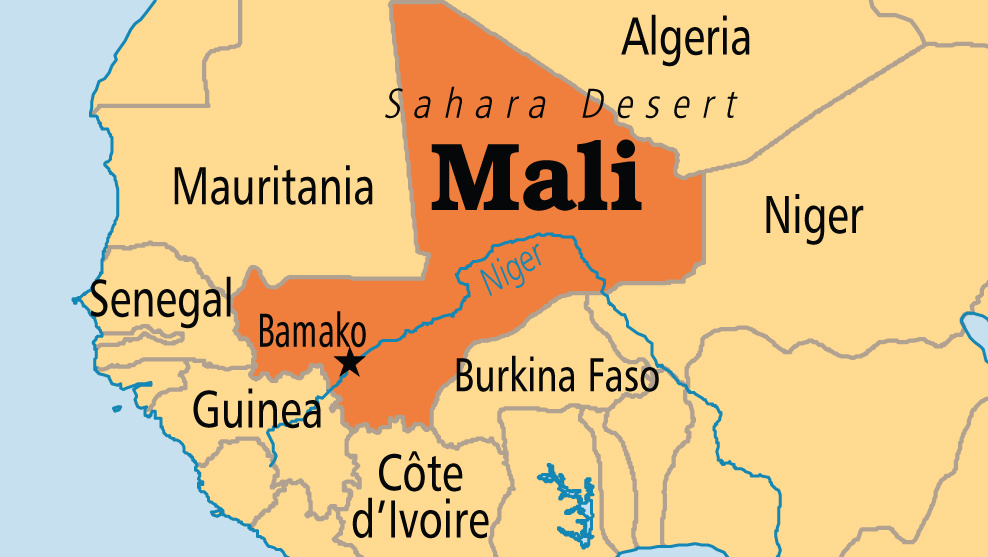
The military authority in Mali confirmed the attack in a statement, saying the terrorists “suffered immediate setback” and many of them were “neutralised.”
A coalition of jihadist and separatist forces, on Saturday, launched a coordinated offensive across Mali, striking strategic military and urban targets from the north to the capital, Bamako, in one of the most significant escalations in recent months.
The military in Mali confirmed the attacks in a statement, saying the terrorists “suffered immediate setback” and many of them were “neutralised.”
Fighters from Jama’at Nusrat al-Islam wal-Muslimin (JNIM)—an al-Qaeda affiliate in the Sahel—and the Azawad Liberation Front (FLA), a Tuareg-dominated rebel alliance, are reported to be behind the attacks, which appear to have been synchronised across multiple fronts.
In the capital region, gunfire and explosions were reported in Kati, home to Mali’s main military base, as well as near Bamako’s airport and key military installations. A major vehicle-borne improvised explosive device (VBIED) reportedly detonated outside the residence of Mali’s defence minister, Sadio Camara, while unverified accounts suggest a military helicopter may have been downed. Authorities have also shut down Airbase 101 as a precaution.
Across the country, the scale of the offensive is becoming clearer. Northern army positions are reported to have been overrun, with Kidal said to be under rebel control, while Gao has been breached and Sévaré is witnessing ongoing clashes and active militant movement.
Despite the intensity of the attacks, Mali’s armed forces in a statement say counter-operations are underway and insist the situation is “under control.”
Authorities have urged the public to remain calm and avoid sharing unverified or alarmist content, even as the United States Embassy in Mali has advised against all travel due to the deteriorating security environment.
JNIM, Islamic State affiliate, and the expanding militant footprint in the Sahel
The latest offensive underscores the entrenched presence of JNIM, which has steadily expanded its operational reach across Mali and the wider Sahel in recent years. The group has previously demonstrated its ability to blockade key supply routes, mount complex assaults on military bases, and exert influence over rural populations.
JNIM operates alongside a rival but equally potent jihadist actor, the Islamic State Sahel Province. While the two groups have at times clashed, their parallel campaigns have collectively strained Mali’s security architecture, particularly in the north and central regions where state presence remains limited.
The FLA, meanwhile, represents a consolidation of predominantly Tuareg separatist factions seeking autonomy or independence for northern Mali. Emerging from earlier rebel movements and evolving alliances, the FLA has periodically cooperated with or operated alongside jihadist groups, while also pursuing its own territorial and political objectives.
Both JNIM and Tuareg rebel coalitions have a history of launching major offensives, sometimes independently, sometimes in overlapping theatres. Past attacks have included high-profile assaults on military installations in cities such as Gao and Timbuktu, as well as coordinated strikes on convoys and remote garrisons.
Even so, analysts caution against drawing premature conclusions about state collapse. Despite the breadth of the current attacks, there is, so far, no clear indication of an imminent breakdown of the Malian state.
Philip Brant, a jihadi researcher with focus on Lake Chad region and the Sahel said “nothing indicates that there will be an imminent collapse of the Malian state so far.”
“Mali isn’t Syria and JNIM isn’t HTS, politically, militarily and diplomatically speaking,” he added.
HTS known as Hayat Tahrir al-Sham (HTS) was a dominant rebel force in North-west Syria, before consolidating territorial control,especially in Idlib.
It traces its roots directly to al-Qaeda through its predecessor, Jabhat al-Nusra, which was established as al-Qaeda’s official branch in Syria during the civil war. Although the group later rebranded and publicly severed formal ties in 2016, many analysts argue that ideological links, leadership continuity, and operational legacies have kept its historical connection to al-Qaeda significant.
HTS has now transitioned from a rebel group into the core of Syria’s new governing structure after leading the 2024 offensive that toppled Bashar al-Assad, with its leadership now integrated into the country’s interim government and security apparatus.
Calm has now returned to Mali, according to many observers.
“As expected, after several hours of fighting calm has returned to Bamako and its vicinity (Kati and Senou) after the intervention of the Malian Air Force and the Africa Corps, several JNIM militants were killed by the army and others lynched by crowds,” Mr Brant posted on X.