White House Press Secretary Karoline Leavitt announced the name during a press briefing on Wednesday, April 15, while presenting design renderings. She said the arch would stand about 76.2 metres tall “in honour of 250 years” and would be built on currently unused green space near the Lincoln Memorial in Washington, DC.
White House press secretary Karoline Leavitt holds up an artist rendering of the new triumphal arch as she speaks with reporters in the James Brady Press Briefing Room at the White House, Wednesday, April 15, 2026, in Washington. (AP Photo/Alex Brandon)
Design and scale
The monument, earlier nicknamed the “Arc de Trump” by sections of the US media, is designed to include a large statue of Lady Liberty at the top. If completed, it would be taller than Paris’s Arc de Triomphe and is expected to become the largest triumphal arch in the world, surpassing similar structures in Mexico City and Pyongyang.
Plans for the project first surfaced in October, when a model of the arch was seen on Trump’s desk in the Oval Office. Full renderings were released last week, offering a clearer view of the gold-accented design.
The triumphal arch is part of a broader set of construction and renovation initiatives linked to Trump’s second term. These include proposals for a new White House ballroom and upgrades to the John F. Kennedy Center for the Performing Arts, commonly known as the Kennedy Center.
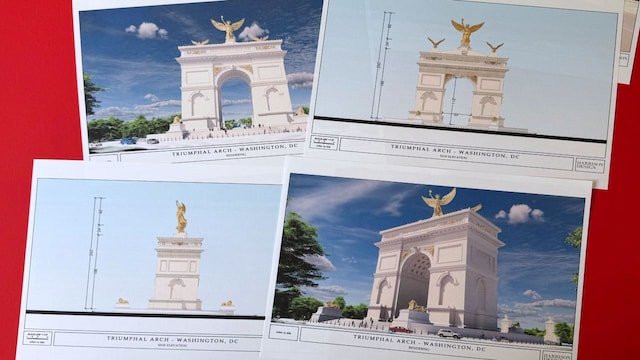
Artist renderings and diagrams for President Donald Trump’s new triumphal arch released by the U.S. Commission of Fine Arts that is planned to be built in Washington between the Lincoln Memorial and Arlington National Cemetery, are photographed Friday, April 10, 2026. (AP Photo/Jon Elswick)
Criticism and legal challenges
The proposal has already drawn criticism from local residents and advocacy groups. Legal challenges have reportedly been filed, raising concerns that construction could damage protected historic land and may violate federal regulations governing the National Mall area.
Critics have also questioned the scale and design of the structure, saying it could dominate the surrounding landscape, including the nearby Lincoln Memorial.
Funding questions
Funding has emerged as another point of debate. Reports indicate that the project could receive $2 million from the National Endowment for the Humanities, along with up to $13 million in matching funds tied to private donations.
The White House has defended the plan, saying the monument is intended to celebrate US history and national pride. “Long after everyone in this room is gone, our children and grandchildren will remain inspired by this national monument,” Leavitt said.
The proposal will now go before a key federal agency for review and a possible vote, with its future dependent on regulatory approvals and the outcome of ongoing legal challenges.