Dangote made the revelation while reflecting on the journey of building what has been described as the world’s largest single-train refinery, a project that has become one of the most ambitious industrial undertakings in Africa.
According to him, the refinery project, which officially commenced in 2013, was conceived with the vision of building “the biggest refinery ever in the world,” with a projected cost of about $20 billion.
You May Like: Dangote Refinery Powers Historic Shift as Nigeria Emerges Net Petrol Exporter, Earns Fresh Forex
“I decided that I was going to make the biggest ever refinery in the world. It was going to be fifty percent more than the biggest. It was going to be worth $20 billion,” Dangote said.
The billionaire industrialist recounted how the project encountered multiple setbacks from its earliest stages, particularly in relation to land acquisition and access issues that delayed development for several years.
“We launched the project in 2013. We had issues with the land for five years. One land had issues for three and a half years and another one had issues for one and a half years. We could not even access the lands,” he stated.
Dangote alleged that resistance from vested interests within the oil sector contributed significantly to the obstacles faced by the project.
“All of these were being caused by the mafia in the oil industry, to make sure we don’t come and address these issues. But we were not deterred at all. We were focused and we knew what we were doing,” he added.
He further explained that the refinery project was also hit by severe economic headwinds, particularly the sharp depreciation of the naira during the construction phase.
“When we started, the exchange rate of a dollar to a naira was N150. We even got to N1,900,” he said, highlighting the enormous financial pressure created by currency fluctuations during the execution of the project.
Dangote also disclosed that his company had to build a dedicated seaport because existing Nigerian ports lacked the capacity to handle the massive industrial equipment required for the refinery.
“We had to build our port because there was no port in the country that could take those heavy equipment,” he explained.
According to him, some of the refinery components weighed as much as 3,000 tonnes, while others, including the crude distillation unit, weighed about 2,700 tonnes.
“One piece was 3,000 tonnes. We had another one which was the regenerator. We have another unit which is the crude distillation unit that was 2,700 tonnes, and we had about thirty of those equipment,” he said.
Dangote noted that most of the refinery components had to be imported in modular form because of the complexity and scale of the project.
He also revealed the enormous scale of infrastructure developed around the refinery, including a water treatment facility covering more than 30 hectares, while about 67,000 people worked directly on the project during peak construction periods.
Despite eventually delivering the refinery project, Dangote admitted that the scale of the undertaking almost overwhelmed him.
“Luckily for us, we didn’t know what we were building because if we knew, I would not have built this refinery. I would have really chickened out,” he said.
The businessman likened the experience to swimming across an ocean and realizing halfway through that there was no turning back.
“When we started, it was like you are swimming across the ocean. When you get to the middle of the ocean, you realize that the tide is bad. When you go forward it’s bad, when you go backwards it’s bad, so you have to go forward.
“And that was what we did. We had to just keep on working and working, believing that at the end we would deliver,” Dangote added.
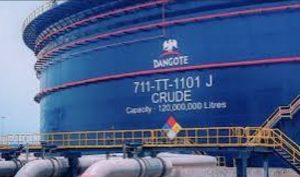
The Dangote Refinery, widely regarded as one of the largest industrial projects in Africa, is expected to significantly reduce Nigeria’s dependence on imported petroleum products, boost local refining capacity, conserve foreign exchange and strengthen the country’s energy security.