By TheNigeriaLawyer Editorial
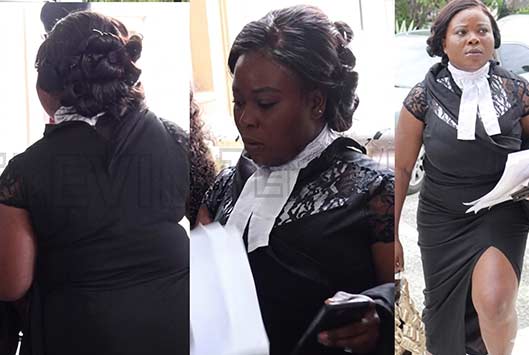
A photograph of a female lawyer seen accompanying the defence team during the recent arraignment of social media influencer and self-styled relationship therapist Blessing CEO before the Federal High Court in Ikoyi, Lagos, has triggered a wave of commentary across legal and social media circles, with observers raising concerns about whether the outfit met the standard of professional decorum expected of counsel in court.
While the official court report identifies P.I. Nwafor as defence counsel who addressed the court on behalf of the defendant, it remains unclear from available records whether the female lawyer captured in the viral photograph is the said counsel of record or another member of the defence team in attendance. For that reason, this report references the lawyer pictured generally, without ascribing identity beyond what the record confirms.
The image, which surfaced shortly after the arraignment, shows the female lawyer in an outfit featuring a high slit, visible lace sleeve detailing, and a cape-style finish, described by several commentators as more reflective of social or fashion wear than the conservative attire traditionally associated with courtroom appearances.
The reactions, however, have been sharply divided. While some commentators have insisted that the outfit fell short of professional standards, others have warned against using the moment to shame or police female lawyers over personal style choices, calling instead for a balanced conversation rooted in the actual Rules of Professional Conduct.
At the heart of the debate is Rule 36 of the Rules of Professional Conduct for Legal Practitioners, which provides that when in the courtroom, a lawyer shall be “attired in a proper and dignified manner” and must not wear “any apparel or ornament calculated to attract attention” to himself or herself. The rule further requires lawyers to conduct themselves with decency and decorum and to observe the court’s customs on appearance, dress, manners, and courtesy.
Closely related is Rule 6(b) of the Rules of Professional Conduct for Legal Practitioners 2007, which similarly requires that a lawyer should always be attired in a proper and dignified manner. Significantly, the rule does not expressly prohibit trousers for female lawyers, nor does it itemise specific clothing items. The longstanding “no-trouser” practice in many Nigerian courts derives largely from courtroom convention and professional custom, rather than from any clear statutory ban.
For context, the Nigerian Law School Code of Conduct, which forms the foundation of professional dressing for lawyers in training, prescribes for female students a white blouse, dark jacket, and black skirt covering the knees, or alternatively a dark ladies’ suit, with black shoes. The Code further provides that there should be no embroidery or trimmings of any type, and that only moderate jewellery should be worn. This dress code is treated as mandatory for law school activities, call ceremonies, and court appearances.
Legal commentators have observed that the core issue is not whether a lawyer is male or female, but whether the appearance reflects the dignity of the court. As one observer put it, “The Rules do not target female lawyers personally, but they require every lawyer in court to be properly and dignifiably dressed. The standard is that counsel’s appearance should not attract unnecessary attention or undermine courtroom decorum.”
Another commentator stressed: “This is not about attacking female lawyers or policing women’s fashion. The issue is courtroom decorum. A lawyer’s dressing, whether male or female, should reflect the dignity of the court. In this case, the high slit and revealing style may be considered inappropriate for formal court appearance, where modesty, professionalism, and respect for the judicial process are expected.”
Still, those defending the lawyer pictured have urged restraint, warning that the legal profession must avoid descending into outfit-policing or selective outrage against women. “Female lawyers should be judged by competence and decorum, not by outfit policing. The RPC requires proper and dignified dressing, but it does not expressly criminalise a woman’s clothing choice; the profession should focus on substance, respect, and courtroom etiquette,” one balanced view noted.
A sharper critique, however, maintained that “the real issue is professionalism. A lawyer, male or female, must dress decently and appropriately, but the profession should avoid double standards or selective outrage.”
The conversation has also drawn comparisons with practice in other jurisdictions. In England, for instance, female barristers traditionally wear dresses rather than slacks, though even there, calls for reform of rigid dress conventions have grown louder in recent years, with arguments that lawyers should be allowed to dress neatly and modestly without being denied reasonable self-expression.
Nonetheless, on the specific photograph in question, legal observers have argued that the strongest professional critique is not that the lawyer wore trousers or that she expressed personal style, but rather that the overall outfit, with its high slit and fashion-forward styling, appears to fall short of the RPC’s standard of “proper and dignified” attire expected of counsel in active courtroom proceedings.
As one commentator summarised: “Rule 6(b) of the RPC requires proper and dignified attire; while the rule does not expressly ban trousers, this outfit still raises a serious question whether it meets the standard expected of a lawyer in court.”
The backdrop to the controversy is the high-profile arraignment of Blessing CEO, whose real name is Okoro Blessing Nkiruka, by the Lagos Zonal Directorate 1 of the Economic and Financial Crimes Commission (EFCC) before Justice D.I. Dipeolu of the Federal High Court sitting in Ikoyi, over an alleged N36 million fraud.
The defendant, who is facing a two-count charge bordering on obtaining money by false pretence and alleged stealing of N36 million, pleaded not guilty. According to the charge, she allegedly obtained the sum from one Mrs. Ifeyinwa Nonye Okoye between July 14 and 17, 2024, under the pretence of leasing a six-bedroom detached duplex located at No. 1B Tunbosun Osobu Street, off Kuboye Road, Lekki, Lagos State. The EFCC alleged that the representation was false and constituted an offence under the Advance Fee Fraud and Other Fraud Related Offences Act, 2006, while a second charge accused her of fraudulently converting the sum to personal use, contrary to provisions of the Criminal Code Act.
During proceedings, defence counsel P.I. Nwafor informed the court that the defendant had already refunded N24 million of the N36 million and sought a short adjournment to resolve the outstanding balance, adding that the nominal complainant had agreed to prevail on the EFCC to drop the case if the balance was paid. Prosecuting counsel S.I. Suleiman, however, argued that the anti-graft agency was not part of any private settlement, insisting that the complainant remained the Federal Government of Nigeria and urging that the defendant take her plea.
Justice Dipeolu ruled that any discussion between the defendant and the nominal complainant would not affect the criminal proceedings, and ordered that the defendant take her plea. The court subsequently remanded Blessing CEO in EFCC custody pending the perfection of her bail conditions and adjourned the matter to June 5, 2026, for commencement of trial.
It is against the backdrop of this otherwise serious criminal proceeding that observers have warned that side-commentary on courtroom attire risks distracting from the substantive legal issues. Yet, the same observers maintain that questions of courtroom decorum are not trivial, given that a lawyer’s appearance is itself part of the integrity of the judicial process.
The balanced view, ultimately, appears to be this: female lawyers should not be unfairly targeted over dressing, but courtroom appearance must still reflect professional decorum. The standard should remain the same for all lawyers dress modestly, professionally, and in a manner that preserves the dignity of the court.