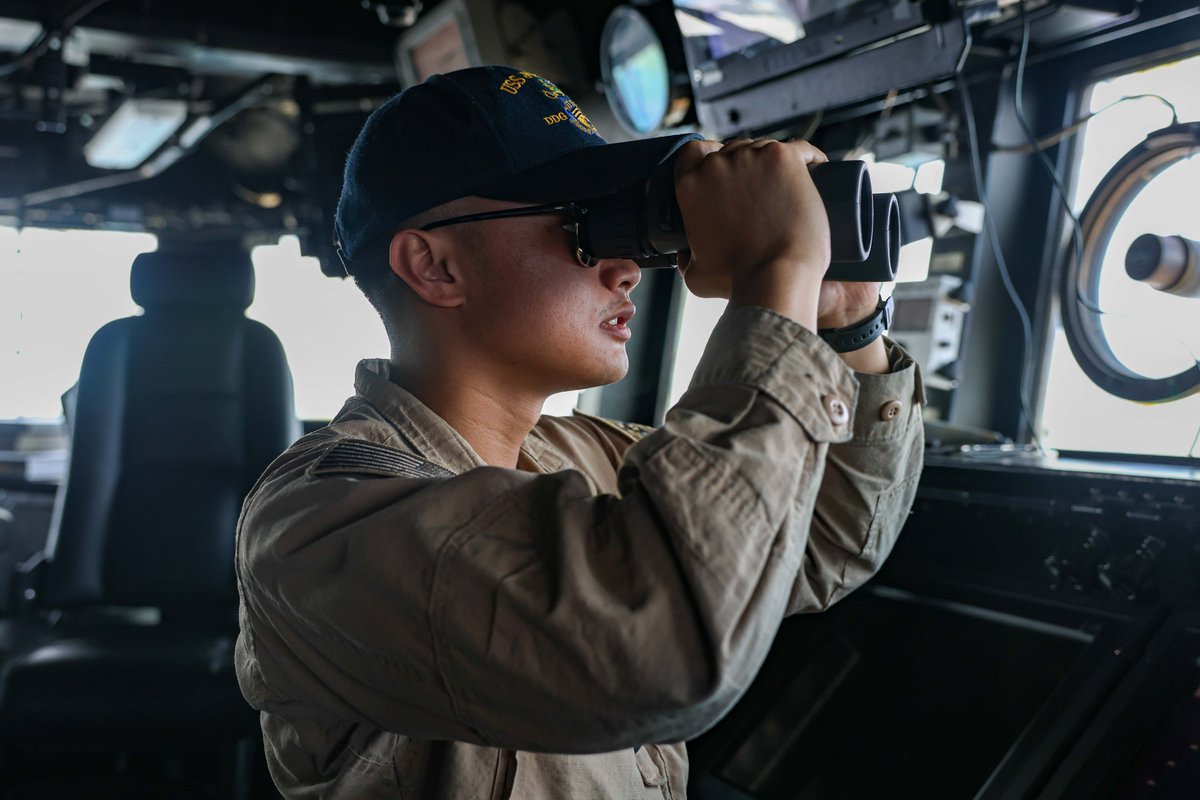
The United States announced Monday that two American-flagged merchant vessels successfully transited the Strait of Hormuz under Navy protection, marking the first reported commercial passage through the strategic waterway since Iran imposed a sweeping blockade that has disrupted global energy markets and strained regional tensions.
U.S. Central Command said guided-missile destroyers operated in the Gulf alongside the transit operation. “American forces are actively assisting efforts to restore transit for commercial shipping,” CENTCOM stated.
Iran’s Revolutionary Guards responded, claiming that “merchant ships and tankers have not passed through the Strait of Hormuz in recent hours.” According to the Revolutionary Guards, “the claims by American officials are baseless, they are lies.”
The passage came hours after Iranian forces claimed to have turned back a U.S. warship attempting to enter the strait. Iranian media alleged missiles struck an American vessel, though CENTCOM denied those reports, saying no U.S. warship had been damaged. A senior Iranian official told Reuters that warning shots were fired.
President Trump characterized the operation as a “humanitarian gesture,” stating that any interference would “have to be dealt with forcefully.” He noted that numerous nations uninvolved in Middle Eastern disputes had requested American assistance in freeing their vessels trapped by the blockade.
“For the good of Iran, the Middle East, and the United States,” Trump wrote on Truth Social, “we have told these Countries that we will guide their Ships safely out of these restricted Waterways.”
Iran’s Revolutionary Guards established what they called a “new control zone” over the strait and rejected Trump’s characterization of the operation. Ebrahim Azizi, head of the Iranian parliament’s National Security and Foreign Policy Committee, dismissed the U.S. initiative, saying “the Strait of Hormuz and the Persian Gulf will not be managed by Trump’s delusional posts.”
The blockade, now exceeding two months, has stranded hundreds of vessels and thousands of seafarers. Oil prices surged approximately 5 percent on concerns the disruption could persist. The strait typically carries roughly one-fifth of the world’s oil and gas shipments.
CENTCOM allocated substantial resources to the escort mission, including guided-missile destroyers, more than 100 aircraft, unmanned platforms and approximately 15,000 troops. Footage released Sunday showed CENTCOM Commander Admiral Brad Cooper flying over the strait in an Apache helicopter, a possible signal to Iranian forces.
Separate diplomatic efforts remain stalled. Iran’s Foreign Ministry spokesman said the United States was making “unreasonable demands” and accused Washington of instability in international waters. Tehran emphasized its only negotiating position: “stopping and completely ending the war.”
In a potential diplomatic gesture, the United States announced that the Iranian vessel M/V Touska—seized after attempting to breach an American blockade—would be transferred to Pakistan for return to Iran along with its crew.
(YWN World Headquarters – NYC)