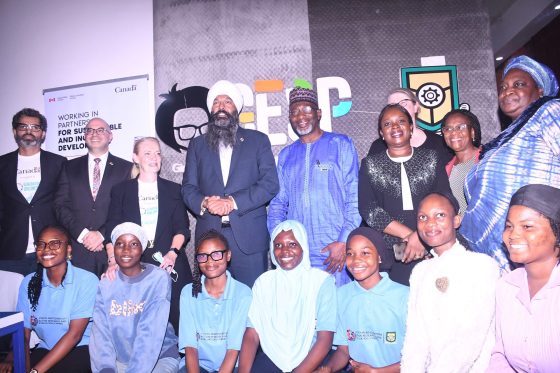
The Government of Canada has expressed strong interest in expanding youth-focused digital and technical empowerment programmes in Nigeria following a high-level visit by Canada’s Secretary of State for International Development, Sarai Randeep, to the Girls’ Education and Skills Partnership (GESP) hub at Yaba College of Technology, Lagos.
The visit, undertaken in partnership with UNICEF and Generation Unlimited, was aimed at assessing the impact of the Generation Unlimited programme in Nigeria.
It was also to explore opportunities for scaling up youth empowerment initiatives, particularly for girls in technology and innovation.
Welcoming the delegation to the institution, the Rector of Yaba College of Technology, Dr. Ibraheem Abdul, described Nigerian youths as “diamonds” whose talents must be polished to shine globally through education, innovation and technical skills acquisition.
According to the Rector, the institution, which will mark its 80th anniversary next year, has continued to position itself as a leader in technical and vocational education by equipping students with industry-relevant competencies capable of producing global champions.
Engr. Abdul noted that the college currently has over 36,000 students and has deliberately intensified efforts to encourage girls to venture into technical fields traditionally dominated by men, including ICT, engineering and digital innovation.
“We are working to ensure that these girls emerge as champions even in global skills competitions,” he stated, adding that the partnership with UNICEF and Generation Unlimited had significantly enhanced the institution’s capacity to train and empower young women.
He further disclosed that Yaba College of Technology was the first tertiary institution in Nigeria selected as a flagship institution for the programme.
Speaking during the visit, Randeep said Canada remained committed to initiatives that empower girls and prepare them to become future leaders and contributors to the global workforce.
The Secretary said: “It is an honour to be here and to witness the Generation Unlimited project.
“Uplifting girls and giving them the training to face the challenges of the world is one of the most effective ways to empower women and strengthen a country.”
Randeep explained that Canada’s growing engagement with African nations was driven by its Africa Strategy, aimed at supporting the continent’s rapidly expanding youth population with quality education, digital skills and employment opportunities.
He said: “Nigeria has one of the largest youth populations in the world, and 51 percent are young girls.
“We want to ensure they acquire the skills necessary to contribute meaningfully to the economy and global workforce.”
The Canadian official commended the entrepreneurial spirit demonstrated by the programme beneficiaries and encouraged them to continue building sustainable careers in technology and innovation.
Also speaking, the Chief of Field Office, UNICEF Nigeria, Celine Lafoucriere, described the partnership as a strategic investment in the future of girls and young women in Nigeria.
Lafourcriere stated that the programme aligns with UNICEF’s mission of supporting adolescents and young people with opportunities that improve livelihoods and strengthen economic participation.
Earlier, the Coordinator of the GESP Programme at Yaba College of Technology and Director of the Centre for Research Support and Grants Management, Dr. Funmilayo Doherty, presented an overview of the initiative and highlighted its transformative impact on thousands of young women.
According to Doherty, the programme has already surpassed its target by training over 11,250 young women in gender-responsive technical and digital skills, including GSM and mobile phone repairs, computer maintenance, web application development and mobile application development.
She explained that the programme adopts an industry-academic partnership model, enabling participants to combine practical apprenticeship training with formal academic qualifications under the Nigerian National Skills Qualification Framework.
She said the mentorship component of the programme had become one of its strongest pillars, helping beneficiaries build confidence, leadership capacity and entrepreneurial skills.
“The girls are moving from learning to earning,” she stated, adding: “They are entering male-dominated fields with confidence and becoming role models in their communities.”
Doherty cited several success stories of beneficiaries who had established businesses, secured employment opportunities or become trainers and mentors themselves.
She disclosed that the GESP hub at Yaba College of Technology has evolved into a safe innovation space where girls continue to access mentorship, internships, entrepreneurial support and professional opportunities even after graduation.
She added that the institution had committed resources toward sustaining the hub and scaling the programme to reach more girls across Nigeria.
Among the beneficiaries reportedly earned about N150,000 from a FinTech-related web development project, while another former trainee now runs a phone repair business after previously hawking goods on the streets of Lagos.
Other beneficiaries showcased innovative projects during the event, including healthcare applications, secure digital payment platforms, laboratory-result interpretation software and multilingual emergency medical systems.
One of them, a 19-year-old web developer, said the programme transformed her confidence and earning capacity after she secured paid web development projects and participated in hackathons through the initiative.
Another beneficiary, demonstrated a web application designed to simplify medical laboratory results for patients using HTML, CSS, JavaScript and Node.js technologies.
The event also featured demonstrations in computer hardware maintenance and youth-led participatory action research projects carried out by beneficiaries of the programme.