The Central Bank of Nigeria has retained the country’s benchmark interest rate at 26.5 per cent, signalling a cautious stance amid rising inflationary pressures and global economic uncertainty….
The Central Bank of Nigeria has retained the country’s benchmark interest rate at 26.5 per cent, signalling a cautious stance amid rising inflationary pressures and global economic uncertainty.
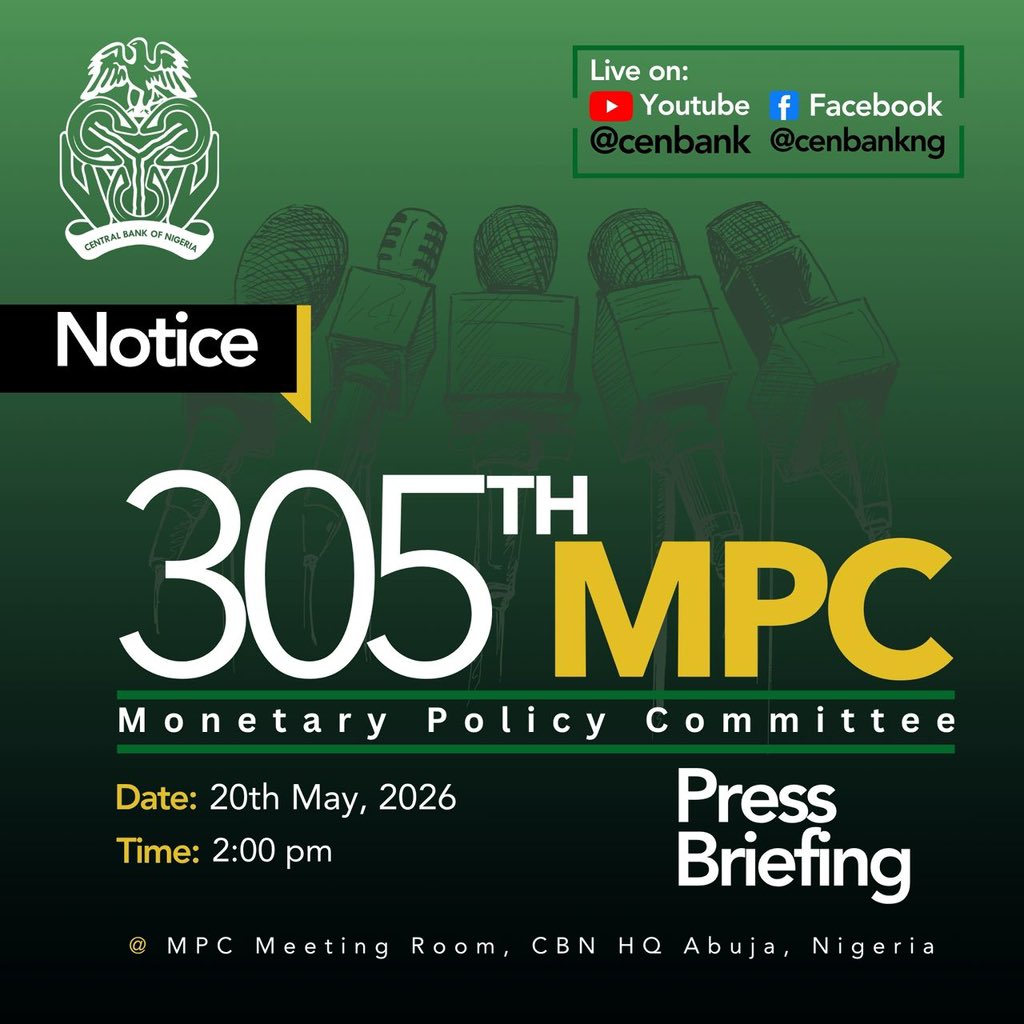
The decision was announced at the end of the 305th meeting of the Monetary Policy Committee (MPC), held on May 19 and 20, 2026, with all eleven members in attendance.
According to the Committee, the Monetary Policy Rate (MPR) was held steady at 26.5 per cent, alongside the retention of the asymmetric corridor at +50/-450 basis points.
The MPC also maintained the Cash Reserve Ratio at 45 per cent for Deposit Money Banks, 16 per cent for Merchant Banks, and 75 per cent for non-Treasury Single Account public sector deposits.
The Committee said its decision was based on a careful assessment of risks to the economic outlook, noting that although inflation has edged up slightly for two consecutive months, the increase is largely driven by external shocks and is expected to be temporary.
Data reviewed by the MPC showed that headline inflation rose to 15.69 per cent in April 2026 from 15.38 per cent in March, with food inflation climbing to 16.06 per cent due to higher transportation and logistics costs, as well as seasonal factors.
However, core inflation moderated to 15.86 per cent, while month-on-month inflation slowed significantly.
The MPC highlighted spillover effects from the Middle East crisis as a key driver of rising energy prices and logistics costs globally.
Nonetheless, it noted that the impact on Nigeria has been relatively contained, attributing this resilience to recent economic reforms, including improved exchange rate stability, stronger external reserves, and enhanced monetary policy transmission.
Gross external reserves stood at $49.49 billion as of May 15, 2026, providing an import cover of over nine months and reinforcing investor confidence.
The Committee also welcomed Nigeria’s recent sovereign rating upgrade, describing it as a reflection of strengthened macroeconomic fundamentals and policy credibility.
It further noted the successful conclusion of the banking sector recapitalisation exercise, which has resulted in 33 stronger and better-capitalised banks.
On growth, the MPC observed that Nigeria’s economy expanded by 4.07 per cent in the fourth quarter of 2025, supported by gains in both oil and non-oil sectors, particularly services, agriculture, and industry.
Looking ahead, the Committee projected that economic growth would remain resilient in 2026, although downside risks persist due to global geopolitical tensions.
Inflation is expected to rise moderately in the short term before returning to a disinflationary path, supported by earlier policy tightening, improved food supply, and exchange rate stability.
The MPC reaffirmed its commitment to a data-driven and forward-looking policy approach, aimed at maintaining price stability while safeguarding the resilience of the financial system.