3 min readMay 26, 2026 09:05 PM IST
China on Tuesday reiterated its opposition to the Quad grouping, saying it is opposed to the formation of exclusive alliances and bloc confrontation, even as the four-member grouping unveiled new measures to strengthen cooperation in the Indo-Pacific region, news agency PTI reported.
Responding to questions on the Quad’s latest initiatives, Chinese Foreign Ministry spokesperson Mao Ning said China had already stated its position on the grouping on multiple occasions.
“Cooperation between countries should be conducive to regional peace, stability and prosperity, and not target any third party. We oppose forming exclusive groupings or engaging in bloc confrontation,” Mao said at a media briefing.
Just completed a productive QUAD FMM with colleagues @SecRubio of the US, @SenatorWong of Australia, and FM @moteging of Japan.
Three major takeaways:
➡️ Agreed on Indo-Pacific Maritime Surveillance Initiative and on a Common Operating Picture in the maritime domain. Will… pic.twitter.com/4b0dFtiAHC
— Dr. S. Jaishankar (@DrSJaishankar) May 26, 2026
The Quad comprises India, the United States, Japan and Australia.
Quad announces new Indo-Pacific measures
At a meeting of Quad foreign ministers in New Delhi on Tuesday, the grouping announced a series of measures aimed at strengthening maritime surveillance and port infrastructure across the Indo-Pacific region amid concerns over China’s growing military posturing.
The Quad also expanded cooperation in critical minerals and energy security.
The grouping announced an Indo-Pacific energy security framework intended to counter supply disruptions through strategic fuel reserves, targeted policy initiatives and coordinated emergency response mechanisms.
The move came amid rising concerns over global energy supply chains following the blockade of the Strait of Hormuz, through which around one-fifth of the world’s oil and liquefied natural gas (LNG) usually passes.
Story continues below this ad
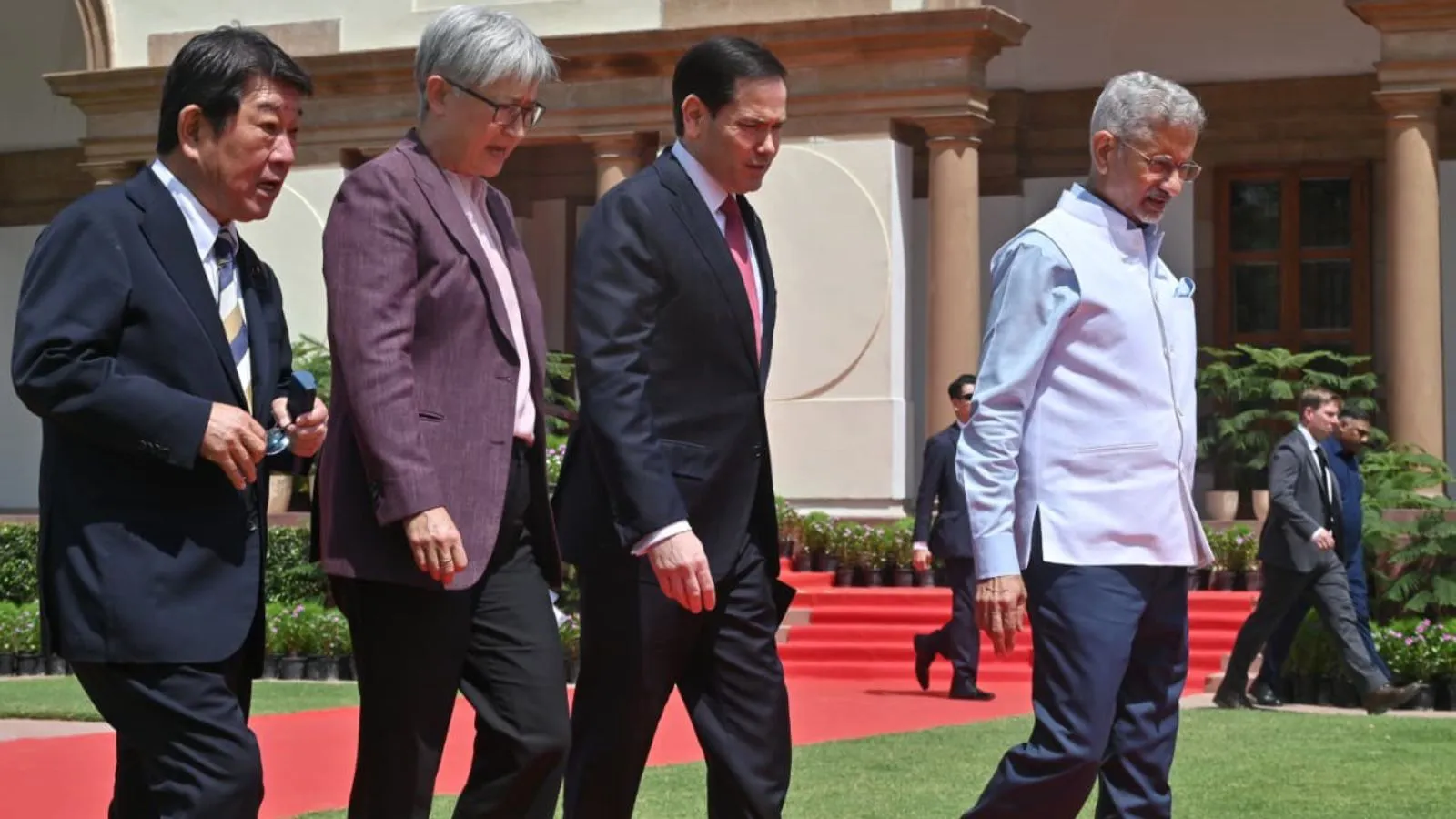
The meeting was chaired by Indian Minister of External Affairs S Jaishankar and attended by US Secretary of State Marco Rubio, Australian Minister of Foreign Affairs Penny Wong and Japanese Foreign Minister Toshimitsu Motegi.
The foreign ministers reiterated the importance of ensuring freedom of navigation and uninterrupted global commerce, including through the Strait of Hormuz and opposed restrictive measures affecting commercial shipping.
They also reaffirmed their commitment to maintaining stable, secure and resilient energy markets and diversified supply chains.
India-US critical minerals framework signed
India and the United States also finalised a framework for cooperation on critical minerals during the sidelines of the Quad meeting.
Story continues below this ad
The agreement focuses on securing supplies of critical minerals and strengthening cooperation in mining, processing, recycling and investments related to rare earth supply chains.
Calling the framework “timely and critical”, Jaishankar said the initiative would deepen cooperation across the entire critical minerals and rare earth supply chain.
Critical minerals are considered essential for technologies such as electric vehicles, drones and battery storage systems. China currently remains a dominant player in the global critical minerals supply chain.
Responding to China’s criticism of the Quad, Wong said the grouping remained focused on regional peace and stability.
Story continues below this ad
“I want to talk about what we are for. We are for peace, stability and prosperity in the Indo-Pacific, and that’s what we’re acting to deliver,” she said after the meeting in New Delhi.
Stay updated with the latest – Click here to follow us on Instagram
© The Indian Express Pvt Ltd