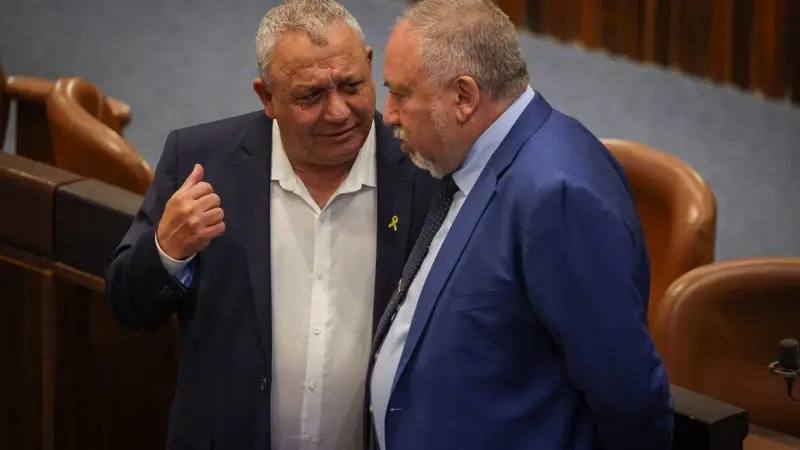
Yashar party chairman Gadi Eisenkot and Yisrael Beytenu chairman Avigdor Liberman are exploring a possible joint run ahead of the upcoming elections, Israeli media outlets reported on Monday monring.
According to a report in Yedioth Ahronoth, preliminary contacts have taken place between Eisenkot and Liberman regarding a potential merger of their parties. The talks are still in early stages, and the key question of leadership—who would head a joint list—has not yet been discussed in depth, though initial messages have already been exchanged and a meeting between the two is expected this week.
A senior source close to Eisenkot told Ynet that “the Lapid-Bennett merger opened additional possibilities for Eisenkot that were not previously on the table, such as a merger with Liberman. Bennett and Lapid thought they would unite and Gadi would immediately join—but that’s not the case.”
A source close to Liberman said he would consider such an alliance only if it strengthens the bloc by at least two additional Knesset seats. “The goal is to replace Netanyahu and this government,” he stressed. “Any cooperation that advances that goal is desirable. If a merger can bring two more seats and help form a 61-seat coalition, then it’s definitely on the agenda.”
Liberman, however, is not expected to rush into a merger as Bennett and Lapid did. He is said to be weighing the move carefully to ensure it would indeed expand the bloc rather than weaken it.
On a personal level, both Eisenkot and Liberman are reportedly disappointed by the way Bennett and Lapid conducted their own merger talks—largely behind their backs. Liberman is not convinced the move will necessarily increase the bloc’s electoral strength, while Eisenkot is said to feel the alliance was meant to pressure him into joining on terms not of his choosing. A source in Eisenkot’s party described their conduct as personally disappointing: “They held secret negotiations and assumed that once it was publicized, Gadi would fall in line. That’s not how he expects partners to behave.”
Eisenkot has yet to decide whether to run independently or join another party, and is expected to take time to assess polling trends. So far, the Bennett-Lapid alliance has not harmed his standing—if anything, it may have strengthened it. The key question is whether that support will hold over time.
If merger talks advance seriously, Eisenkot’s main options would likely be aligning with either Bennett or Liberman. In such a scenario, the central issue will be leadership: Liberman has already declared himself a candidate for prime minister, while Eisenkot has said he did not leave Benny Gantz only to serve as a number two under another candidate.
These questions are expected to be addressed in the coming weeks.
(AP)