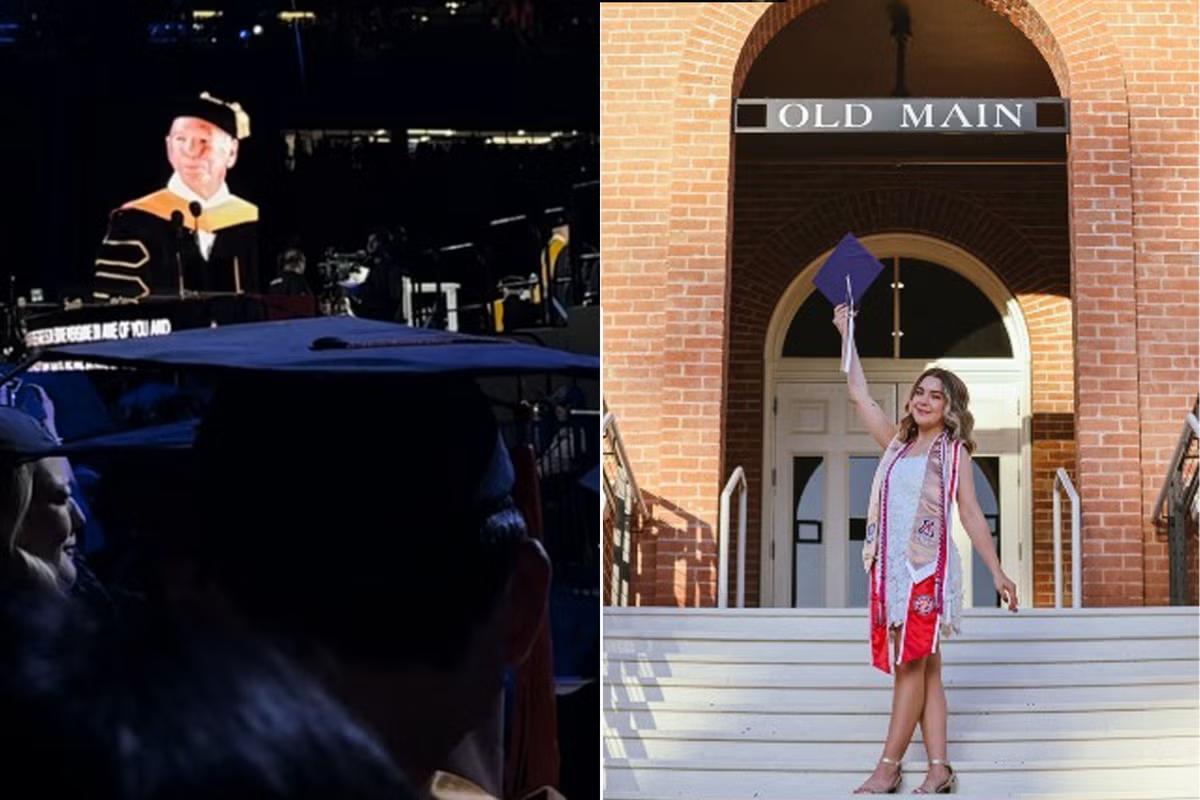
From coast to coast, commencement speakers have faced an audience of booing graduates each time they bring up artificial intelligence.
The boos came when music executive Scott Borchetta told the grads at Middle Tennessee State University, “It’s a tool. Make it work for you.” The capped-and-gowned University of Central Florida crowd jeered when real estate executive Gloria Caulfield called AI the “next industrial revolution.”
But no one got it worse than former Google CEO Eric Schmidt, whose May 15 speech at the University of Arizona was booed, nearly without interruption, for minutes on end.
“It was honestly one of the most surreal experiences,” Bailey Ekstrom, 21, an economics and political science graduate who was in the crowd, told The Independent. She had never seen campus opinion so unified, a mini-referendum suggesting the generation inheriting the post-AI world isn’t all that thrilled about it.
The tech billionaire urged young people to become decision-makers and help shape AI.
“When someone offers you a seat on the rocket ship, you do not ask which seat,” Schmidt said. “You just get on.”
Ekstrom recalls seeing a student a few rows ahead stand and say, to no one in particular, “Oh f*** this guy.”
Schmidt tried a few times to win back the crowd — raising his finger professorially, bringing up the importance of immigrants and diverse perspective for America and American AI — but it didn’t seem to be going well.
The speech touched a nerve for a few reasons, Ekstrom said. Campus groups already wanted to replace Schmidt as speaker before he arrived because of his mention in the Epstein files and sexual assault allegations against him from a former partner. (The files do not suggest Epstein-related wrongdoing and capture the tech executive declining a 2013 dinner invite. Schmidt has denied the assault allegations. His attorney has called the claims, which come from Schmidt’s former girlfriend and business partner Michelle Ritter, “false and defamatory statements to escape accountability” in the midst of a business dispute. The two sides entered private arbitration in March.)
His comments on AI landed like a lead balloon at a time when about half of new grads think AI will reduce the number of entry-level jobs.
“In terms of young people, a lot of it comes down to the fact that we don’t really feel like any of the people making policy decisions around AI right now either A: have our best interests in mind, or B: know what they’re doing,” Ekstrom said.
She recalled, in horror, sitting in on a congressional hearing during an internship in Washington, where legislators couldn’t even spell ChatGPT, let alone understand it.
Another new Arizona grad, who studied anthropology and asked to remain anonymous, said she felt the same way.
“Yes, there are some incredible AI programs that are helping in the medical industry, for example, but that’s not what students are complaining about when we talk about AI,” she said. “We’re upset about the job applications that don’t even get read by a real person anymore. We’re upset that we seemingly made it through college just in time for AI to take over all our job prospects.”
Throughout her time at the university, this student felt AI had coarsened people’s thinking, generating homogenous, machine-aided writing and reducing students to tears because AI programs wouldn’t give them the answers they wanted.
The whole tone of the speech, a University of Arizona staff member told The Independent, showed how the university was “completely out of touch with students.”
“Eric strongly encourages free speech and open discussion of issues, especially around AI, and believes that his remarks stimulating further conversation is a good thing, even if there are those who disagree,” an adviser for the executive told The Independent.
The Independent has contacted the university for comment.
The discontent extends beyond just the graduation hall.
As The Independent has reported, even within Silicon Valley itself, which helped create AI, tech workers are being laid off in droves, in some cases after AIs were trained on their work.
“They can’t find jobs. Thirty to 40 percent of them are unemployed, and they blame AI for this, and you know, they may well be right,” Sen. Josh Hawley told Fox Business this week, when asked about the wall-to-wall booing from the class of 2026.
“We want to see new technology create jobs, not destroy jobs.”
Ekstrom, the Arizona political science grad, has plans to move to Seattle to become a legal assistant, with an eye towards going to law school. Beyond that, the AI-inflected future is almost impossible to predict.
“When it comes to actually going to law school and practicing law, I truly have no idea what that will look like,” she said. “I can speak for a lot of us when I say we kind of feel like guinea pigs.”