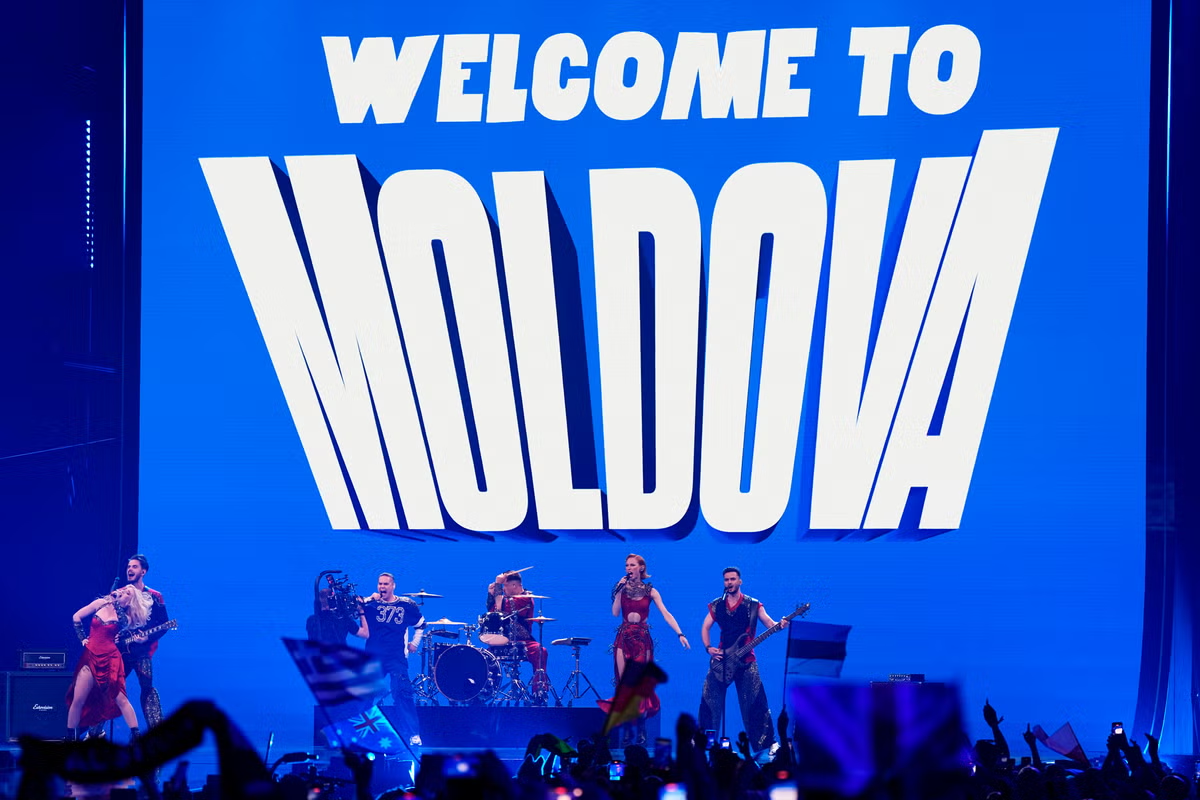
The head of Moldova’s public radio and television broadcaster resigned on Monday following mass public protests over the country’s voting in last weekend’s Eurovision Song Contest.
Hundreds of fans took to social media to denounce the Moldovan jury’s decision to award only three points to neighbouring Romania in Saturday’s contest.
Moldova, before achieving independence in 1991, was once a part, in turn, of the Russian empire, Greater Romania and the Soviet Union and shares strong linguistic and cultural ties with Romania.
“This was my decision,” Vlad Turcanu, director general of Moldovan Radio and Television, told a hastily-called news conference.
“We distanced ourselves from the jury’s voting, but it is still our responsibility, my responsibility in the first instance, as head of this institution.”
The resignation was a dramatic demonstration of the role played by social media in one of Europe’s poorest countries, whose president has denounced Russia’s invasion of neighbouring Ukraine and is vowing to join the European Union by 2030.
Moldova’s jury, selected by the public broadcaster, gave the maximum 12 points to the entry from Poland, which finished 12th.
Ten points went to Israel, the second-place finisher in the contest, jolted by boycotts by five countries over Israeli actions in Gaza. Bulgaria was declared the winner.
Television viewers, whose votes are also considered in the contest’s final standings, gave 12 points to Romania, represented by Alexandra Capitanescu.
Viewers also expressed outrage that the jury had awarded no points to the Ukrainian entry in the contest.
“The only thing that matters is votes by ordinary people,” former Defence Minister Anatol Salaru wrote on Facebook. “This was a vote among brothers. The rest is an unimportant detail.”
Moldova’s entry, Satoshi, said the mass public support for Romania “reflects the real opinion of our society.”