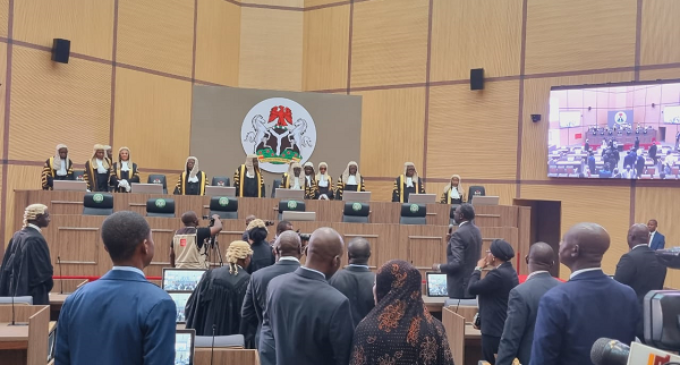
The Supreme Court judgment on the leadership crisis in the
African Democratic Congress (ADC) has generated mixed interpretations and
confusion about who is in charge of the party.
However, rather than settle the dispute, the apex court’s
decision focused on a procedural misstep and sent the case back to where it
began.
To understand the case in its entirety and what the Supreme Court judgment means, it is important to start from the beginning.
FEDERAL HIGH COURT
On September 2, 2025, Nafiu Bala, former vice chairman of
the ADC, approached a federal high court in Abuja (Suit No.
FHC/ABJ/CS/1819/2025), seeking to stop David Mark, former senate president, and
his faction from parading themselves as leaders of the party.
Bala listed the ADC, Mark, Rauf Aregbesola (national
secretary), the Independent National Electoral Commission (INEC), and Ralph
Nwosu, the party’s founder and former national chairman, as defendants.
He also sought an order to restrain INEC from recognising
them and to compel recognition of himself as acting national chairman.
He further filed motions seeking to stop the party from
holding meetings, congresses, or conventions pending the determination of the
suit.
The motion ex parte was heard on September 4, 2025, and
Emeka Nwite, the trial judge, directed that the respondents, including INEC, be
put on notice to show cause why the motion ex parte should not be granted.
This means the motion ex parte was neither granted nor
refused.
COURT OF APPEAL
Dissatisfied with the interim ruling, Mark filed an appeal
challenging the jurisdiction of the federal high court to continue to hear
Bala’s suit.
However, on March 12, 2026, the court of appeal dismissed
Mark’s case in its entirety, holding that it was incompetent and unmeritorious.
A three-member panel of the appellate court, led by
Uchechukwu Onyemenam, found that there was no substantive ruling by the federal
high court on the ex parte application, as the trial judge merely ordered that
parties be put on notice.
As such, there was no valid decision upon which an appeal
could properly be anchored.
The court further faulted Mark for relying on an enrolled
order rather than the actual proceedings and ruling of the trial court, noting
that only the judge’s pronouncement constitutes the authentic record of the
court.
The court also held that the appeal arose from an
interlocutory ruling, for which Mark failed to obtain the required leave before
approaching the appellate court.
On the issue of jurisdiction, the court of appeal noted that
the question was still pending before the federal high court and could not be
determined at the appellate level at that stage, describing the appeal as
premature.
Having dismissed the appeal, the court issued preservatory
orders to safeguard the subject matter of the dispute.
The court directed the parties to maintain the status quo
ante bellum and to refrain from any action that could undermine the proceedings
before the trial court.
On April 1, INEC announced that it would no longer recognise
the factions of the ADC led by Mark or Bala, following its review of the court
of appeal judgement.
SUPREME COURT
On further appeal to the apex court, Mark, among other
things, argued that he had a lawful right to proceed with the appeal without
seeking leave of the trial court.
He also raised the issue of jurisdiction, arguing that the
trial court lacks the jurisdiction to entertain Bala’s suit.
In a unanimous judgment delivered on Thursday, a
five-member panel of the Supreme Court held that the appeal fails in part and
succeeds in part.
In the first part, the apex court agreed with the court of
appeal’s verdict that the appellant (Mark) ought to have sought leave of the
trial court before filing an appeal, since the substantive issues before the
trial court had not yet been heard and determined.
“I find the court below to be right that the appellant, in
whose favour the order of the federal high court was made, ought to have sought
the leave of the court before appeal…” the supreme court held.
Mohammed Garba, who read the lead judgment, held that since
the appellant failed to meet the condition precedent for filing the appeal, it
robbed the appellate court and, by extension, the supreme court of jurisdiction
to entertain the suit.
The lead justice also held that the issue opposing
jurisdiction of the trial court cannot be determined by the Supreme Court since
it is already the subject of a pending preliminary objection, which has not yet
been determined at the High Court.
“I therefore endorse the decision by the court below
upholding the first respondent’s preliminary objection to the competence of the
appellant’s appeal and an order striking it out on that ground,” Garba said.
Consequently, the court ordered the parties to go back and
continue with the suit pending at the federal high court.
On the second issue, which succeeded, the Supreme Court said
the Court of Appeal overstepped its boundaries by asking parties to maintain
the status quo.
“Status quo ante bellum”, in legal terms, refers to
restoring the condition of the position of things as they were before the
dispute arose.
The court reasoned that once the appeal was dismissed, the
court of appeal had become functus officio — meaning it had exhausted its
authority in the case and could not make further substantive orders.
The Supreme Court consequently set aside the status quo
order, describing it as “unnecessary, unwarranted and improper”.
“The court was wrong to have made a purported preservatory
order suo moto in respect of a proceeding pending before the lower court, as
that power belongs to that trial court, which shall be in control of
proceedings in the matter when it is returned to it by the appellate court
either for continuation, hearing or retrial as the case may be,” the court
ruled.
DOES THIS MEAN DAVID MARK’S FACTION HAS WON?
The verdict of the Supreme Court does not mean victory for
the Mark-led faction or even any faction.
While the removal of the status quo order may give the
Mark-led faction some breathing room, the Supreme Court did not affirm any
leadership.
The most important question of who legitimately controls the
ADC remains unresolved.
The outcome will now depend on the decision of the trial
court after full proceedings.
After the matter is resolved at the trial court, the losing
faction would likely appeal the verdict back up to the Supreme Court.
Meanwhile, INEC has updated its website, listing Mark as the
national chairman of the ADC and Aregbesola as national secretary
Click to signup for FREE news updates, latest information and hottest gists everyday
Advertise on NOP NIGERIA to reach thousands of our daily users