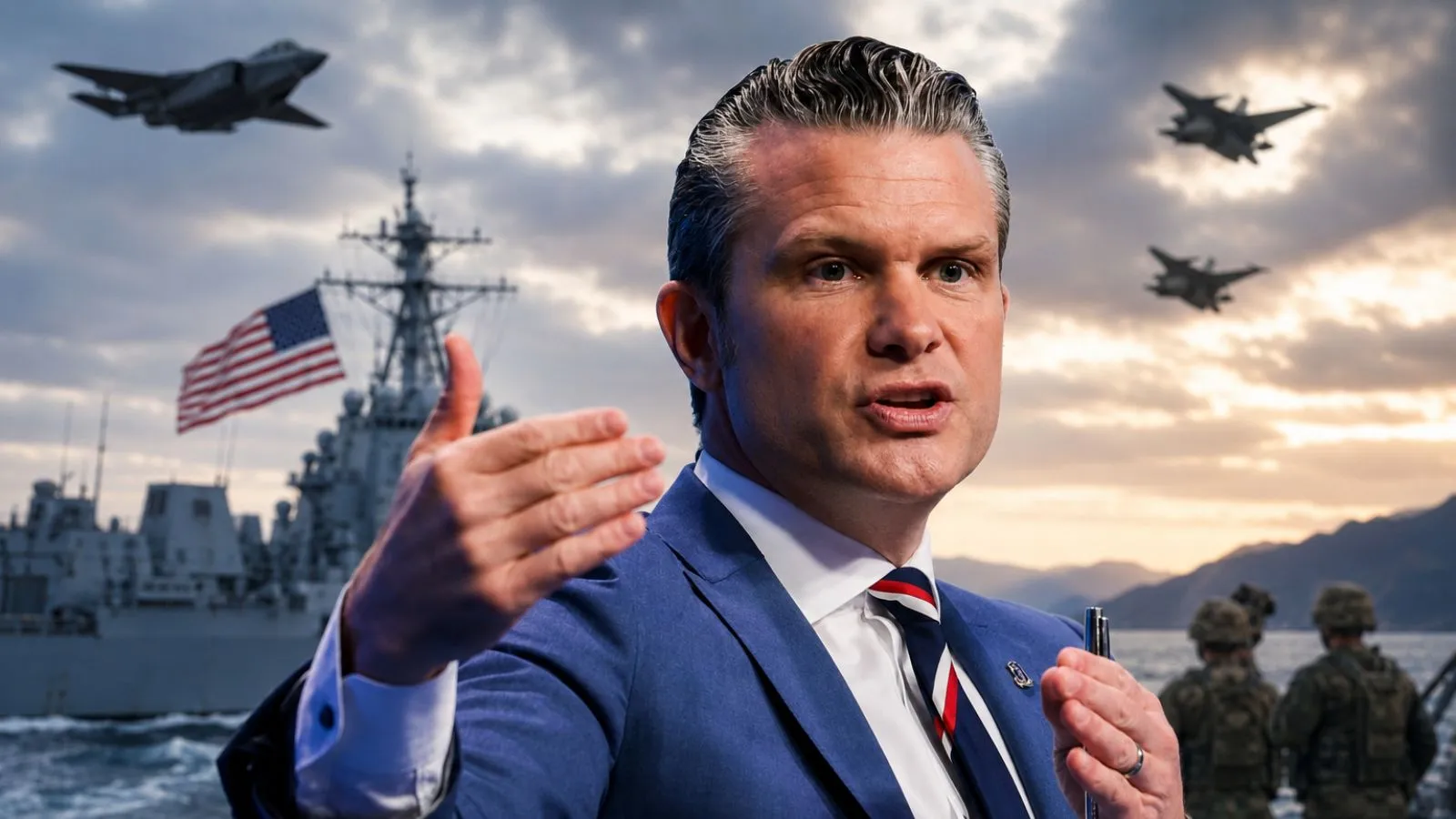
US Secretary of War Pete Hegseth Saturday described India as “powerful” and “modernising” its military with the heavy industrial and logistics capacity to sustain “high-end military operations,” in remarks at the Shangri-La Dialogue in Singapore that combined high praise for New Delhi. Hegseth also had a sharper-edged message to Beijing and a sweeping demand that Asian allies raise their defence spending to 3.5 per cent of GDP.
Speaking at Asia’s premier defence and security forum, convened annually by the International Institute for Strategic Studies (IISS), Hegseth said New Delhi was “maintaining a balance of power, particularly in the Indian Ocean” and was “building a heavy industrial and logistics capacity to sustain high-end military operations.” He added, “We’ve also committed to pursuing co-production with India to advance capabilities.”
“India is powerful and modernising its military.
We’ve also committed to pursuing co-production with India to advance capabilities.
No state, including China, can impose hegemony and hold the security of our nation and allies in question.”
– US Secretary of War Pete Hegseth pic.twitter.com/XV7ByCosqV
— News Arena India (@NewsArenaIndia) May 30, 2026
Hegseth also assessed defence-related relations with Japan, South Korea, ASEAN and Australia in the same address, while reaffirming Washington’s view that the Indo-Pacific was the most consequential region in the world and that the security of the region rested “disproportionately” on US military power.
India’s senior representative at the Singapore forum is Defence Secretary Rajesh Kumar Singh, who earlier on the sidelines outlined India’s vision for a “stable, secure and inclusive Indo-Pacific” at an academic-policy engagement attended by Indian High Commissioner to Singapore Shilpak Ambule, per the Ministry of Defence.
Defence Minister Rajnath Singh is hosting the 2nd Australia-India Defence Ministers’ Dialogue in India after Australian Deputy Prime Minister and Defence Minister Richard Marles concludes his Shangri-La engagements.
‘Rightful alarm’ over China’s buildup
The China-focused thrust of Hegseth’s Saturday plenary was sharper than the India passages, though noticeably more measured than his 2025 speech, coming roughly two weeks after President Donald Trump’s visit to Xi Jinping in Beijing.
“There is rightful alarm regarding China’s historic military buildup and the expansion of its military activities in the region and beyond,” Hegseth said. “A Pacific dominated by any hegemon would unravel the regional balance of power. No state, including China, can impose its hegemony and hold the security or prosperity of our nation and our allies in question.”
Story continues below this ad
He coupled the warning with a conciliatory note on US-China bilateral ties, saying relations were “better than they have been in many years” under Trump, with more frequent military-to-military engagement helping to manage tensions. “We are meeting more frequently with our Chinese counterparts by maintaining open lines of military-to-military communication,” he said.
Chinese minister skips the meeting again
China’s defence minister skipped the dialogue for the second consecutive year. Zhou Bo, a senior fellow at Tsinghua University and retired People’s Liberation Army senior colonel who was part of the Chinese delegation, described US-China relations as “complicated”, but said Hegseth had struck “a much better tone” this year than last, attributing the shift to Trump’s Beijing visit. “Both sides have open channels of communication; the situation is not as exaggerated as the outside world makes it out to be,” Zhou said.
Hegseth signalled a shift in posture, telling the audience, “What they want, and what the United States delivers, is strength that is disciplined, resolve that is steady, and leadership that is confident enough to speak and walk softly while carrying a big stick.”
‘3.5% of GDP’ and ‘no freeloading’
Hegseth said the United States expected its Asian allies and partners to increase defence spending to 3.5 per cent of GDP, even as Washington pledged a $1.5 trillion investment in its own military.
Defence Spending · Asia-Pacific · SIPRI 2025
None of 7 Asia-Pacific economies meets Hegseth’s 3.5% GDP benchmark
US Secy of Defense Pete Hegseth called for 3.5% of GDP in defence spending at Shangri-La Dialogue, Singapore · 31 May 2026
Largest Abs. Spender
India
Filter:
1
Singapore
~$13 bn · est.
2
South Korea
$47.8 bn · SIPRI
3
India
~$86 bn · SIPRI est.
4
Taiwan ★
$18.2 bn · SIPRI
5
Australia
~$36 bn · est.
6
7
Philippines
~$5 bn · est.
| # | Country | Spend (USD bn) | % of GDP | Gap to 3.5% | SIPRI Status |
|---|---|---|---|---|---|
| 1 | 🇮🇳 India | ~$86 bn | ~2.3% | −1.2pp | SIPRI approx. |
| 2 | 🇯🇵 Japan | $62.2 bn | 1.4% | −2.1pp | Confirmed |
| 3 | 🇰🇷 South Korea | $47.8 bn | ~2.6% | −0.9pp | SIPRI rounded |
| 4 | 🇦🇺 Australia | ~$36 bn | ~2.0% | −1.5pp | SIPRI approx. |
| 5 | 🇹🇼 Taiwan ★ | $18.2 bn | 2.1% | −1.4pp | Confirmed |
| 6 | 🇸🇬 Singapore | ~$13 bn | ~3.0% | −0.5pp | SIPRI approx. |
| 7 | 🇵🇭 Philippines | ~$5 bn | ~1.1% | −2.4pp | SIPRI approx. |
How far is each country from Hegseth’s 3.5% benchmark? Hatched area = additional GDP share needed to reach target.
🇵🇭 Philippines
~1.1%
Hatched area = additional GDP share needed to meet 3.5% target · pp = percentage points
Source: SIPRI, Trends in World Military Expenditure 2025 (published April 2026). Singapore, Philippines, Australia and India % of GDP are SIPRI estimates. South Korea % of GDP is rounded. ★ Taiwan shown as reference — not in original brief. Hegseth’s 3.5% of GDP target stated at Shangri-La Dialogue, Singapore, 31 May 2026.
Story continues below this ad
He echoed Trump’s long-standing demand that allies shoulder more of their own defence costs. “The era of the United States subsidising the defence of wealthy nations is over,” Hegseth said. “We need partners, not protectorates. We don’t have a strong alliance unless everyone has skin in the game. No freeloading.”
He praised contributions from South Korea, the Philippines, Australia, Singapore, Malaysia and Thailand, and said Japan was taking concrete steps to bolster its defences. “Tokyo and Washington must each pull our weight to strengthen the US-Japan alliance,” he said.
Hegseth also took a pointed swipe at European allies. According to the Associated Press, he reiterated criticism of European partners, without naming names, who he suggested got “distracted by empty globalist rhetoric about the rules-based international order”. Asian partners, he said, had “long understood that the bedrock of a durable partnership is not based on idealistic values but on the concrete alignment of national interests”.
“When our interests diverge, we adjust pragmatically, without the drama or the moralising,” Hegseth said. “I think Western Europe might take note — this is a mindset we fully embrace.”
Story continues below this ad
Taiwan arms decision rests with Trump
On Taiwan, Hegseth said any decision on future arms sales would rest with President Trump, signalling no shift in Washington’s longstanding approach despite recent engagement with Beijing. “Those decisions will depend on the president and the nature of that relationship,” he said. “There’s been no change in our status.”
Taiwan, which China views as its own territory, has been waiting for the US to approve an arms package that Reuters has reported could be worth up to $14 billion. Trump had earlier sowed uncertainty in Taipei by saying, after his Beijing meeting with Xi, that he was undecided on whether to approve the package — describing it as “a very good negotiating chip” with China. The US follows a policy of “strategic ambiguity” on whether it would intervene militarily in any Chinese attempt to take the island.
Asked about whether the multi-billion-dollar package could be affected as the United States draws down its weapons stockpiles amid the Iran conflict, Hegseth pushed back. “We feel very good about our stockpiles and how we use them,” he said.
The 2026 edition of the Shangri-La Dialogue, the 23rd, is being held in Singapore from 29 to 31 May, with top officials from 44 nations attending.
(With inputs from Reuters, AP and PTI)