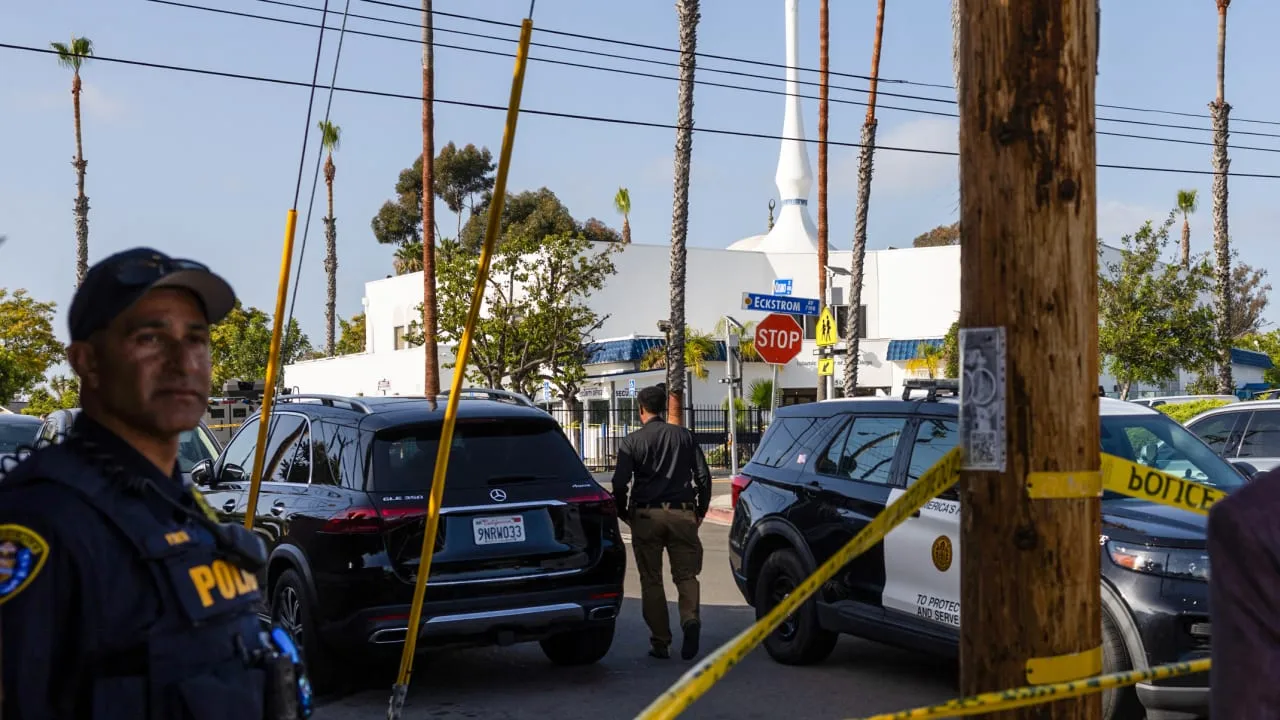
Over a year before Caleb Vazquez and Cain Clark murdered three men in a shooting at the Islamic Center of San Diego, Vazquez demonstrated behavior so concerning that it led local law enforcement to confiscate his father’s guns, according to a New York Times report on Friday.
According to the report, documents filed at San Diego Superior Court demonstrate that Vazquez had been on the police’s radar long before Monday’s shooting.
In a January 2025 protective order, one police officer noted that Vazquez “was involved in suspicious behavior idolizing nazis and mass shooters.”
Due to his concerning behavior and involvement, a court order to temporarily confiscate weapons from the Vazquez household was filed.
Under California law, such court orders, known as gun violence restraining orders, can be filed by police or civilians who worry that an individual may be violent.
Vazquez’s family secured weapons, sharp knives away from him
According to the NYT, court documents show that Vazquez’s parents, Marco and Lilliana Vazquez, owned a total of 26 guns, three Glock handguns, a Mossberg 12-gauge shotgun, and several rifles.
In a 2025 court affidavit, Marco Vazquez stated that “he was well aware of the seriousness of the allegations made against my son.”
Marco Vazquez claimed that before the gun violence restraining order was filed, he had voluntarily moved the weapons to a storage facility due to his own concerns regarding his son’s behavior.
He and Lilliana Vazquez also secured all sharp knives, increased their supervision of Caleb Vazquez, and put him in therapy. Marco Vazquez pronounced that he had no intention of bringing the guns back into his home “until my wife, my son’s therapist, and I believe it is safe to do so.”
However, in court filing documents, the police stated that Marco Vazquez “would not allow officers to confirm if firearms were stored properly.”
The Vazquez family also stated that measures were taken to help Caleb Vazquez “through his mental instability,” which included encouraging him to seek help and Vazquez voluntarily spending time in multiple rehabilitation centers.
The origin of the specific weapons used in the mosque shooting is still unknown, according to the NYT.
Clark also grew up with guns at home, and Cain Clark’s mother had told the police that some of her guns were missing when she called to report her son as missing and possibly suicidal two hours before the shooting.
After the shooting, over 30 guns were confiscated from at least one of three homes with connections to Clark and Vazquez.
Vazquez’s family issues statement of solidarity, warns of online radicalization
The Vazquez family issued a statement on Thursday evening saying they stand with the family of the victims of the shooting, the community, and with the Muslim community as a whole.
“As much as we mourn the child we raised and love, we mourn even more deeply for the innocent lives of Amin Abdullah, Mansour Kaziha, and Nadir Awad,” the statement read.
“No statement can undo that pain, and no apology could ever be enough.”
The Vazquez family also stated that their son’s ideologies did not align with their own as “a diverse family that not only includes immigrants but Muslims as well.”
“Our son was on the autism spectrum, and it is painfully clear to us now that he struggled not only with accepting parts of his own identity but also grew to resent them. We believe this, combined with exposure to hateful rhetoric, extremist content, and propaganda spread across parts of the internet, social media, and other online platforms, contributed to his descent into radicalized ideologies and violent beliefs,” they wrote.
The Vazquezs warned against the danger of online radicalization, stating that “while there is no excuse for his actions, we have come to recognize how dangerous online spaces are that normalize hatred.”
The statement further encouraged anyone struggling with violent thoughts, anger, radicalization, or hate to seek help.
“Do not allow anger, isolation, propaganda, or hatred to grow into violence and terror. Nothing is worth causing this kind of irreversible pain to innocent people, families, and entire communities,” it read.