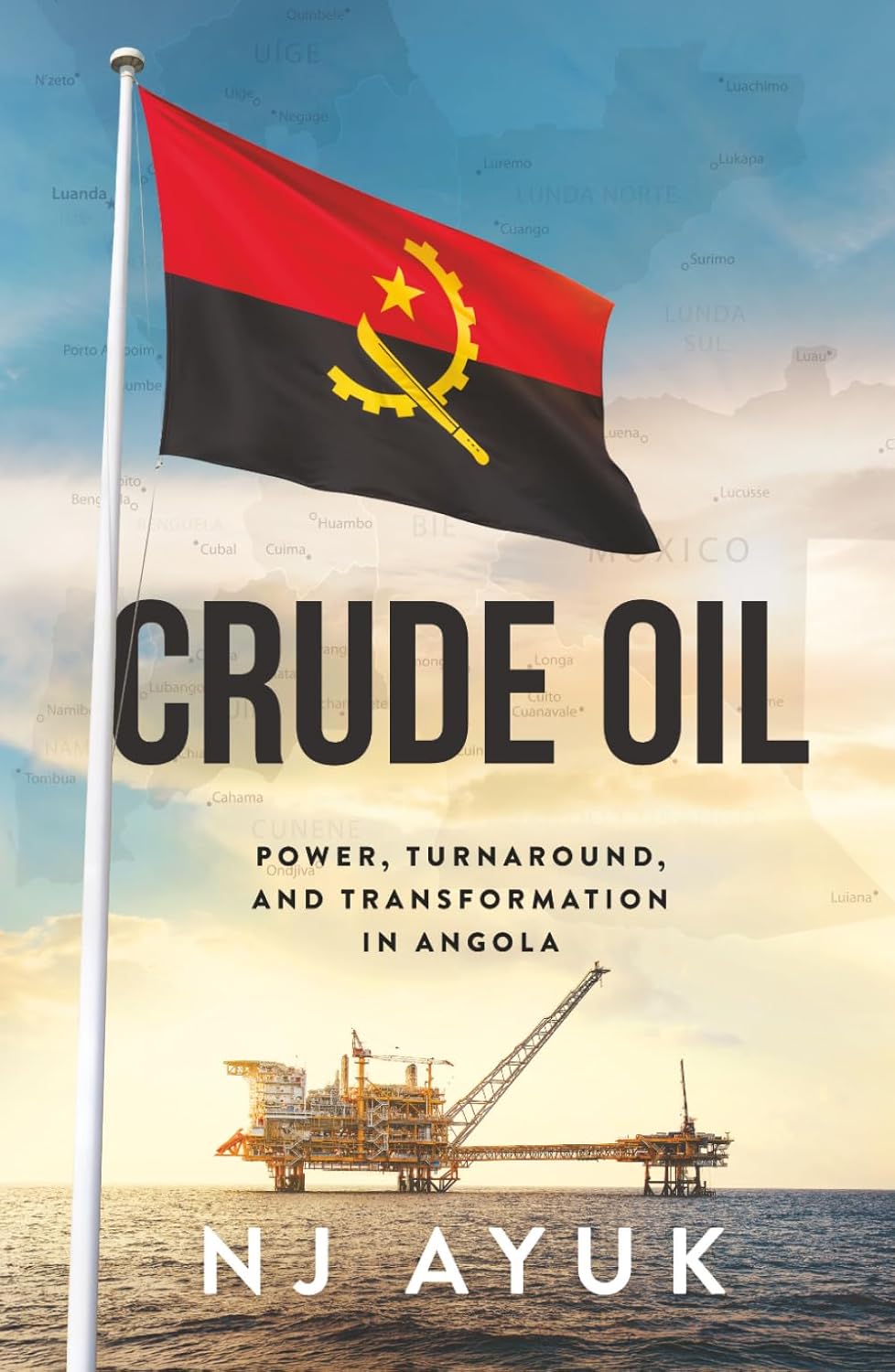
NJ Ayuk’s new book, Crude Oil: Power, Turnaround and Transformation in Angola, presents Angola’s oil industry as more than a story of barrels, rigs and exports….
NJ Ayuk’s new book, Crude Oil: Power, Turnaround and Transformation in Angola, presents Angola’s oil industry as more than a story of barrels, rigs and exports.
It frames the country as a political-economy case study in how a resource-dependent African state is attempting to rebuild credibility after years of war, corruption, institutional weakness and overdependence on crude.
The book argues that Angola has moved from a troubled oil-dependent past into a reform-driven phase under President João Lourenço, with Diamantino Azevedo, the country’s Minister of Mineral Resources, Petroleum and Gas, presented as one of the key technocratic figures behind the sector’s turnaround.
At the centre of Ayuk’s argument is the idea that Angola’s oil sector is becoming a model for how African resource states can reform their petroleum industries without abandoning hydrocarbons.
The book positions Angola not as a cautionary tale alone, but as a country seeking to convert its oil wealth into a more credible platform for governance reform, investment, local participation and energy transition.
Oil as blessing and burden
Ayuk’s treatment of Angola’s oil story begins with the familiar paradox of resource-rich African economies: oil as both blessing and burden.
Angola’s crude wealth helped drive postwar reconstruction, economic expansion and international investor interest.
But that same dependence exposed the country to volatility, weak diversification, corruption and inequality.
The 2008 oil-price collapse is presented as a decisive moment in that story. After years of postwar growth, Angola’s dependence on crude made it vulnerable to external shocks.
The crash exposed the fragility of an economy in which oil revenue carried too much of the national burden and too little of the benefit reached ordinary citizens.
Lourenço and the politics of reform
A major part of the book focuses on Lourenço’s attempt to break from the long shadow of the José Eduardo dos Santos era.
Ayuk presents Lourenço as a reformer who sought to confront corruption, restructure the petroleum sector and restore investor confidence in Angola’s economy.
One of the strongest institutional examples in the book is the restructuring of Sonangol, Angola’s national oil company.
For decades, Sonangol symbolised the fusion of oil, politics and patronage.
In Ayuk’s account, its reform represents a wider attempt to separate commercial operations from regulatory oversight and to rebuild the credibility of the oil sector.
Sonangol as metaphor for the old and new Angola
The creation of the National Agency for Oil, Gas and Biofuels is treated as a central pillar of Angola’s reform agenda. By separating regulatory functions from Sonangol’s operational role,
Angola sought to address one of the most persistent weaknesses in African petroleum governance: the concentration of policy, regulation, commercial activity and political influence in one dominant state oil company.
In this sense, Sonangol becomes one of the book’s most important institutional characters.
It represents both the old Angola and the new Angola Ayuk believes is emerging. When Sonangol changes, the book suggests, Angola’s political economy also begins to change.
Diamantino Azevedo and the technocratic face of reform
Ayuk also places significant emphasis on Azevedo, presenting him as a veteran engineer, professor and industry executive whose role has been central to Angola’s energy-sector reforms.
The book portrays him as a technocrat focused on using oil and gas revenue to support broader development, rather than allowing hydrocarbons to remain detached from the wider economy.
This gives the book a human dimension. Angola’s reform programme is not presented only through laws, agencies and production targets, but through personalities who are shown as shaping policy direction, investor engagement and sector discipline.
Local content and the Angolan stake
Local content is another major theme.
The book argues that Angola’s oil revival cannot be measured only by foreign investment, production levels or new licensing rounds.
It must also be judged by the extent to which Angolan companies, workers and service providers participate in the petroleum value chain.
That focus moves the conversation beyond crude exports.
It raises a larger development question: whether Angola’s energy reforms can build domestic capacity, strengthen local businesses and create wider economic linkages in construction, logistics, technology, agriculture and services.
Natural gas as the next strategic chapter
Natural gas is presented as Angola’s next major strategic chapter.
Ayuk highlights Angola’s gas reserves, the 2018 Natural Gas Law, the Gas Monetization Law and the Angola LNG project as evidence that gas is moving from a neglected by-product of oil production to a central development asset.
The book’s argument on gas speaks directly to Africa’s energy transition debate.
Ayuk’s position is clear: gas should be treated as a development fuel for African economies, not dismissed because of climate timelines shaped largely by Western industrial powers.
Angola, OPEC and production sovereignty
The book also treats Angola’s 2023 exit from OPEC as a defining moment.
Rather than presenting the exit merely as a technical dispute over quotas, Ayuk frames it as a statement of national interest and production sovereignty. In his telling, Angola’s departure from OPEC reflects a broader desire by African producers to assert agency in a global energy order that often constrains them.
This is one of the sharper contemporary angles in the book.
It shows Angola not simply as a producer responding to global market rules, but as a state trying to reclaim room for manoeuvre in a system where African producers often operate from a position of limited leverage.
Refining and the domestic paradox
Another important issue raised in the book is refining.
Angola remains a major oil producer, but like many African producers, it faces the domestic paradox of exporting crude while struggling with adequate refining capacity at home.
The planned Lobito Refinery, with a proposed capacity of 200,000 barrels per day, is used to illustrate both Angola’s ambition and the structural constraints that still stand in its way.
This refining question goes to the heart of Angola’s next economic challenge: whether it can move from crude extraction to value addition.
For many African oil producers, the real test is no longer just whether they can produce oil, but whether they can build the infrastructure, institutions and industrial base to capture more value domestically.
A just transition on African terms
Ayuk extends his argument in the final chapters, where the book turns to renewables, critical minerals, hydropower, green hydrogen and the just energy transition.
He makes the case for an African transition pathway rooted in energy access, industrialisation and realism.
His position is that countries such as Angola must diversify their energy mix while still using oil and gas to finance development and reduce energy poverty.
This is perhaps the book’s most polemical argument: that Africa should not be forced into an externally imposed transition timetable that ignores the continent’s development realities.
History as energy background
Ayuk’s book is also notable for its historical sweep.
The early chapters cover Angola’s geography, demography, natural resources, colonial experience, slavery, civil war and postwar political economy.
This gives the work a wider frame than a conventional energy-sector book.
It seeks to explain how land, history, war, colonial extraction and governance shaped Angola’s modern oil industry.
That wide canvas is one of the book’s strengths, although it may also slow the pace for readers looking for a tighter sector-focused account.
Ayuk appears determined to show that Angola’s oil industry cannot be understood outside the country’s broader historical and political formation.
The question of reform optimism
The book’s main limitation may be its reform optimism.
While it acknowledges corruption, infrastructure gaps, skills shortages, gas-price volatility and competition from other African producers such as Nigeria and Mozambique, its tone remains strongly positive about Angola’s direction.
That raises a fair question for readers: is Crude Oil a rigorous account of Angola’s transformation, or a persuasive advocacy text for the country’s energy-sector revival?
The answer may be that it is both. Ayuk writes not as a detached academic observer, but as a strong advocate of African energy development and resource sovereignty.
Lessons for African oil producers
Still, the book’s value lies in how it connects oil to governance, sovereignty and national renewal.
It presents Angola as a country trying to move from extraction to reform, from state capture to institutional credibility, and from crude dependence to a broader energy future.
For other African oil producers, particularly Nigeria, the book offers a useful mirror.
It suggests that petroleum reform is not just about new laws or production targets.
It is about institutions, leadership, local capacity, domestic value addition and the political will to ensure that national resources serve more than a narrow elite.
Africa’s right to define its own energy future
In Crude Oil, Ayuk makes Angola’s oil story a continental argument: Africa should not be forced to choose between development and energy transition.
It should be allowed to use its resources responsibly, reform its institutions honestly and define its own path from resource wealth to broad-based prosperity.
The result is a book that is both analytical and argumentative.
It is a defence of Angola’s oil-sector turnaround, but also a wider statement about Africa’s place in the global energy debate.
Its strongest contribution is not simply that it explains Angola’s reforms, but that it asks a larger question: can African resource states turn oil from a source of vulnerability into an instrument of national renewal?