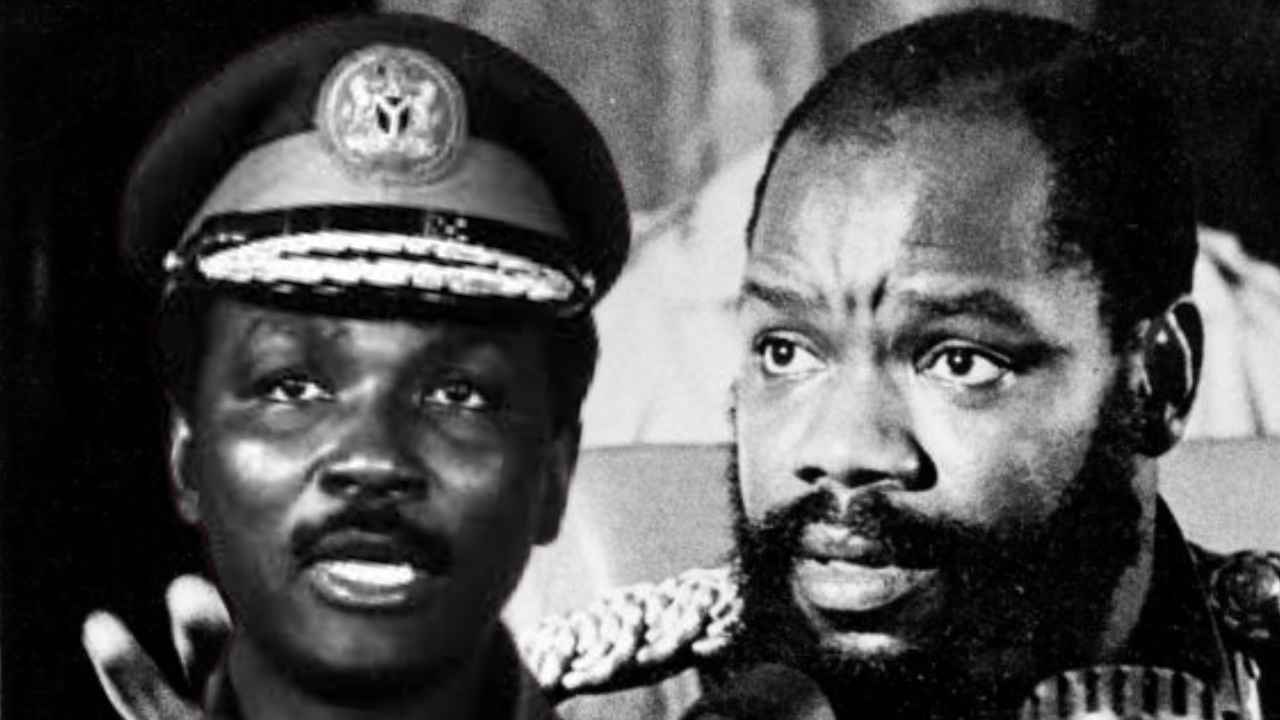
Mr Gowon said he was shocked to hear Mr Ojukwu telling people in the Eastern Region that both parties had agreed to partition Nigeria so that each region could go its separate way following the Aburi meeting held in Ghana on 4 and 5 January, 1967.
Nigeria’s former military Head of State, Yakubu Gowon, has said no agreement was reached at the Aburi meeting to allow the Eastern Region to secede and establish Biafra, contrary to claims made by the then Eastern Region leader, Chukwuemeka Odumegwu Ojukwu, in the build-up to the Nigerian civil war.
Mr Gowon, who ruled Nigeria between 1966 and 1975, said he was shocked to hear Mr Ojukwu telling people in the Eastern Region that both parties had agreed to partition Nigeria so that each region could go its separate way following the Aburi meeting held in Ghana on 4 and 5 January 1967.
The former Nigerian leader gave the account in his autobiography, “My Life of Duty and Allegiance,” launched in Abuja on Tuesday.
The event, chaired by former President Goodluck Jonathan, was attended by prominent Nigerians, including President Bola Tinubu, who was represented by his deputy, Kashim Shettima.
Mr Gowon, who was the Nigerian leader during the civil war, fought between 6 July 1967 and 15 January 1970.
The war broke out following deep ethnic, economic and political issues that emerged after the country gained independence from Britain barely six years earlier in 1960.
At the time, Nigeria was divided into four regions: the Northern Region, dominated largely by the Hausa-Fulani; the Eastern Region, dominated by the Igbo; and the Western Region, dominated by the Yoruba. The Midwest Region was created in 1963 from the Western Region to accommodate minority groups.
The Eastern Region, led by Mr Ojukwu, then a Colonel in the Nigerian Army, fought for independence and survival under the banner of the self-declared Republic of Biafra. The declaration of secession eventually triggered the civil war, which claimed between one and three million lives, many through starvation and disease.
Before the outbreak of the war, both leaders sought dialogue, including a peace meeting facilitated by Ghana’s then Head of State, Joseph Arthur Ankrah, at Peduase Lodge in Aburi, Ghana.
At the meeting, both sides agreed to renounce the use of force in resolving the crisis, although the country later descended into war.
Mr Ojukwu, who led the Biafran side during the war, died in London on November 26, 2011, at the age of 78 after a prolonged illness. He was later buried in his hometown of Nnewi, Anambra State, in March 2012, following a state funeral.
In his memoir, Mr Gowon recounted that shortly after returning from Aburi, the then-governor of the Mid-West Region, David Ejoor, contacted him to ask if he had heard Mr Ojukwu’s broadcast about the outcome of the meeting.
“I rose from bed, aghast as Ejoor summarised the thrust of Ojukwu’s address to the people of Eastern Region. Among other things, he had told his people that we had agreed to partition Nigeria so that each Region could, from that point, go its separate way,” he said.
He quoted Mr Ojukwu as telling Easterners that: “Politically, it was unanimously agreed that it was in the interest of the safety of this nation that the regions should move slightly further apart than before.”
Mr Gowon, however, argued that the interpretation was false and inconsistent with the resolutions reached at the meeting.
“That was completely wrong. First, it should be remembered that Gen. Ironsi had, by the Unification Decree No. 34 of 1966, decreed Nigeria a unified country and government. That Decree created a lot of fears everywhere in Nigeria. The Midwest may have found it a bit non-threatening because the Region has always believed in one Nigeria. In the Eastern Region, everyone appeared to have warmly received it. This may have been because people from the region were the ones who advised Ironsi to carry through his programme and, consequently, were the ones in charge.
“The implementation of the Decree encouraged the posting of people from one part of the country to assume superior offices in other parts. In the North, the Midwest and the West, the implementation of the decree further fuelled the fear of Eastern domination. On coming to power, I restored the Federal system of government by abrogating the Unification decree.”
The former head of state further argued that Mr Ojukwu’s interpretation of the Aburi resolutions reflected a personal political agenda rather than a collective national position and specifically said records of the meetings did not support Mr Ojukwu’s claim.
“What Ojukwu said, therefore, merely confronted to his own personal agenda, not the agreed position at Aburi and not what the generality of Nigerians wanted. Records of the meeting did not support his stance either,” Mr Gowon said.
The former head of state maintained that the Aburi meeting was fundamentally aimed at preserving Nigeria’s unity rather than facilitating separation.
“More worrisome, however, was that he consciously preached a divisive philosophy, knowing fully well that the meeting at Aburi was all about our collective resolve to commit to an indivisible Nigeria. Worse, he sold the illusion of ‘independence’ to traumatised people who were already tired of bloodshed and needed some form of healing and closure. These were some of the considerations that informed my acquiescence to the weakening of my position as Head of State,” he said.
Mr Gowon also accused the former Eastern Region leader of repeatedly breaching agreements reached during the crisis.
“Ojukwu’s serial breach of simple agreements cast a shadow on the light I thought I saw at the end of the tunnel before we met in Aburi. By his action, he quite easily confirmed our suspicion that he had pressed for a renunciation of the use of force to settle the brewing national crisis, knowing fully well that he had no plan to keep his word. But it was a bad strategy for him to have shown his hand that early. His action naturally set the ground for unavoidable disagreements and confrontation.”