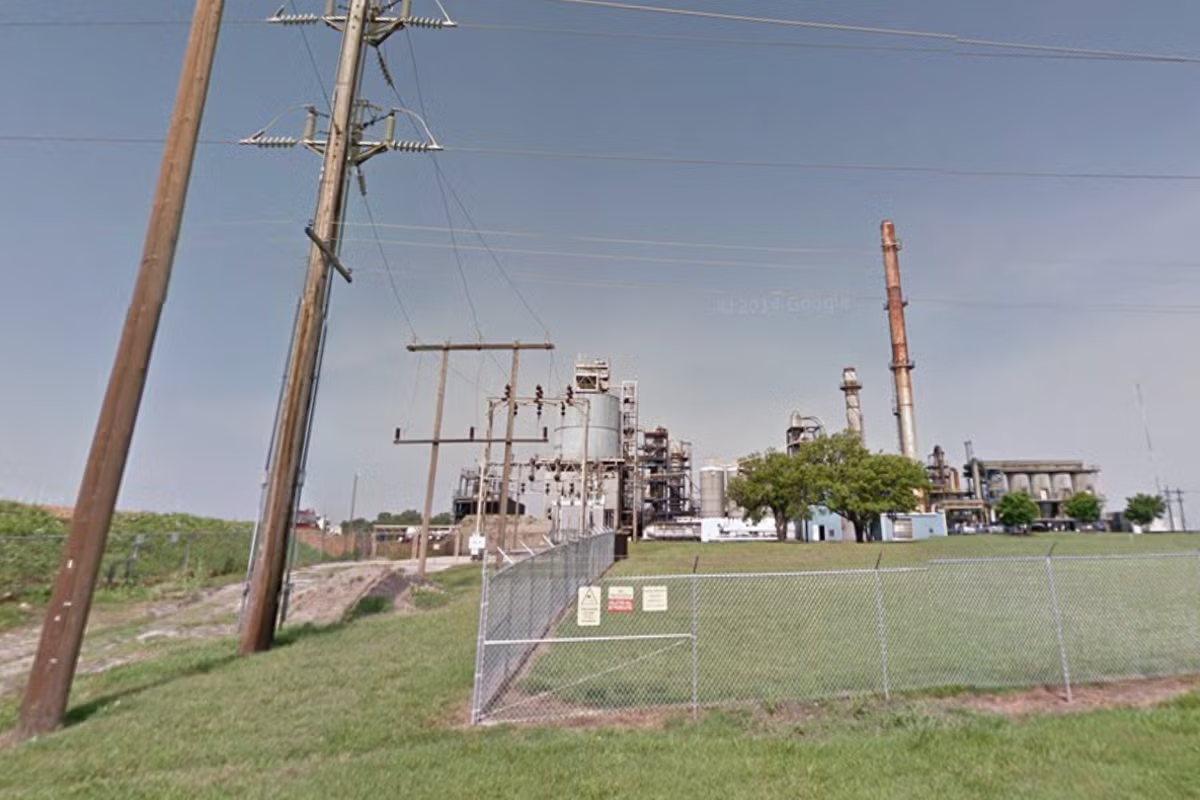
Residents of a small Oklahoma town are begging for help as a mysterious black dust coats their homes, cars, yards, playgrounds and entire neighborhoods.
Locals in Ponca City, a small town about 106 miles north of Oklahoma City, are concerned about potential health risks or pollution that may come with the fine black substance, which many believe is carbon black — a fine powder mainly used to make tires.
“I hate it when people tell us, ‘Well, if you don’t like it, you can move,’ and I think that’s your response to contamination in a whole community?” Linda Kirby, who has lived in the town for 10 years with her husband, Travis, told KOCO 5, which published a sweeping report on the phenomenon.
“We need help,” she said. “We need to know what direction to go and to get this resolved for this community.”
Over the past two years, nearly two dozen complaints filed with the Oklahoma Department of Environmental Quality report dust coming from the Continental Carbon Company, which is located in the southern half of town.
“Continental Carbon Co is generating fugitive dust that is affecting surrounding properties,” one complaint says.
“There is thick black smoke coming from Continental Carbon,” says nother.
Longtime resident Carla Moulton told the news station that it wasn’t the first time there had been black dust coating her property.
“The last time this happened was approximately 1996 to 1999. I then had a white dog, and she would get black paws. It was this company that was letting the black out and I believe they are doing it again,” Moulton wrote in her complaint.
Residents Linda and Travis Kirby, who have lived in the town for 10 years, said the black dust coats everything, including the school their granddaughter attends.
“We’ve gone to pick up our granddaughter from school and she looks like she has come out of a coal mine from playing on the playground,” Travis said.
In 2005, members of the Ponca Tribe of Oklahoma and residents filed a federal class-action lawsuit against Continental Carbon over alleged risks of pollution and health impacts from the manufacturer.
“Air-polluting emissions” from the plant include “very fine” and “sticky” carbon black dust that is “difficult to wipe off or clean off of skin, and it can be impossible to clean off of objects such as homes, buildings, children’s toys, and cars,” according to the complaint, which was filed in the Western District of Oklahoma.
Inhaling carbon black and particulate matter can impact “internal tissues, including lung tissues,” the lawsuit said.
The company paid a $10.5 million settlement in 2009.
While the black dust seemingly went away, locals noticed its return in 2024.
“Those of us that were here in Ponca City when that happened in 2006, we know where it comes from,” Moulton told the KOCO 5.
Officials with the Department of Environmental Quality have not confirmed the source of the dust or what it is.
Ponca City Mayor Kelsey Wagner said in a statement that the agency is “actively working on strategic monitoring solutions to identify the source.”
“Right now, we have no confirmed evidence linking the dust to any specific source — and that is exactly what we’re working to find. We’re going to let the science lead this investigation and take action when we have the facts to support it,” she said.
The Independent requested comment from Continental Carbon.
The company has also previously been accused of causing environmental issues. In 2005, the Paper, Allied-Industrial, Chemical and Energy Workers Union, which included members who worked for the facility, as well as the Ponca Tribe, filed a lawsuit accusing the company of violating the Clean Water Act by polluting the groundwater and contaminating a nearby marsh.
The company later agreed to implement a “Groundwater Monitoring Plan,” according to the report. It was not immediately clear what the plan entailed. However, the trees outside the facility are stained black, according to the report.
Locals have also reported health issues that they fear may have been caused by exposure to carbon black. The 2005 lawsuit from the Ponca Tribe noted that repeated exposure to carbon black can cause respiratory issues and cancers.
Moulton, who filed the complaint in 2024, said she recently had lung cancer and felt she shouldn’t be inhaling the black dust.