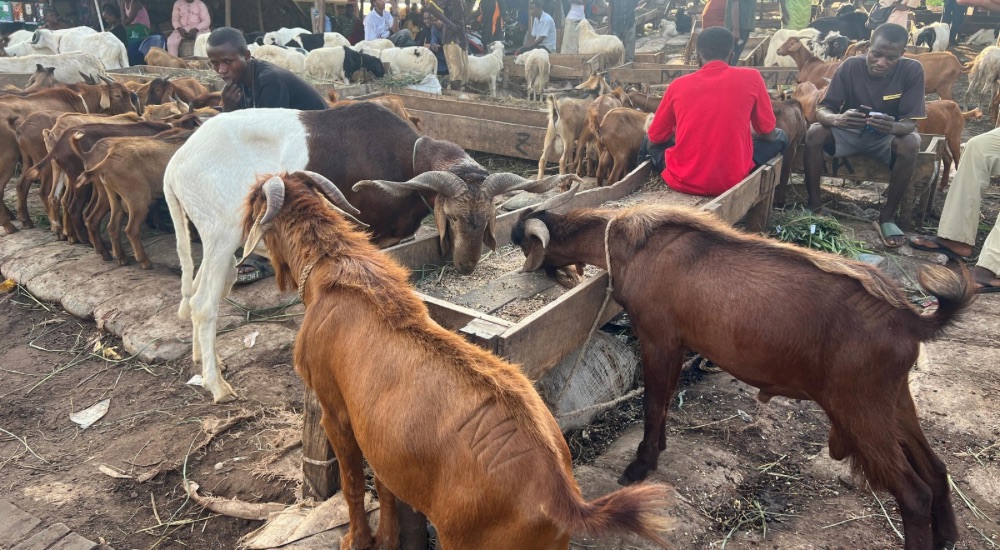
Eid-ul-Adha is one of the most important religious celebrations for Muslims across Nigeria and beyond. But THE WHISTLER’s survey indicates that many families may be forced to scale down plans as the prices of rams, cows and staple food items continue to climb.
The survey showed increases in the prices of livestock and food commodities compared to 2025, with traders and buyers blaming inflation, insecurity, transportation costs, fuel prices and supply shortages.
In some of the markets visited by our correspondents, rams sold for as high as N1.2m. Rams that sold for about N380,000 last Sallah are now priced as high as N700,000 in some stalls visited by our correspondents. Cows also crossed N2.5m in some markets. A bag of rice averaged N55,000.
Traders who spoke to THE WHISTLER said the price increases are affecting patronage despite the rush usually associated with the festive period.
At the Kugbo Ram Market in Abuja, Kabiru Hassan, a ram seller who spoke in Hausa, said the prices this year had risen beyond what many buyers could afford.
“The price of rams ranges from N250,000, N350,000, N500,000, N600,000 and N1.2m.
“This year the price is high due to the cost of transportation; last year’s N300,000 rams are now N350,000.”
Another livestock dealer at the market, Sani Ibrahim, confirmed that many traders were struggling to sell because buyers no longer had the spending power they had last year.
“The factors that cause it (rising cost) are from the leadership. There’s a huge difference in prices between the last year and now. The ram we are selling N1m now was N600,000 to N700,000.
“I came with over 30 rams, it was with grace I am able to sell only 3 rams for now. I have to slash the price to sell. The rams cost N1m but I later sold them at N700,000.
“We are calling on the government to look into the market issues and provide a solution to it.”
Buyers said the market reality has forced them to adjust budgets or change their plans.
Speaking with THE WHISTLER at Kugbo Market, Ibrahim Sediq, a civil servant, said his budget of N500,000 could no longer secure the size of ram he bought last year.
“If you look at all the rams here now, compared to this time last year, they’d have bought all of them. There’s no money. The one I bought last year was about N450,000.
“We are still bargaining. The high prices have affected my plan. My budget this year is N500,000 but the rams I’m seeing here are going for N600,000, N650,000 and N700,000.
“As you can see, the prices are high, that is why the market is not moving, because there’s no money.”
Another buyer, Mustapha Sheika, said although prices had increased, several factors were responsible for the rise.
“There’s a slight difference in this year compared to last year, yes, there’s an increase. Of course, last year we got it way cheaper than this year, but the change in price is not really very high. You can still get a good ram for around N300,000, N400,000, and N500,000.
“Based on my budget, I don’t plan to spend more than N400,000 on ram.”
Sheika added, “…If you understand a lot of the factors that contribute to some of these increases in prices, you will not really be (angry), you will understand, you know, you’ll understand why there’s that price increase.
“Number one, of course, there’s insecurity, you know, this livestock, they are moved from the north to Abuja and all the way down to southern Nigeria. So, of course, where you source them, there’s a lot of insecurity there, that’s one.
“Again, there’s an increase in petrol prices. The cost of transportation has gone up, so it also affects the prices.
“Then, by extension, there’s an increase in the prices of feed, which is also affected by some other factors that I mentioned earlier. So by and large, that’s what affected the increase in prices.”
At the same market, Okpe Emmanuel, a staff member of the Animal Husbandry Services under the Agricultural and Rural Development Secretariat (ARDS), Federal Capital Territory Administration (FCTA), said the restriction on livestock movement from Niger Republic had also contributed to the increase.
“The reasons why prices went up are many. What we heard was that the president of the Niger Republic refused rams or animals to cross the border.
“So the border has been closed for animals coming to Nigeria except the ones being smuggled in or the ones we already have.
“The species of rams are different. The types that come from Niger are the Uda and the Balami, which you can see some of them here, are not as many as compared to previous years.”
He also mentioned rising transportation and fuel costs.
“Also, the sellers transport the livestock from far away down here. The price of a single ram on transit is higher than the previous year.
“Last year, it was like N500 but this year I think it’s over a thousand just to transport a ram, not to talk of feeding along the way.
“The other factor is because of the fuel. Because of the war in Iran, the prices of fuel went up. So the price of everything, even medication, also went up.
“So if the prices of things go up like this, definitely the prices of the ram itself as a product will go up.”
More details here...