• US report: 30,000 armed Fulani militants operating across Nigeria
•Says attacks have displaced 1.3 million people
•Highlights Nigeria’s efforts, limitations in ending menace
Emmanuel Addeh in Abuja
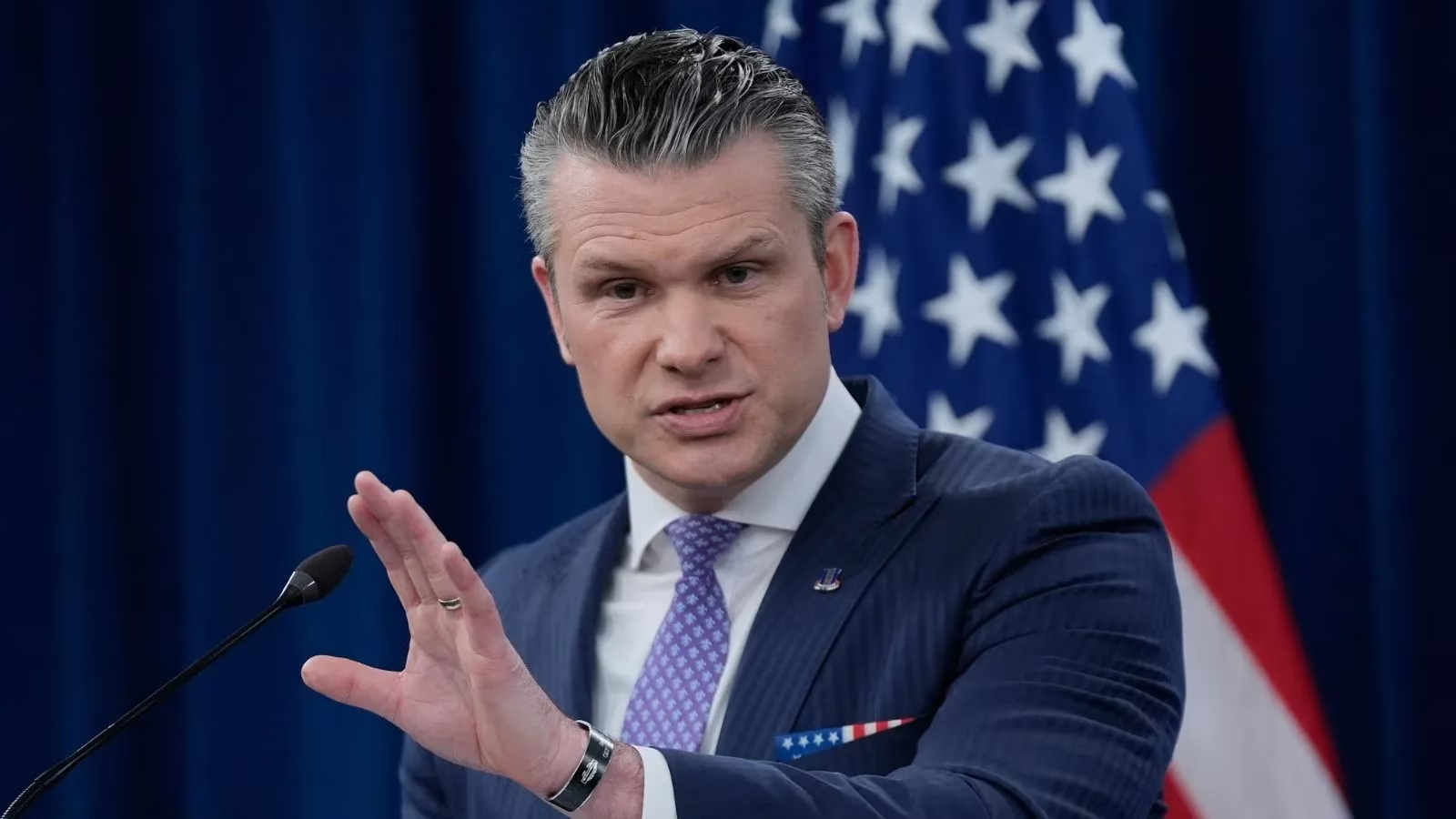
Secretary of War, Pete Hegseth, yesterday praised recent efforts by the U.S. military to counter the Islamic State amid its ongoing attack on Nigerians, especially Christians in the West African country.
The secretary, in a statement posted on the department’s website, recalled how President Donald Trump charged the War Department to take steps to protect the persecuted Christians, who the US said compose roughly one-half of Nigeria’s population.
“Maybe a year ago, (the president) heard the call of Nigerian Christians who were being targeted and killed by ISIS. … And he said, ‘Pete, I want the War Department to focus on ensuring that we do everything we can to protect those Christians,’” Hegseth explained.
He added that while forming the partnerships necessary to execute such a mission could take time behind the scenes, the president remained persistent, until the proper assets were eventually put in place.
“And, over the past month — and there hasn’t been much coverage of this — we killed ISIS’ No. 2 (commander), who was most responsible for killing Christians and trying to target the U.S. homeland,” Hegseth said.
On May 16, U.S. Africa Command announced via a press release that, at the direction of the president and secretary of war, U.S. forces had conducted an operation that day against ISIS elements in Northeastern Nigeria.
“The command’s initial assessment is that multiple terrorists, to include Abu-Bilal al-Minuki, the director of global operations for ISIS, as well as other senior ISIS leaders, were killed during this operation. No U.S. service members were harmed,” the statement read at the time.
“This operation underscores the exceptional value of the U.S.-Nigeria partnership and was made possible through the cooperation and coordination of our forces in recent months,” Air Force Gen. Dagvin Anderson, Africom commander, was quoted in the release.
Hegseth pointed out that from the outset of U.S. operations against ISIS in Nigeria, high-quality intelligence gathered has led to the elimination of additional “hundreds” of ISIS members who had been killing Christians in the country.
He underscored the importance of the president’s initiative to protect the Nigerians. “There’s a lot of things we do … and a lot of things the president empowers the department to do on behalf of the American people that he deserves great credit for,” Hegseth said.
Also, a new report released by the United States Commission on International Religious Freedom (USCIRF) has revealed that about 30,000 armed Fulani militants are currently operating across Nigeria, carrying out deadly attacks, kidnappings and widespread violence that have displaced over 1.3 million people, especially in the country’s Middle Belt region.
The report described the armed groups as one of the most dangerous non-state actors in Nigeria, stressing that their activities have intensified insecurity, deepened humanitarian crises and worsened religious tensions in several parts of the country.
The report stated that attacks linked to the groups have resulted in thousands of deaths, destruction of villages and mass displacement of rural populations over the years.
“An estimated 30,000 Fulani militants likely operate across the country, traditionally concentrating in the country’s northwest, then migrating down through the Middle Belt, and becoming increasingly active in the South. Each group consists of anywhere from 10 to 1,000 members.
“While these militants do not share a centralised leadership, some collaborate on attacks. Violence by Fulani militants caused the highest number of deaths among all religious communities in Nigeria over the last year as compared to attacks by organised insurgent groups and criminal gangs.
“Fulani assailants have not spared Muslims, raiding herders’ cattle and violently attacking non-Fulani Muslim communities. Furthermore, many militants have targeted Christian communities in the Middle Belt and, increasingly, the South, burning homes and churches as well as kidnapping, raping, and murdering.
“Militants often coordinate via radio and utilise motorcycles and automatic weapons, rapidly hitting several targets at once in rural, isolated areas. They often wield machetes and descend on vulnerable communities,” the report said.
The commission estimated that at least 1.3 million people had been displaced by violence associated with the groups, with Benue, Plateau, Kaduna, Nasarawa and parts of Niger states among the worst-hit areas.
However, the report cautioned against viewing the violence solely through a religious lens, stressing that the conflict is rooted in multiple overlapping factors.
“The violence associated with Fulani militants is driven by a complex combination of religion, ethnicity, competition over land and water resources, criminality, and environmental degradation,” USCIRF stated.
It added that worsening desertification, population growth and shrinking grazing routes have intensified clashes between nomadic herders and sedentary farming communities across northern and central Nigeria.
The commission further alleged that some militant factions have developed links with criminal gangs and extremist groups operating in the region. “Some Fulani militant groups reportedly collaborate with bandit groups and other armed actors to conduct raids, cattle rustling, kidnappings for ransom, and attacks on civilians,” the report said.
USCIRF criticised the response of Nigerian security agencies, arguing that authorities have struggled to effectively contain the violence despite repeated military deployments and security operations.
“Government authorities have often failed to prevent attacks, respond rapidly to incidents, or hold perpetrators accountable,” the report stated.
According to the commission, the inability to consistently prosecute perpetrators has contributed to a climate of impunity and recurring cycles of violence in affected communities.
The report also cited accusations by some local communities that security responses are sometimes delayed or inadequate, although it acknowledged that Nigerian authorities continue to face enormous operational and logistical challenges in tackling insecurity across multiple fronts.
Despite its criticisms, USCIRF highlighted several efforts undertaken by the Nigerian government to address the crisis. The report referenced increased military operations in parts of the North-central and North-west, expanded intelligence-sharing efforts and the deployment of special security task forces to troubled communities.
It also noted that the administration of President Bola Tinubu had taken steps to strengthen counterterrorism measures and intensify actions against armed groups involved in kidnappings and violent attacks.
Nevertheless, USCIRF maintained that the government’s response has not been sufficient to stem the scale of the violence. “Despite government efforts, attacks by Fulani militants continue with devastating consequences for civilians,” the report stated.
USCIRF argued that persistent violence by both state and non-state actors, including extremist and armed groups, continues to threaten religious communities and undermine stability in Africa’s most populous nation.
“There has been some evidence of increased government efforts, both before and after the October CPC (Country of Particular Concern) designation, to address Fulani-led violence through prosecutions and community-level engagement.
“In September, prosecutors filed initial terrorism charges against nine Fulani herders. All nine defendants, including the alleged organiser of the massacre, Lawal Mohammed Dono Ardo, have reported ties to the Miyetti Allah Cattle Breeders Association of Nigeria (MACBAN),” it stated.