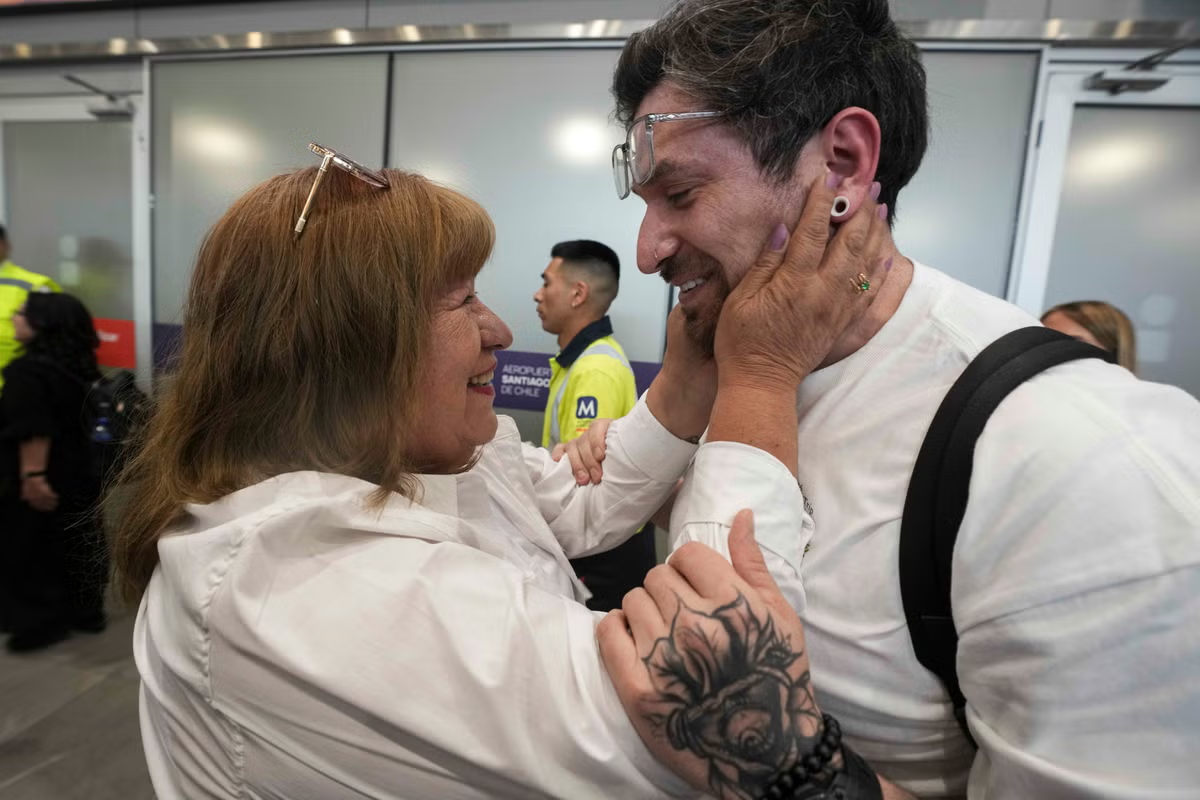
The profound discovery that he was stolen from his Chilean mother as an infant sent Kyle Adler into an identity crisis that spanned years, culminating in an emotional reunion with his biological family earlier this year.
“It’s been so eye-opening to see who my people are,” Adler said. “I feel the love, I feel the compassion, the care — it’s nice to have a family again.”
Adler, 36, was adopted by an American family at nine months old. He is one of thousands of children forcibly taken from Chilean families during Gen. Augusto Pinochet’s 17-year dictatorship, and among hundreds now being reunited with their birth relatives through DNA tracing and dedicated organizations.
These groups are not only facilitating reunions but also campaigning for justice for the families torn apart.
Raised in an affluent Chicago suburb by his adoptive parents, Mike and Connie Adler, Kyle believes they were unaware of the illicit circumstances surrounding his adoption in 1990.
“My parents didn’t steal me; they didn’t name me Kyle out of malice. They saw me as who they wanted me to become, and there’s a lot of love that was put into that,” Adler stated.
He noted that neither parent, who both passed away in 2022, initially supported his quest to find his birth mother. Despite his successful upbringing, Adler felt a void. “Suddenly, now I found myself where I didn’t know what to do. I knew I was adopted and at that point, I was just like, I need to find my mom.”
His biological mother, Ana Maria Navarrete, was a 19-year-old single parent working nights at a fish shop in Coronel, 331 miles south of the capital. She had named him Marcos Antonio Navarrete.
Unable to afford a room for both of them, she entrusted her baby to a caregiver. Navarrete told The Associated Press she visited him whenever possible. One day, the caregiver informed her that an American couple had taken her son, arranged by a local priest for a baby “in need of a family.”
“And she let them have him,” Navarrete recounted, expressing both fury and shame. A police investigator later suggested the baby was likely part of a vast counterfeit adoption network involving agencies, immigration officials, judges, nurses, and doctors.
Navarrete said no one was held accountable, and “those years afterward were some of the worst years of my life.” Lacking family support, she eventually abandoned the hope of getting her son back.
“Justice for the poor did not exist in Chile and it still does not,” said Constanza Del Rio, founder of Nos Buscamos, a nonprofit with an extensive database of cases. The government estimates over 20,000 children were stolen.
Human rights lawyer Jimmy Lippert Thyden González, himself illegally adopted, explained that children from poor and Indigenous populations were targeted during the Pinochet regime from 1973 to 1990.
“It was an effort to eliminate and eradicate the poor class. It was a way of eradicating the Indigenous population, the uneducated population,” he asserted.
Adler’s journey to uncover his past began in early 2017 when he stumbled upon the Nos Buscamos Facebook group while searching online for “Chilean birth mom search.” He messaged Del Rio, who, within three months, confirmed his origin story and arranged a virtual reunion.
Initially, the revelation of his illegal adoption was crushing, leading to years of therapy. Last year, Adler finally felt ready for answers. A DNA test from MyHeritage, a global family history company, confirmed a match with 56-year-old Navarrete, making it “official.”
MyHeritage collaborates with Nos Buscamos, Connecting Roots, and other nonprofits to provide free at-home DNA testing kits to Chilean adoptees and suspected trafficking victims.
Tyler Graf, founder of Connecting Roots, who also reunited with his birth mother decades after being taken, traveled with Adler. Graf stated his mission is now to track others taken from Chilean families: “Now it’s time to mend these families and bring everyone back home so they can see where they came from.”
The fight for justice continues. Lippert Thyden González sued the Chilean government three years ago, aiming to take the battle to the Inter-American Court of Human Rights. He also founded Grafting Hope, a nonprofit dedicated to educating U.S. lawmakers and advocating for survivors of counterfeit adoptions.
The Chilean government did not immediately respond to AP’s requests for comment. “I want justice. Not just for me, but also for him because I don’t know the type of life he had,” Navarrete told AP days after her reunion, now working with a law firm in hopes of seeing those involved face jail time.
“My birth mom’s just been wanting me to be alive,” Adler said before boarding his flight from Miami in February. The reunion occurred two days after Navarrete’s 56th birthday, on Valentine’s Day, with an AP team present in Miami and Chile. Tears flowed as Adler emerged from international arrivals in Chile.
Both mother and son, dressed in white, embraced, with the tall, dark-haired Adler bending to bury his face in his mother’s hair. “I’m so happy to be finally meeting him, my dream has finally come true,” Navarrete exclaimed.
The emotional week included visits to Coronel beach, the hospital where Adler was born, and the house from which he was taken. They recovered a copy of his original birth certificate, and he met one of his four siblings, having previously met another sister and her daughter in Miami.
Back in Santiago, they shared keepsakes Adler brought: a framed graduation diploma, childhood photographs, and baby shoes his adoptive parents had kept. A translator from Connecting Roots facilitated communication, now supplemented by translation apps.
Navarrete described the time with her son as joyful but also a painful reliving of the past 35 years. “It took me so long to find him. And then to spend a week together only to have him leave,” she said through tears, adding, “it’s like I found him but I’ve now lost him all over again.”
More details here...