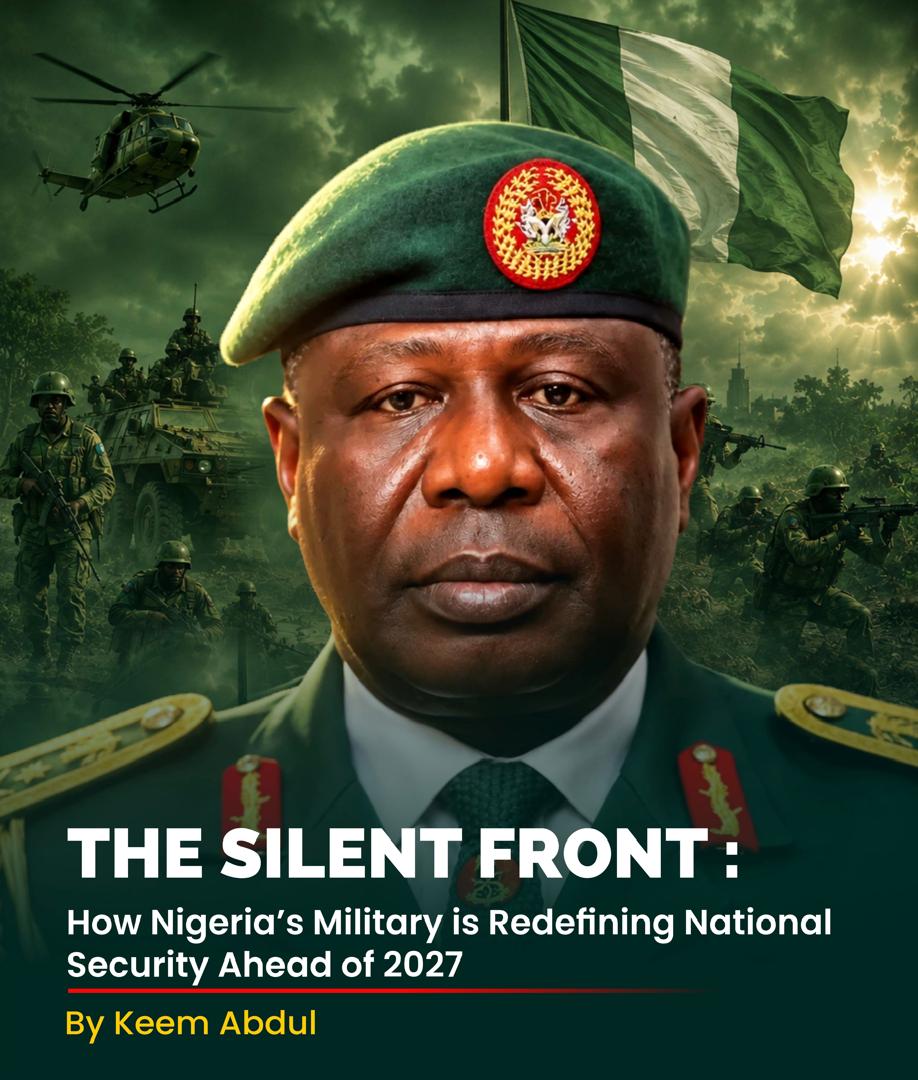
When Nigerians think of the Armed Forces, the image is usually stark: troops in desert fatigues, armored vehicles rolling through the Northeast, gunboats patrolling the Niger Delta, fighter jets streaking over the Northwest. For two decades, Nigeria’s security story has been written in the language of bullets, bombs, and body counts.
But under Chief of Defence Staff General Olufemi Oluyede, a quieter front is opening up. It’s a front shaped by his years in Port Harcourt as General Officer Commanding of the 6 Division and Land Component Commander of Operation Delta Safe, where he saw firsthand how quickly a military operation could be won on the ground and lost in the court of public opinion.
Today, the weapons are narratives, the battles are fought in news cycles, and the territory being contested is public perception. It is a shift that signals more than a change in tactics. It is the emergence of a new military doctrine for Nigeria — one that treats information integrity and strategic communication as equal to firepower. And with the 2027 general elections already casting a long shadow over the political landscape, the implications are profound.
From the Battlefield to the Information Space
For years, Nigeria’s military doctrine was built around kinetic response. Insurgency in the Northeast, banditry in the Northwest, separatist agitation in the Southeast, militancy in the South-South — each demanded troops, equipment, and boots on the ground. The Defence Headquarters reported in terms of terrorists neutralized, camps destroyed, weapons recovered.
That approach has not disappeared. Operation Hadin Kai in the Northeast, Operation Safe Haven in the Plateau, and the ongoing campaigns against bandits in Zamfara and Katsina remain central to the Armed Forces’ mandate. But senior officers now admit privately that kinetic operations alone have limits.
“You can clear a village today,” one senior officer told a closed-door forum in Abuja earlier this year, “but if the narrative that follows says the military is the enemy, that village is lost again tomorrow.”
General Oluyede appears to have internalized that lesson. His posting in Port Harcourt put him at the center of one of Nigeria’s most complex theatres, where military action, community relations, and media narratives constantly collided. It was a role he once considered the height of his career — not knowing destiny would take him beyond even that ambition.
Since assuming office as CDS, he has pushed the Defence Headquarters to treat strategic communication not as an afterthought or a PR function, but as a core operational domain.
The logic is simple. In an era of smartphones, Telegram channels, and viral TikTok clips, a single video of an alleged military excess can undo months of battlefield gains. Conversely, a well-timed, factual clarification can prevent a localized incident from spiraling into national outrage.
This is not new globally. The U.S. Department of Defense has run information operations since the Cold War. Israel’s IDF has a dedicated unit for social media and narrative management. The Nigerian military is late to the game, but the urgency is now undeniable.
Why 2027 Changes Everything
Elections in Nigeria are never just about ballots. They are about legitimacy, trust, and the perception of who holds power. The 2023 elections exposed how quickly misinformation can warp the political environment. Fake results sheets circulated within minutes. Out-of-context videos were used to allege rigging in states where voting had not even begun. Deepfakes, though limited, made their debut.
The 2027 cycle promises to be worse. Internet penetration is higher. AI-generated content is cheaper and more convincing. And the stakes are higher still, as President Bola Tinubu’s first term approaches its midterm review.
For the military, this creates a dilemma. The Constitution bars the Armed Forces from partisan involvement. Yet the military is inevitably pulled into the political conversation whenever there are allegations of election interference, human rights abuses, or “militarization” of polling units.
General Oluyede’s strategy seems to be preemption. By investing in information integrity now, the Defence Headquarters aims to reduce the space for false narratives that could drag the military into political controversy later.
This means three things in practice: faster verification and debunking of viral claims, proactive communication about military operations, and closer engagement with civil society and the media to build credibility before a crisis hits.
Information Integrity as a Security Pillar
Information integrity is a term borrowed from global security discourse, but it has specific meaning in the Nigerian context. It refers to the ability of the state and its institutions to ensure that the information environment is not poisoned by deliberate falsehoods that threaten national stability.
Think of it as the digital equivalent of border control. Just as the military guards Nigeria’s land and maritime borders against external threats, it is now expected to help defend the information border against threats that can destabilize communities and undermine state authority.
Under Oluyede, the Defence Headquarters has begun restructuring its Directorate of Defence Information and the public relations arms of the Army, Navy, and Air Force. The goal is to move from reactive press releases to real-time monitoring and response.
The Directorate is now experimenting with a 24-hour digital monitoring cell that tracks hashtags, WhatsApp broadcast chains, and regional Facebook groups for emerging narratives about the military. When a false claim gains traction — for example, that soldiers are being withdrawn from a conflict zone for political reasons — the cell prepares a factual rebuttal within hours, not days.
This is unglamorous work. It does not make headlines. But in the eyes of military planners, it is as important as a successful ambush against insurgents. Because if citizens believe the military has abandoned them, they stop cooperating. Intelligence dries up. Communities turn inward. The insurgency wins without firing a shot.
Strategic Communication: From Silence to Engagement
The Nigerian military has historically been criticized for its communication style: terse, technical, and often released days after an incident. The public perception was one of secrecy and defensiveness.
Oluyede is attempting to change that culture. Under his leadership, the CDS has held more direct engagements with editors, civil society leaders, and digital media influencers than any predecessor in recent years. The message is consistent: the military wants to be scrutinized, but it wants that scrutiny to be based on facts.
This does not mean the military is opening its operations room to journalists. Operational security remains sacrosanct. But it does mean explaining the “why” behind visible actions. Why was a curfew imposed in a particular town? Why were certain routes closed during a clearance operation? Why did troops respond the way they did to a protest?
Strategic communication also involves telling the human stories that rarely make it into situation reports. The soldier who negotiated the release of kidnapped students without a shot fired. The naval team that rescued fishermen during a storm. The Air Force pilots who evacuated civilians from a flood zone.
These stories do not replace the need for accountability. But they do balance the narrative. Without them, the only stories that circulate are those of alleged misconduct, often amplified by actors with no interest in the truth.
The Risk of Overreach
Any discussion of military involvement in information management must confront the risks. In authoritarian contexts, “information integrity” often becomes a euphemism for censorship and narrative control.
Nigeria’s democratic framework and vibrant press create a natural check against that. But the line between countering disinformation and suppressing dissent can be thin. If the Defence Headquarters begins to label legitimate criticism as “hostile propaganda,” it risks eroding the very trust it seeks to build.
General Oluyede appears aware of this. In public remarks, he has emphasized that the military’s role is to protect the information environment, not to control it. The distinction matters. Protecting means exposing and debunking falsehoods. Controlling means deciding what citizens are allowed to say.
Civil society groups are watching closely. Organizations like the Centre for Democracy and Development and the Premium Times Centre for Investigative Journalism have called for clear guidelines on how the military engages in the information space, and for judicial oversight where necessary.
The next two years will test whether the Defence Headquarters can maintain that balance.
Lessons from Elsewhere
Nigeria is not alone in this evolution. Kenya’s military faced similar challenges during its 2022 elections, when misinformation about troop deployments threatened to delegitimize the process. The Kenya Defence Forces responded with a public information campaign that clarified their constitutional role and debunked viral falsehoods in real time.
In Colombia, the military’s shift toward strategic communication helped reduce the influence of FARC and ELN propaganda in rural areas. By combining precise kinetic action with community engagement and narrative management, the state slowly regained control of contested regions.
For Nigeria, the lesson is that information operations work best when they are integrated with ground operations and backed by genuine accountability. A slick video means nothing if citizens on the ground have a different lived experience.
This is why Oluyede’s doctrine links information integrity to operational conduct. The two reinforce each other. Professional conduct makes communication credible. Credible communication makes professional conduct visible.
What This Means for 2027
The 2027 general elections will be a stress test for every Nigerian institution. The military is no exception.
If the Defence Headquarters succeeds in building a credible information function now, it will be better positioned to resist pressure to be dragged into partisan disputes. It will be able to respond quickly when false claims about “military rigging” or “troop intimidation” surface. And it will have a reservoir of public trust to draw on if a genuine security incident occurs during the election period.
If it fails, the consequences could be severe. A single viral video, taken out of context, could be used to justify post-election violence. A false narrative about military bias could undermine the legitimacy of the results, regardless of the actual conduct of the polls.
This is why Oluyede’s focus on perception and communication is not a distraction from thecore mission of defending Nigeria. It is an extension of it. In the 21st century, the battle for legitimacy is fought as much in the information space as it is in the forest, the desert, and the creeks.
The Road Ahead
Changing military culture is slow work. The Nigerian Armed Forces are a hierarchical, operationally focused institution. Shifting resources and mindshare toward strategic communication requires sustained leadership and budgetary support.
There are also technical challenges. Real-time monitoring of the information space requires tools, training, and partnerships with tech platforms. Countering AI-generated disinformation requires expertise that the military does not currently have in-house. Collaboration with universities, civil society, and the private sector will be essential. But the direction is clear. General Oluyede is betting that the next war Nigeria fights will not be won solely by those with the most guns, but by those who control the narrative around the guns.
It is a bet that reflects a hard truth: in a democracy, the military’s legitimacy ultimately depends on public consent. And public consent is shaped by what people believe they see, hear, and understand about the men and women in uniform.
Conclusion: Winning the War of Belief
Nigeria’s security challenges are not going away before 2027. Bandits will not suddenly lay down arms. Insurgents will not disappear. Oil theft will not stop on its own.
What can change is how Nigerians understand and interpret those challenges. If the information space is dominated by rumors, propaganda, and mistrust, every kinetic victory becomes harder to sustain. If the space is defended with facts, transparency, and timely communication, the military’s operational gains gain political meaning.
General Oluyede’s emerging doctrine recognizes this. It treats information integrity not as a soft issue for PR officers, but as a hard pillar of national security.
Whether that doctrine succeeds will depend on execution, oversight, and the military’s willingness to subject itself to the same scrutiny it demands of others.
One thing is certain: ahead of 2027, the silent front has become impossible to ignore. And for Nigeria’s Chief of Defence Staff, winning that front may be as important as any battle yet fought.
- Keem Abdul, a public relations guru, publisher and writer, hails from Lagos. He can be reached via text +23418038795377 or [email protected]