Speaking to CNBC-TV18 after the Quad foreign ministers’ meeting in New Delhi, Ratna said the ongoing crisis around Iran and the Strait of Hormuz has elevated the importance of energy security within the India-US strategic relationship.
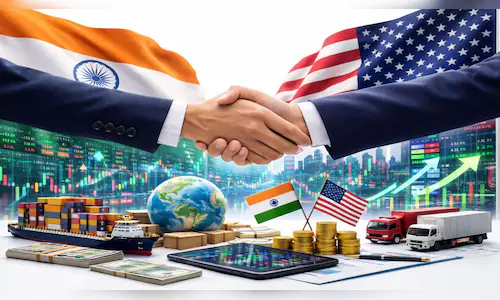
“Yes, I do believe it could be,” Ratna said when asked whether energy purchases from the US could become essential for a wider trade agreement. “During this period of the Hormuz crisis and the pushback against Russian energy, energy trade assumes a very important role.”
“I do think those deals will be critical,” she added.
The remarks come amid heightened uncertainty in West Asia after the US launched fresh strikes on Iranian missile launch sites and boats allegedly attempting to lay mines near the Strait of Hormuz. Washington described the strikes as defensive measures intended to protect American troops stationed in the region.
US President Donald Trump later said on social media that Iran’s enriched uranium would either be handed over to the United States or destroyed under international supervision, though Tehran rejected the claim. Iran’s Revolutionary Guards also warned they reserved the right to retaliate against any ceasefire violations and stressed that sovereignty over the Strait of Hormuz remained central to any peace deal.
The Strait of Hormuz remains one of the world’s most critical oil shipping routes, carrying a substantial share of global crude exports. Any prolonged disruption could sharply affect energy-importing economies such as India.
During the Quad foreign ministers’ meeting in New Delhi, the grouping refrained from directly naming Iran but condemned attacks on commercial shipping and opposed the imposition of tolls on the Strait of Hormuz.
Ratna said the Quad’s current priorities are increasingly aligned with Washington’s broader focus on economic security and strategic supply chains.
“There was also a lot of discussion around AI, telecommunications, and digital identity,” she said. “So very much, the Quad is aligning with what is actually the current foreign policy priority, which is economic security.”
She added that the grouping’s emphasis on semiconductors, critical minerals and secure supply chains reflected a major shift in American strategic thinking under the current administration.
“The reason it looks somewhat incoherent compared to what existed previously is because the entire basis of American foreign policy has been reworked under this administration,” Ratna said.
Alongside energy concerns, India and its Quad partners agreed to mobilise up to $20 billion for secure critical minerals supply chains to reduce reliance on China. India and the United States also signed a bilateral critical minerals framework focused on mining and processing cooperation.
Former US Assistant Commerce Secretary Raymond Vickery said energy agreements are likely to become a key transactional focus for Trump as he seeks economic wins through bilateral deals.
“What he wants is a transaction that shows the United States coming out on top, and energy is one of his preferred areas,” Vickery said.
He added that Washington was likely to push India to increase purchases of American oil and gas supplies if tensions with Iran begin to ease.
“I would expect progress on that front,” Vickery said.
However, he cautioned that bilateral energy arrangements alone would not resolve the broader geopolitical risks in West Asia.
“That is no substitute for keeping the Strait of Hormuz open and dealing with the elephant in the room, which is what is happening between the US and Iran,” he said.
Also Read | Quad countries launch Indo-Pacific energy security initiative amid global shipping worries
The growing focus on energy trade also comes as global supply chains remain under pressure from geopolitical uncertainty, maritime security risks and shifting alliances.
At the same time, Chinese President Xi Jinping hosted Pakistan Prime Minister Shehbaz Sharif in Beijing, where both leaders reaffirmed their strategic partnership. Xi also praised Pakistan’s efforts to play a mediating role in the West Asia crisis.
Against that backdrop, analysts say India’s expanding energy and technology ties with the US are likely to play an increasingly important role in shaping the next phase of Indo-Pacific economic and strategic cooperation.