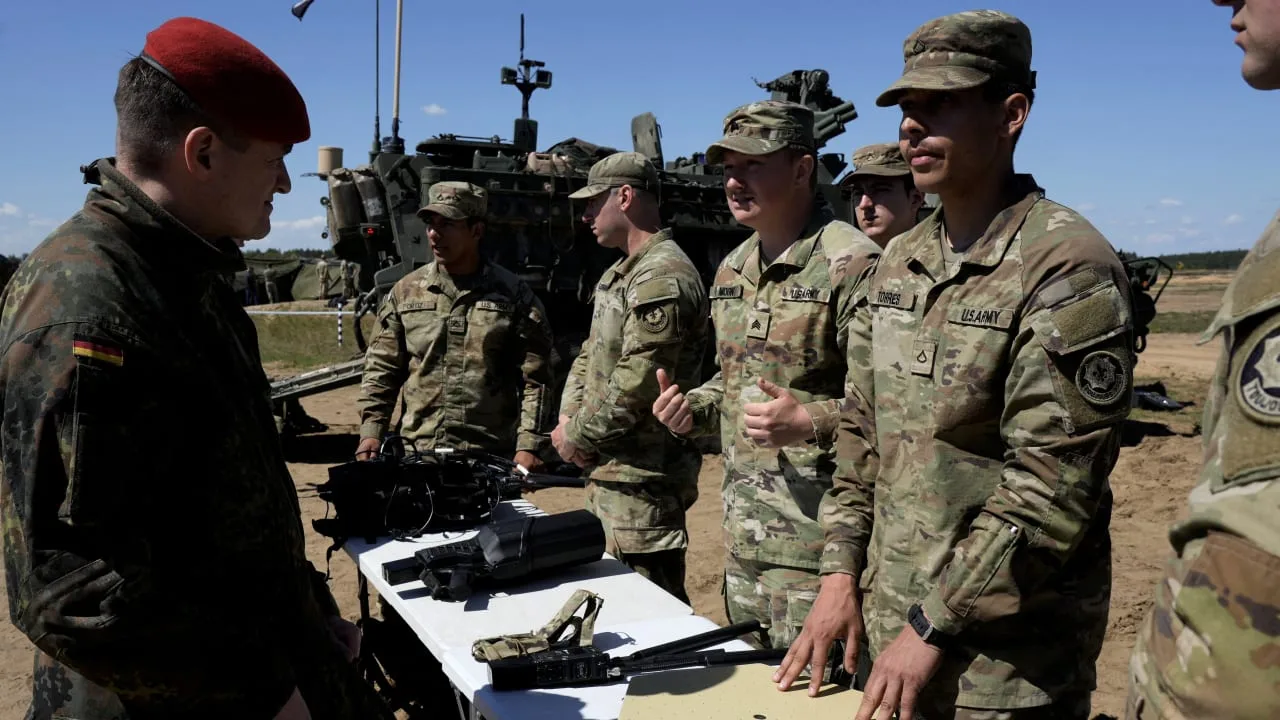
The Trump administration is planning to tell NATO allies this week that it will shrink the pool of military capabilities that the US would have available to assist the alliance’s European nations in a major crisis, three sources familiar with the matter said.
Under a framework known as the NATO Force Model, the alliance’s member countries identify a pool of available forces that could be activated during a conflict or any other major crisis, such as a military attack on a NATO member.
While the precise composition of those wartime forces is a closely guarded secret, the Pentagon has decided to significantly scale down its commitment, said the sources, who requested anonymity to speak candidly about the plans.
US President Donald Trump has made clear he expects European countries to take over primary responsibility for the continent’s security from the US. The message to allies this week is a concrete sign of that policy being implemented.
Several details were unclear, such as how quickly the Pentagon plans to shift crisis-mode responsibilities onto European allies. The sources said, however, that the Pentagon plans to announce its intention to lessen its commitment at a Friday meeting of defense policy chiefs in Brussels.
Pentagon policy chief Elbridge Colby has said publicly that the United States will continue to use its nuclear weapons to protect NATO members, even as European allies take the lead on conventional forces.
The US will likely be represented by Alex Velez-Green, a key aide to Colby, the sources said. Adjusting the NATO Force Model has emerged as a key priority of Colby’s team heading into the next NATO leaders’ summit, which will take place in Turkey in July, one of the sources added.
A NATO spokesperson directed a request for comment to the United States. The Pentagon did not immediately respond to a request for comment.
Alliance under strain
The NATO alliance is under unprecedented strain, with some European countries concerned that Washington may withdraw outright. A major adjustment to the forces the US would make available during wartime will only intensify those concerns.
In the past few weeks, the Trump administration has announced plans to cut some 5,000 US troops from Europe, including a decision to cancel a deployment of an Army brigade to Poland, a surprise decision that was slammed by US lawmakers.
One of the sources and another source familiar with the matter said aides on Capitol Hill were aware of and concerned about the Pentagon’s plans to narrow its commitments under the NATO Force Model.
A senior NATO diplomat said, however, they still believed there is an understanding that the United States would come to Europe’s aid if it were in trouble.
Trump and many of his aides have slammed European allies for not spending enough on their militaries and relying on the US for conventional defense, and they point out that the US still has tens of thousands of troops in Europe.
The president’s ambition to take control of Greenland, a Danish overseas territory, has further inflamed transatlantic tensions, as has an ongoing spat between Trump and German Chancellor Friedrich Merz, who has sharply criticized Trump’s war with Iran.
European allies generally counter that they are rapidly beefing up their military capabilities, but that doing so cannot be done overnight.
Rubio to visit NATO, India, amid strained ties
US Secretary of State Marco Rubio will travel to Sweden for a meeting of NATO foreign ministers this week where he will discuss the need for “greater burden sharing” by the alliance, and then visit India, the State Department said on Tuesday.
Under President Donald Trump, US ties with both NATO and India have been strained, with the president repeatedly threatening to pull out of the alliance and imposing high tariffs on India.
Rubio will stop in Helsingborg on May 22 and “discuss the need for increased defense investment and greater burden sharing in the Alliance,” State Department spokesperson Tommy Pigott said in a statement.
He will also meet counterparts from the Arctic Seven nations: Canada, Denmark, Norway, Sweden, Finland, and Iceland.
The goal of the meetings is to discuss “shared economic and security interests,” Pigott said.
Rubio will visit India from May 23 to 26, stopping in Kolkata, Agra, Jaipur, and New Delhi for talks on energy security, trade, and defense cooperation, he said.
The Trump administration has repeatedly criticized NATO members for not contributing more to joint military efforts. Friction has deepened after European countries declined to send ships to help secure the Strait of Hormuz and over Trump’s earlier proposal to acquire Greenland, a semi-autonomous Danish territory.
European leaders have agreed that Europe should take on more responsibility for its own security.
NATO countries last year set new spending targets of 3.5% of GDP on core defense and 1.5% on broader measures such as cybersecurity, infrastructure, and logistics.
Trump and Indian Prime Minister Narendra Modi enjoyed warm ties during Trump’s first term, but relations cooled after India was hit last year with some of the highest US tariffs, many of which were rolled back. The two countries are now working on a trade deal aimed at avoiding further tariff hikes.
India is also a member of the Quad grouping with the United States, Japan, and Australia. Japan’s Jiji Press reported Foreign Minister Toshimitsu Motegi will visit New Delhi on May 26 for a Quad meeting expected to focus on strengthening supply chains for critical minerals in response to China.
The State Department statement made no mention of a Quad meeting.
In an April call, Trump and Modi stressed the importance of keeping the Strait of Hormuz, which serves as a conduit for 40% of India’s crude oil imports, open and secure.