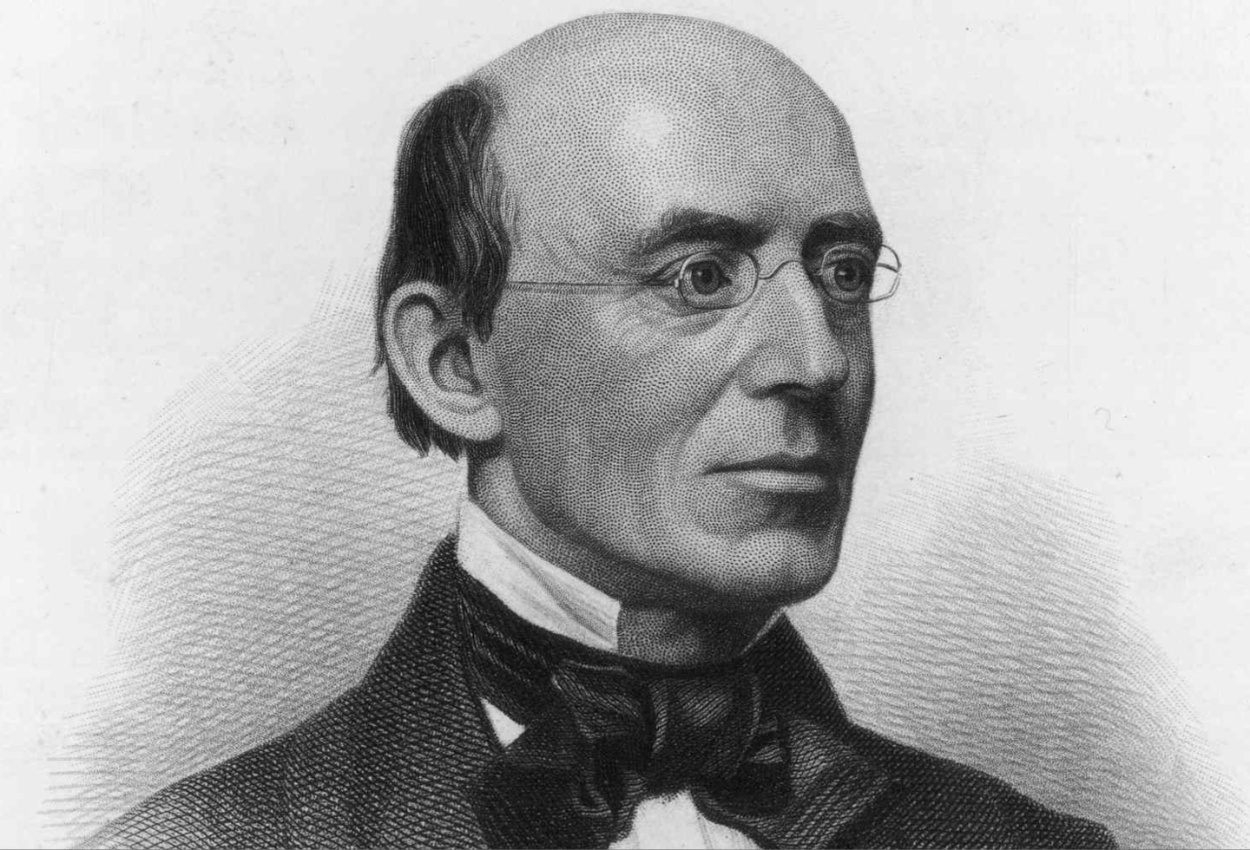
William Lloyd Garrison (December 10, 1805 – May 24, 1879) was an American abolitionist, journalist, and social reformer. He founded the anti-slavery newspaper The Liberator in 1831 and published it in Boston until slavery was abolished in the United States by the Thirteenth Amendment in 1865. Garrison also supported women’s rights and became a leading advocate for women’s suffrage in the 1870s.
Garrison supported “no-governmentism,” or anarchism, and believed the American government was corrupt and tyrannical because of its involvement in war, imperialism, and slavery. His ideas about individual freedom and criticism of authority influenced later libertarian thought. At first, he opposed violence and supported Christian pacifism. But when the Civil War began, he saw that armed struggle was necessary to end slavery and supported President Abraham Lincoln’s efforts. Garrison helped found the American Anti-Slavery Society and called for the immediate and uncompensated emancipation of slaves, rather than a gradual or compensated approach.
Profile Summary
| Category | Details |
|---|---|
| Full Name | William Lloyd Garrison |
| Date of Birth | December 10, 1805 |
| Place of Birth | Newburyport, Massachusetts, U.S. |
| Date of Death | May 24, 1879 (aged 73) |
| Place of Death | New York City, U.S. |
| Burial Place | Forest Hills Cemetery, Boston, U.S. |
| Occupations | Abolitionist; Journalist |
| Known For | Editing The Liberator; Supporting Women’s Rights |
| Political Party | Republican |
| Spouse | Helen Eliza Benson (m. 1834; died 1876) |
| Children | 7 |
Age
William was born on December 10, 1805, in Newburyport, Massachusetts, U.S.
Early life & Biography
Garrison was born on December 10, 1805, in Newburyport, Massachusetts, as the youngest son of immigrants from New Brunswick, now part of Canada. His father, Abijah Garrison, was a merchant-sailing pilot who moved the family to Newburyport in 1806 after obtaining American papers under An Act for the relief of sick and disabled seamen. The Embargo Act of 1807 led to a decline in shipping, and Abijah soon lost his job and left the family in 1808. Garrison’s mother, Frances Maria Lloyd, was known for her height, charm, and strong religious faith. She began calling her son Lloyd, his middle name, to keep her family name alive, and he later used “Wm. Lloyd” in print. She died in Baltimore in 1823.
As a child, Garrison sold homemade lemonade and candy and delivered wood to help his family. At age 13, he started a seven-year apprenticeship as a compositor at the Newburyport Herald. He soon began writing articles, often using the pen name Aristides, after the Athenian statesman known as “the Just.” Garrison could write while typesetting, without using paper. In 1826, during his last year as an apprentice, he wrote a strong criticism of American Writers by John Neal, which led to a long feud. After finishing his apprenticeship, Garrison became the owner, editor, and printer of the Newburyport Free Press, taking over from his friend Isaac Knapp. Poet and abolitionist John Greenleaf Whittier was a regular contributor. These early experiences helped Garrison develop the skills he later used as a national writer, speaker, and publisher. In 1828, he became editor of the National Philanthropist in Boston, the first American journal to support legally mandated temperance.
Marriage
On September 4, 1834, Garrison married Helen Eliza Benson (1811–1876), the daughter of a retired abolitionist merchant. They shared a close relationship and worked together toward common goals. After Helen died, Garrison mourned deeply and even tried to contact her through spiritualism. They are buried together in Forest Hills Cemetery in Boston. The couple had two daughters and five sons, but lost a daughter and a son in childhood.
Death
Garrison spent more time at home with his family, writing weekly letters to his children and caring for his wife Helen as her health declined. After a minor stroke on December 30, 1863, Helen became mostly housebound. She died on January 25, 1876, after a severe cold developed into pneumonia.[35] The family held a quiet funeral at home. Garrison, grieving and ill with fever and bronchitis, was unable to attend the service. Wendell Phillips delivered a eulogy, and many of Garrison’s abolitionist friends visited him upstairs to offer condolences.
Garrison gradually recovered from his wife’s death and began attending Spiritualist meetings, hoping to contact Helen. He made his final trip to England, where he met George Thompson in 1877 and other longtime friends from the British abolitionist movement.
In April 1879, Garrison’s health declined due to kidney disease, prompting him to move to New York to stay with his daughter Fanny and her family. In late May, as his condition worsened, his five surviving children gathered at his side. Fanny asked if he wanted to hear hymns. Although he could not sing, his children sang his favorite hymns while he kept time with his hands and feet. Garrison lost consciousness and died just before midnight on May 24, 1879.
Garrison was buried alongside his wife in Forest Hills Cemetery in Boston’s Jamaica Plain neighborhood on May 28, 1879. At the public memorial service, Theodore Dwight Weld and Wendell Phillips delivered eulogies. Eight abolitionist friends, both white and black, served as pallbearers, including Weld, Phillips, Lewis Hayden, and Charles Lewis Mitchell. Flags were flown at half-staff throughout Boston. Frederick Douglass, then a United States Marshal, spoke in Garrison’s memory at a church service in Washington, D.C., stating, “It was the glory of this man that he could stand alone with the truth, and calmly await the result.”
Legacy
Leo Tolstoy was greatly influenced by the works of Garrison and his contemporary Adin Ballou, whose writings on Christian anarchism aligned with Tolstoy’s developing theo-political ideology. Tolstoy published a short biography of Garrison in 1904 and frequently cited him in non-fiction works such as The Kingdom of God Is Within You. In a 2018 publication, American philosopher and anarchist Crispin Sartwell wrote that Garrison and his Christian anarchist contemporaries, including Ballou, directly influenced Mahatma Gandhi and Martin Luther King Jr.