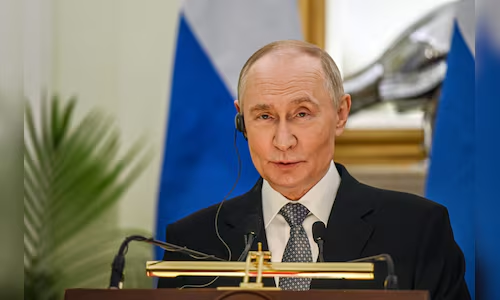
Vladimir Putin is set to travel on Tuesday, May 19, to Beijing for talks with President Xi Jinping in his first foreign visit of the year, with the war in Iran offering an opportunity for Russia to deepen energy links with China.
Russia hopes the turmoil in energy markets from the West Asia conflict will make China more flexible in negotiations on a contract for gas prices for the planned Power of Siberia 2 pipeline project, according to people close to the government. Chinese officials expressed an interest in accelerating the talks, though there has been no firm progress so far, one Russian official said.
The gas pipeline project “is on the agenda, and we’re committed to discussing it seriously,” Kremlin foreign policy aide Yuri Ushakov told reporters Monday. “I believe this topic will be discussed in great detail between the leaders.”
Still, progress on any deal depends on Xi and there’s little sign so far that Russia can easily reach an agreement.
Putin and Xi are due to hold talks on Wednesday and will take tea together in the evening to resume discussions, Ushakov said. The Russian delegation includes five deputy prime ministers, eight ministers and central bank Governor Elvira Nabiullina as well as heads of state corporations and major businesses, he said.
With its economy under growing strain, Russia is heavily reliant on trade with China to weaken the impact of Western sanctions over the full-scale invasion of Ukraine that’s in its fifth year. US President Donald Trump’s war with Iran may give Moscow an opportunity to rebalance the relationship as Beijing looks for greater energy security amid disruption caused by the closure of the Strait of Hormuz.
Also Read: Donald Trump drops IRS lawsuit in exchange for DOJ $1.7 billion ‘weaponisation’ fund
The West Asia conflict “strengthens Russia-China relations by reinforcing Russia’s role as a key raw material supplier to China,” said Vasily Kashin, an expert on China at the Higher School of Economics in Moscow. “Putin’s upcoming visit is expected to reflect this new geopolitical reality, with increased Chinese interest in Russian logistics and energy cooperation.”
Gazprom made a very competitive offer on gas pricing for the Power of Siberia 2 pipeline that would stretch to China from Siberia through Mongolia, though Chinese counterparts didn’t show a willingness to move the project forward, according to a person close to the Russian state energy giant. The goal is still to agree on a gas price by September, the person said, asking not to be identified because the matter is private.
Gazprom’s press office didn’t respond to a request to comment.
China said in March, after the war in Iran began, that it aimed to make progress on a Russian natural gas pipeline in its five-year plan. In late April, Gazprom CEO Alexey Miller and China National Petroleum Corporation Chairman Dai Houliang met in Beijing and discussed “the development of strategic partnership.”
Putin said May 9 that “virtually all the key issues” on gas and oil cooperation had been agreed with China. “If we manage to finalize them and bring the process to a final point during the visit, I would be very pleased,” he said.
While transport corridors via Russia have also been on the agenda in bilateral talks for a long time, Moscow sees more interest now from Chinese officials in expanding transit routes by land and via the Arctic Northern Sea Route, according to people familiar with discussions.
“The war in Iran shows that the security of conventional routes and chokepoints with strategic significance can no longer be taken for granted,” said Wang Yiwei, a former Chinese diplomat and director of Renmin University’s Institute of International Affairs. “This forces China to develop alternative routes and more actively hedge the risks.”
Formally timed to mark the 25th anniversary of a friendship and cooperation treaty between Russia and China, Putin’s visit follows Xi’s summit with Trump last week and gives the Russian president a chance to learn details of those discussions, according to the Kremlin.
For Xi, it’s the second time this year he’s held back-to-back diplomacy with Trump and Putin. He spoke separately with the US president and Putin within hours of each other in calls in early February.
Putin and Xi last met in September when the Chinese president hosted a security conference followed by a military parade in Beijing marking the anniversary of the end of World War II in Asia.
The US has at times sought to peel Russia away from partnership with China as part of a broader geopolitical strategy linked to the war in Ukraine and potential confrontation with Beijing over Taiwan. But Putin has little incentive to turn away from Xi, even as some Kremlin officials are growing uneasy over Russia’s economic and diplomatic dependence on China.
Also Read: Japan’s economy grows faster than expected, makes case for BoJ’s rate hike
Trade between China and Russia stood at $228 billion in 2025, down 6.9% from the previous year, according to Chinese customs data. Putin acknowledged a decline in his call with Xi but said bilateral trade had exceeded $200 billion “by a solid margin” for three consecutive years.
With its gas sales to European markets largely cut off over the war in Ukraine, Russia has ramped up exports to Asia. It expects to sell natural gas for several years to China at about a third less than the price paid by Europe, with annual eastbound flows forecast to reach 52.5 billion cubic meters in 2029.
Russia currently imports more than 90% of its sanctioned technology through China, up from about 80% last year, according to European officials, who asked not to be identified discussing private assessments.
While Beijing sees Moscow as a useful partner in weakening US dominance and advancing the so-called multipolar world order, China appears determined not to become too closely identified with the risks of Putin’s war in Ukraine — particularly as it tries to present itself globally as a force for stability.
That balancing act helps explain apparent contradictions in China’s position. Beijing has refused to condemn Russia’s invasion, though Chinese officials continue to invoke sovereignty, territorial integrity and the authority of the United Nations — language that sits uneasily beside Moscow’s territorial demands in Ukraine.
China wants to avoid being held responsible for using its ties with Moscow to end the war. Still, Beijing is seeking to preserve its relationship with Russia.
An editorial on Monday in the People’s Daily, the Chinese Communist Party’s flagship newspaper, said international turbulence meant both sides should “strengthen strategic coordination and comprehensive cooperation.”
It highlighted space research, energy, science and tech, agriculture, AI, green initiatives and biotechnology as areas of potential cooperation.
“China’s interest in Russia is grounded in strategic advantage as Moscow offers energy security, access to critical resources and access into the Arctic,” said Vita Spivak, a consultant at Gatehouse, a UK-based geostrategy advisory firm. “But, of course, Russia needs China more than the other way round.”